
SIJAQ II 캠페인 기간 서울 도심의 휘발성 유기화합물(VOCs) 조성 특성
 ; Gangwoong Lee3)
; Limseok Chang4) ; Sun-A Shin5) ; Joo-Ae Kim1), 6), *
; Gangwoong Lee3)
; Limseok Chang4) ; Sun-A Shin5) ; Joo-Ae Kim1), 6), *
Abstract
Volatile organic compounds (VOCs) are key precursors in the formation of ozone and secondary organic aerosols. Emitted into the atmosphere from a variety of sources, VOCs exhibit a wide range of reactivity. Consequently, accurately determining VOC species is imperative for reducing VOC-related air pollution on local and regional scales. In this study, 56 VOC species were measured in real time using the TD-GC-FID method, which involves collecting airborne VOCs by thermal desorption (TD) tubes, separating them via gas chromatograph (GC), and determining their concentrations with a flame ion detector (FID). Experiments were conducted for the Satellite Integrated Joint Air Quality (SIJAQ) campaign at the Mediheal Earth Environmental Science Hall of Korea University in Seoul in May~June (early summer) and November (early winter) 2022. In this campaign, the proportion of alkene has increased compared to the past, with the proportion of alkene 25.3% in summer and 23.3% in winter, respectively. Alkenes such as propylene, trans-2-pentene, trans-2-butene were higher in summer than in winter and exhibited the highest ozone formation potential (OFP). In particular, butene and pentene isomers along with propylene, showed strong correlations with temperature, suggesting the contribution of fugitive emissions through evaporation. The temporal distribution of VOCs, correlations, and principal component analysis results all emphasize automobile emissions as the main source of VOCs in Seoul.
Keywords:
Volatile organic compounds(VOCs), PAMS, TD-GC-FID, SIJAQ, Seoul1. 서 론
휘발성유기화합물(Volatile Organic Compounds, VOCs)은 대기 중에서 광화학 산화반응을 통해 오존(O3)과 이차 유기 에어로졸(Secondary Organic Aerosol, SOA)을 생성하는 주요 전구물질로 도시대기질 변화에 핵심적인 역할을 한다(Carter, 2009; Atkinson and Arey, 2003). 또한 일부 VOCs는 국제 암연구기관(IARC)에 의해 발암 물질로 분류되는 등 인체 위해성이 높으며(Eun et al., 2024), 단수명 기후변화 유발물질로 기후변화에도 영향을 미친다(Ghirardo et al., 2020; Stocker, 2014; IPCC, 2007).
도시 지역에서 O3 생성은 VOCs와 질소산화물(NOx)의 농도 비율에 따라 비선형적으로 변화하며, 배출원의 특성과 지역적 여건에 따라 O3 민감도가 달라진다(Fanizza et al., 2014; Atkinson, 2000). 특히 서울은 NOx가 높은 VOC limited 조건의 대표적인 도시 지역으로 NOx 저감만으로는 O3 농도를 효과적으로 낮추기 어렵고, VOCs 조성과 반응성 관리가 필수적이다 (Park et al., 2022; Kim et al., 2020). 최근 수년간 서울의 O3 농도는 꾸준히 증가하는 추세를 보이고 있으며(Yeo and Kim, 2021), 이는 VOCs의 농도 및 조성과 밀접한 관련이 있는 것으로 보고되고 있다(Kim et al., 2020).
기후에너지환경부는 2002년부터 광화학대기오염측정망(Photochemical Assessment Monitoring Stations, PAMS)을 설치하여 56종의 VOCs를 모니터링하고 있다. 그러나 PAMS는 고정된 측정 지점에서 장기 관측에 초점이 맞춰져 있어, VOCs의 공간적 변동이나 개별 화학종의 반응성, 배출원의 상대적 기여를 정밀하게 파악하는 데 한계가 있다(Kim and Lee, 2018). VOCs의 농도와 반응성은 계절과 기상조건에 따라 달라지며(An et al., 2017; Mo et al., 2017), 도시 내에서도 VOCs 조성과 배출 특성이 지역 및 시간대별로 상이하다(Kang et al., 2022; Kim et al., 2020). 따라서 서울과 같은 대도시에서는 VOCs 농도 모니터링을 넘어 화학종별 조성과 반응성 및 이차오염물질(O3, SOA) 생성 기여도를 통합적으로 규명할 수 있는 연구가 필요하다.
본 연구에서는 서울 도심 지역의 계절에 따른 VOCs 농도, 조성 특성 및 이차오염물질 생성에 대한 반응성 차이를 규명하고자 하였다. 이를 위해 2022년 5~6월 및 11월 SIJAQ (Satellite Integrated Joint Monitoring of Air Quality) 캠페인 기간 동안 TD-GC-FID를 이용하여 56종의 VOCs를 측정하였다. 측정된 자료를 바탕으로 주요 VOCs의 농도 및 조성 특성을 분석하고 화학종별 배출 특성과 O3 및 SOA 생성에 기여하는 정도를 정량적으로 평가하였다.
2. 연구 방법
2. 1 VOCs 측정 및 데이터 검증
본 연구는 SIJAQ 캠페인의 일환으로 2022년 5월 2일~6월 12일(초여름)과 11월 7일~12월 1일(초겨울)에 서울시 성북구 고려대학교 캠퍼스 내 메디힐지구 환경관 7층(37.585°N, 127.026°E)에서 대기 중 VOCs를 연속 측정하였다. 이 지역은 서울 중심부에서 북동쪽에 위치하며, 소규모 상권과 주거 지역이 혼합된 지역이다. 북쪽으로 약 5 km 반경 내에 북한산(해발 835.6 m)을 포함한 가파른 지형이며 남쪽과 서쪽으로는 비교적 평탄한 도시화된 지역으로 이루어져 있다(Yun et al., 2024).
미국 환경보호청(Environmental Protection Agency, EPA) PAMS 프로토콜(Chow and Watson, 1998)에서 정한 56종 VOCs를 대상으로 열탈착-가스크로마토그래프-불꽃이온화검출기(TD-GC-FID, UNITY-xr, Markes, UK; TD & 8890 GC system, Agilent, USA; GC-FID) 시스템을 이용하여 분석하였다. 공기를 blower를 통해 manifold로 유입한 후 15 mL/min 유량으로 40분 동안 흡착관에 포집하였다. 포집된 공기는 Nafion dryer 및 O3 제거용 scrubber를 거쳐 수분과 O3을 제거한 후 -20°C의 cold trap에 농축하였다. 이후 300°C로 열탈착하여 GC로 주입하였으며, Dean switch를 이용해 시료를 두 개의 컬럼(Al-PLOT 및 CP-Sil 5CB capillary, Agilent, USA)에 분리 주입하였다. CP-Sil 5CB 컬럼에서는 C6-C12 VOCs (benzene~dodecane), Plot Al2O3/Na2SO4 컬럼에서는 C2-C5 VOCs (ethane~hexene)가 분리되어 각각 독립된 FID로 검출되었다(Badol et al., 2004). 시료 채취에 1시간(공기포집 40분, 라인 플러싱 20분), 화학 분석에 1시간, 총 2시간이 소요되어 VOCs 측정 자료가 1시간 단위로 연속 산출되었다.
VOCs 종별 농도 정량을 위해 100 ppbv 표준가스(PAMS 57 compound with nitrogen, Rigas, South Korea)를 dilutor를 이용해 3~5개 working standard를 만들어 multi point calibration을 수행하였다. 56종 VOCs의 종별 검량곡선은 결정계수(R2)가 모두 0.95 이상이었다. Round robin test (국가 대기분석 숙련도 시험)를 통해 산출된 TD-GC-FID의 정확도는 benzene, toluene, ethylbenzene, m,p-xylene이 ±10% 이내였다. 불확도는 표준물질 반복분석 오차, 시료채취유량 오차, 동일농도 반복분석 오차를 포함하여 산정한 결과 52종의 VOCs가 10% 이내의 불확도를 보였으며 acetylene, cis-2-butene, i-pentane, 1-pentene는 15% 이내의 불확도를 나타냈다. 방법검출한계(method detection limit, MDL)는 VOCs 종별 최저 농도를 7번 반복 측정하여 산출하였으며, 대부분 0.01 ppbv 수준이었다. 측정 결과의 QA/QC는 US EPA에서 제공한 technical assessment document를 기반으로(Purdue et al., 1991), 국내 광화학 측정망에서 사용하고 있는 VOC dataset 검증 방법을 도입하여 피크오인과 콜드트랩으로 인한 자료 검증을 수행하였고(Jeong et al., 2012; Shin et al., 2011; Chow and Watson, 1998) 순간변동치의 변동폭이 전체 기간 표준편차의 2배 이상 되는 자료를 이상치로 간주하고 제거하였다.
기상 인자는 고려대학교 메디힐지구환경관 옥상에 설치된 자동 기상 관측장비(Automatics Weather System, AWS)에서 산출된 자료를 1시간 평균하여 사용하였으며, PM2.5, O3, NO2 및 CO mixing ratio는 측정 지점에서 약 1.1 km 떨어진 동대문구 도시대기 측정망 자료를 사용하였다.
2. 2 주성분 분석
VOCs의 주요 배출원을 추정하기 위해 주성분 분석(Principal Component Analysis, PCA)을 수행하였다. PCA는 다차원 변수 간의 상관관계를 기반으로 데이터의 변동성을 설명하는 통계적 방법으로, 많은 변수로 구성된 복합 자료를 소수의 요인으로 축약하여 해석을 용이하게 한다(Jolliffe, 2002).
전체 측정 기간 동안 검출률이 50% 이상이며 공통성(communality value)이 0.6 이상인 VOCs 29종과 NO2와 CO를 변수로 포함하여 SPSS Statistics 27 (IBM corporation, USA) 소프트웨어를 이용해 분석하였다.
각 요인의 해석을 높이기 위해 varimax 회전을 적용하였으며, 고유값(Eigenvalue)이 1보다 큰 요인만을 Kaiser’s 기준에 따라 선택하였다(Guo et al., 2004; Kaiser, 1958). 또한 factor loading이 0.5 이상인 경우 주요 기여 변수로 간주하였다. 표본의 요인분석 적합성과 변수 간 상관성은 KMO (Kaiser-Meyer-Olkin) 검정과 Bartlett 구형성검정을 통해 평가하였다.
2. 3 OFP (Ozone Formation Potential) 및 SOAFP (Secondary Organic Aerosol Formation Potential)
VOCs는 일차적으로 OH radical에 의해 산화되어 O3과 SOA를 생성하므로 OH와의 반응상수는 이차 오염물질 형성에 대한 VOCs의 종별 기여도를 결정하는 주요 요소이다(Carter, 1994). VOC-limited regime에서, VOC 종의 O3 생성에 대한 기여 정도를 종별 MIR (Maximum Incremental Reactivity) 값과 농도를 곱하여 오존생성기여도(Ozone Formation Potential, OFP)로 추정할 수 있다(Carter, 2009). Eq. 1에서 OFPi와 MIRi는 개별 VOC 종들 i에 대한 Ozone Formation Potential과 MIR scale이며, 이때 [VOCi]는 측정된 VOC mixing ratio (ppbv)이다.
이차 유기에어로졸 생성의 기여율은 SOAFP (Secondary Organic Aerosol Formation Potential)로 나타낼 수 있으며 또한 SOAFPi (μg/m3)는 개별 VOC 종 i에 대한 VOCi의 aerosol yield Yi (μg/m3/ppm)을 기준으로 산정할 수 있다(Eq. 2) (Pandis et al., 1992). 이때 VOCi의 aerosol yield Yi는 PAMS VOCs 56종 중 31종의 값에 대해서만 계산하였다.
| (1) |
| (2) |
3. 결과 및 고찰
3. 1 VOCs 조성 특성
전체 측정 기간 동안, 56종 VOCs 중 30종이 50% 이상의 검출 빈도를 보였다. 평균 농도가 높은 상위 15종 VOCs는 TVOC 농도의 80% 이상을 차지하며 data coverage가 90% 이상이었으며 나머지 VOCs는 대부분이 검출한계 0.01 ppbv에 가까운 농도 수준이었다. 따라서 5~6월 초여름과 11월 초겨울 약 두 달간 측정 결과를 농도가 높은 상위 15종을 중심으로 비교하였다. 이때 alkyne은 acetylene 1종으로 alkene에 포함하였다(표 1).

Statistical summary of the top 15 abundant VOC species observed in Seoul during SIJAQ Campaign.
전체 측정 기간 중 평균 농도는 ethane이 3.6 ppbv로 가장 높았으며, 그 다음은 propane 1.8 ppbv, toluene 1.6 ppbv, ethylene 1.4 ppbv, propylene 1.1 ppbv, n-hexane 1.0 ppbv, n-butane 0.9 ppbv, acetylene 0.7 ppbv, cyclopentane 0.6 ppbv, isobutane 0.5 ppbv, benzene 0.5 ppbv 순이다. 상위 15종 VOCs는 모두 5~6월과 11월에 전반적으로 높았다. 그중 toluene, n-hexane, propylene, trans-2-butene, trans-2-pentene는 5~6월에, ethane, propane, ethylene, acetylene은 11월에 상대적으로 더 높았다. 특히 toluene은 11월에 비해 5~6월에 더 높았으며, m,p-Xylene과 ethylbenzene은 두 계절 차이가 없었다. 측정된 모든 56종 VOCs의 합인 TVOC의 평균은 5~6월과 11월에 각각 18.0 ppbv와 20.1 ppbv였다.
측정된 56종의 VOCs를 alkane, alkene, aromatic 세 그룹으로 구분하면 농도가 가장 높은 alkane은 5~6월에 평균 9.7 ppbv로 TVOC의 53.8%를 차지하였고, 11월에는 11.9 ppbv로 60.1%를 차지하여 여름철에 비해 겨울철에 농도와 비중 모두 높았다. Alkene은 두 계절 농도가 4.6 ppbv로 같았으나 비중은 5~6월에 25.3%로 11월 23.3%보다 약간 높았다. 비중이 가장 낮았던 aromatic 역시 5~6월 3.8 ppbv와 11월 3.3 ppbv로 두 계절 분명한 차이는 없었으나 TVOC에 대한 비중은 여름철(20.9%)이 겨울철(16.6%)에 비해 높았다(그림 1). 이러한 결과는 겨울철에는 화석연료 연소의 기여가 크고 여름철에는 용매 사용과 증발의 영향이 증가한다는 사전 연구 결과와 일치한다(Kang et al., 2022; Liu et al., 2017; Borbon et al., 2013).
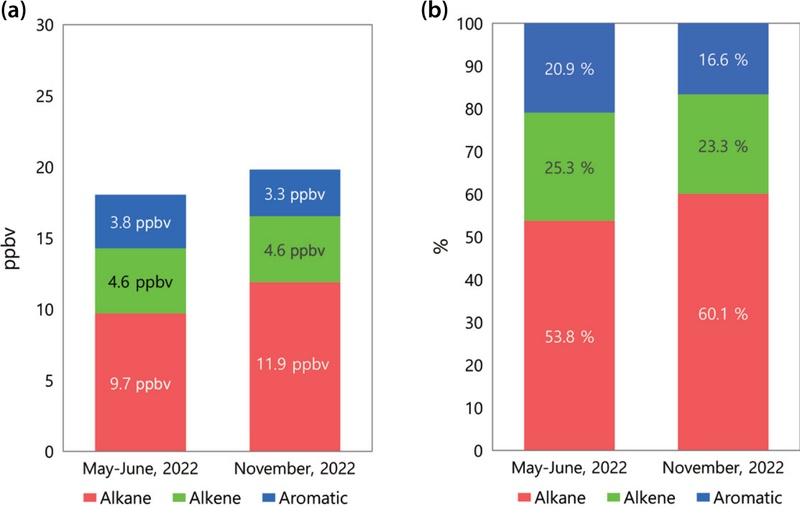
Average (a) mixing ratios and (b) proportion of alkane (red), alkene (green), and aromatic (blue) for the entire experiment. The x-axis represents the sampling periods, and the y-axis indicate the mixing ratio (ppbv) and percentage contribution (%), respectively.
VOCs의 농도 분포는 계절 특성을 보다 명확히 보여준다(그림 2). 초여름이 초겨울보다 log-normal 분포에 가까웠다. Alkane은 평균이 초겨울에 높았으나 고농도 빈도는 두 계절 유사했고 최빈 농도는 오히려 초여름에 더 높았다. Alkene은 두 계절 평균 농도는 같았으나 최빈 농도의 범위가 초여름에 더 넓었고 aromatic은 초여름에 약간 높은 빈도의 차이만 보이며 분포는 매우 유사했다. 이러한 빈도 분포는 연료 사용 및 비배기 배출, 온도 의존적 배출 특성을 간접적으로 잘 보여준다.
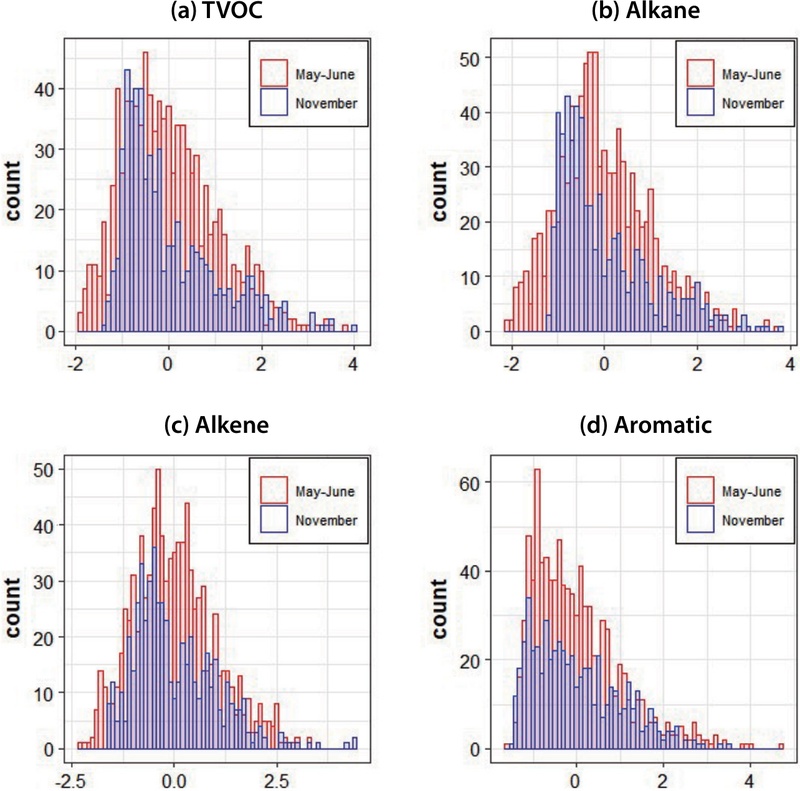
Frequency distribution of (a) TVOC, (b) alkene, (c) alkene, and (d) aromatic mixing ratios (ppbv). The x-axis represents the normal distribution of mixing ratio, and the y-axis indicates the frequency count. The red and blue histograms correspond to the data observed in May~June and November, respectively.
과거 서울에서 수행되었던 연구 결과와 비교하면 본 연구에서 측정된 TVOC는 현저히 낮은 수준을 보인다. 2013년부터 2021년까지 서울의 여러 지점에서 측정된 TVOC의 연평균 농도에 비해 두 배 이상 낮다(표 2). 종별로는 동일한 계절에 수행되었던 2016년 실시한 KORUS-AQ 캠페인 결과와 비교하면 ethane이 가장 높고, toluene과 propane은 상위 순위를 유지하는 것은 동일하나 평균이 2배가량 낮아졌다. 반대로 propylene과 n-hexane은 약 3배 높아졌다(Kim et al., 2020). 본 연구의 5~6월 VOCs 농도는 2016년에 비해 약 10 ppbv가 낮은데 특히 alkane과 aromatic이 크게 줄었고 aromatic는 57%가 감소하였다.
Statistical summary of the most abundant VOC species (ppbv) measured in Seoul during SIJAQ campaign, which are compared with results from previous studies.
3. 2 VOCs 분포 특성
VOCs의 분포는 배출뿐 아니라 광화학 산화 및 기상조건에 의해서도 영향을 받으므로 캠페인 기간의 풍향, 풍속 및 기상조건을 분석하였다. 측정 기간 동안 평균과 최고 기온은 5~6월과 11월에 각각 20.2°C와 30.4°C, 10.3°C와 21.6°C였다. 5~6월에는 낮 시간에 남서풍이 평균 2~4 m/s로 강했고(그림 3), 5월 초에는 서풍, 5월 중하순에는 남서풍, 6월에는 북동쪽에 고기압이 확장되면서 정체와 함께 동풍이 우세하였다 (https://www.kma.go.kr/). 11월은 일반적으로 공기 정체가 심한 시기로 연구 기간에도 북풍과 북동풍의 빈도가 가장 높고 풍속이 낮은 정온 상태(calm condition)가 15.6%로 공기가 정체되었음을 알 수 있다.
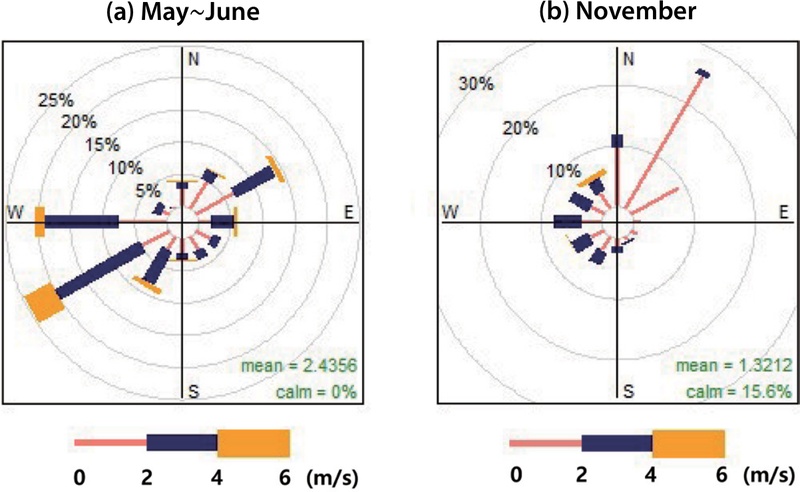
Wind rose diagram during (a) May~June, and (b) November, frequency of count by wind direction (%) with wind speed.
풍향과 시간에 따른 VOCs 농도 분포를 그림 4에 나타냈다. 링의 방향은 방위를 나타내며 링의 축은 안쪽에서 바깥쪽으로 0~23시 시간을 의미한다. Ethane, propane, i-butane, n-butane, i-pentane, ethylene, acetylene 풍속이 낮은 북풍 계열에서 밤에서 새벽 사이 농도가 높은 분포를 보였다(그림 4). 이는 CO와 NO2의 분포와 유사하며 일변화는 특히 11월에 아침과 저녁 시간에 농도가 증가하는 일변동이 분명했다(그림 5). 이러한 분포는 지역 배출이 대기혼합고(mixing layer height)의 확산 및 수축의 효과로 인한 결과로 볼 수 있는데(Song et al., 2018; Cheng et al., 1997) 대기 중 life time이 상대적으로 긴 VOCs 에서 잘 나타났다.
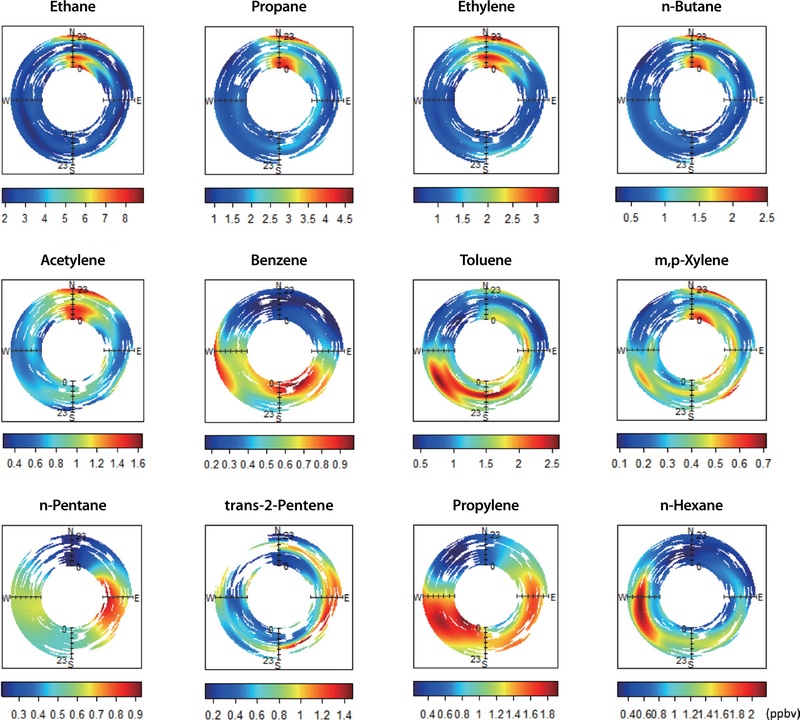
Polar annulus distributions of hourly averaged mixing ratios (ppbv) of selected VOC species. The angular coordinate represents wind direction, and the radial coordinate denotes local time of day (0~23 h). Color scales indicate VOC mixing ratios (ppbv) for each compound.
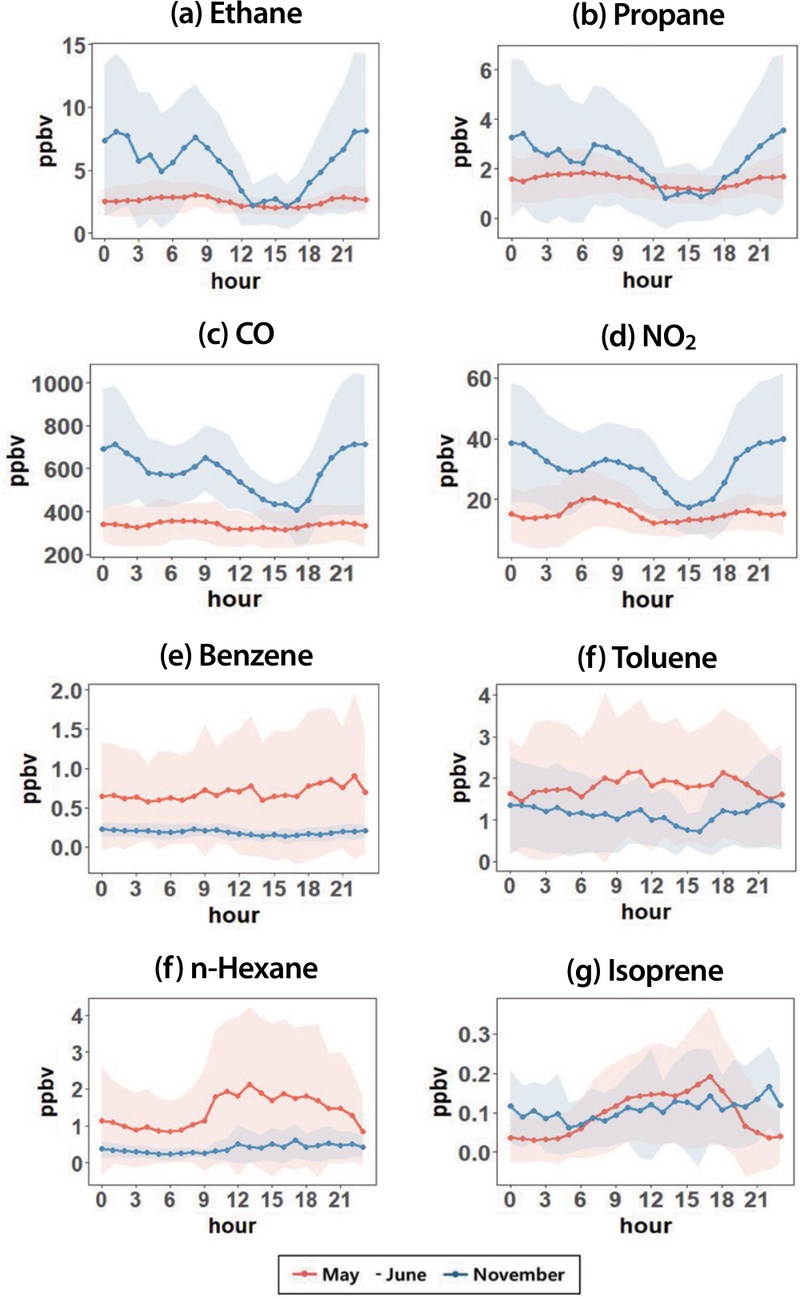
Diurnal variations of selected VOC species during SIJAQ Campaign (red line: May~June, and blue line: November). (a) Ethane, (b) Propane, (c) CO, (d) NO2, (e) Benzene, (f) Toluene, (g) n-Hexane, (h) Isoprene.
이와는 대조적으로 benzene은 새벽 시간에는 남동풍 계열에서 오후 시간에는 toluene과 유사하게 남서풍 계열에서 높았다. Benzene과 toluene은 각각 서울의 남동쪽과 남서쪽에서 밤과 낮에 농도가 높았는데 이는 서울의 CAPSS 배출량 분포 양상과 상당히 일치하며(Lee et al., 2024) 혼합고가 낮고 공기가 정체되었을 때 국지적 배출과 낮 시간에 서울 주변 도시에서의 영향이 반영된 것으로 보인다(Liu et al., 2021). 본 측정지점과 인접한 종로 지역에서 수행된 선행 관측에서도 benzene은 서쪽 계열의 상대적으로 높은 풍속 조건에서 농도가 증가하는 경향을 보였으며, toluene은 남서 및 남동 계열에서 높은 분포를 나타내 본 연구 결과와 일관된 특성을 보였다(Kang et al., 2022). m,p-Xylene과 ethylene의 고농도 분포는 propane, butane과 유사했다(그림 4). 특히 xylene은 남서풍 계열에서 고농도가 뚜렷하였다. 이러한 경향은 passive sampler를 이용해 서울 전역의 공간 분포를 분석한 선행 연구들에서 서울 서쪽 및 중구 지역에서 상업·용제(solvent) 사용과 연관된 aromatic VOCs 농도가 높게 나타난 결과와 잘 부합한다(Lee et al., 2024; Kim et al., 2021). 또한 종로구 VOCs 관측 결과에서도 ethylene과 propylene은 풍향 중심부에서 고농도를 보였으며, 오전 시간대에 증가가 가장 뚜렷하였다(Kang et al., 2022). 이러한 시간·풍향 특성은 출·퇴근 시간대 교통량 증가와 밀접하게 연관된 전형적인 자동차 배출 특성으로, 본 연구에서 관측된 alkene류의 거동과도 높은 일관성을 보인다.
Toluene의 일변화는 다른 VOCs에 비해 계절 차이가 명확했다. 11월에는 alkane과 유사하게 15~16시 사이에 최저 농도를 보였으나 5~6월에는 낮 시간에 전반적으로 상승하는 경향을 보였다. 본 측정 기간에 benzene은 5~6월에 평균 농도가 더 높으며 밤에도 증가하였고 11월에는 일변화 폭이 매우 낮았다. 위에서 언급한 바와 같이 11월에 공기 정체가 빈번하여 국지적 배출영향이 주로 나타났기 때문으로 보인다(그림 5). n-Pentane과 trans-2-pentene, propylene 등의 alkene은 5~6월 정체 기간에 농도가 크게 증가하였다. 그중 propylene은 계절에 상관없이 남서풍 계열에서 높은 농도를 보였다. n-Hexane역시 남서풍 시 고농도가 뚜렷하였으며(그림 4), 낮 시간에 증가하는 패턴이 가장 뚜렷했다(그림 5).
Isoprene은 대표적인 BVOC로 5월보다 6월에 농도가 높았고 최고 농도 역시 6월에 관측되었으며 17시에 최고 농도를 보여 선행 연구와 유사한 경향성을 보였다(Kang et al., 2022). 주목할 점은 11월에 isoprene의 평균 농도는 낮았지만 밤에는 여름철보다 농도가 높아 biogenic 이외의 배출원 및 대기 경계층에 의한 농축 효과를 동시에 유추할 수 있다. 전반적으로 낮 시간에 농도가 증가하는 VOCs 종이 5~6월에 농도가 높아 온도와 관련되는 것으로 판단된다.
3. 3 VOCs와 온도의 상관성
VOCs 중 온도가 증가함에 따라 농도가 증가하는 경향을 보이는 종은 isoprene과 propylene, trans-2-pentene, 1-butene 등으로 대부분 alkene에 해당한다(그림 6). 특히 BVOC의 대표 종인 isoprene은 광화학이 활발한 여름과 온도가 높은 낮에 농도가 높아 온도와의 상관성이 분명했다. Isoprene은 주로 광합성이 활발한 낮에 배출되어 온도에 대한 지시자로 알려져 있다(Kang et al., 2022; Rasulov et al., 2010). 과거 서울의 장기 관측 결과에서는 isoprene과 toluene, xylene 등 aromatic은 온도와 높은 상관성을 보였으나 본 연구에서는 상관성이 크지는 않았다. 온도에 따른 배출 민감도는 alkene이 aromatic에 비해 높은 것으로 알려져 있으며(Huang et al., 2022) 최근 기온 상승에 따른 인위적 VOCs 배출 증가가 중요하게 연구되고 있다(Wu et al., 2024). 특히 일부 인위적인 활동은 온도 상승에 따라 aromatic 배출에 미치는 영향이 제한적인 반면, 자동차 배출에 기인한 alkene은 온도 상승에 따른 농도 증가가 보다 뚜렷하게 나타나는 것으로 보고되고 있다(Song et al., 2019a).
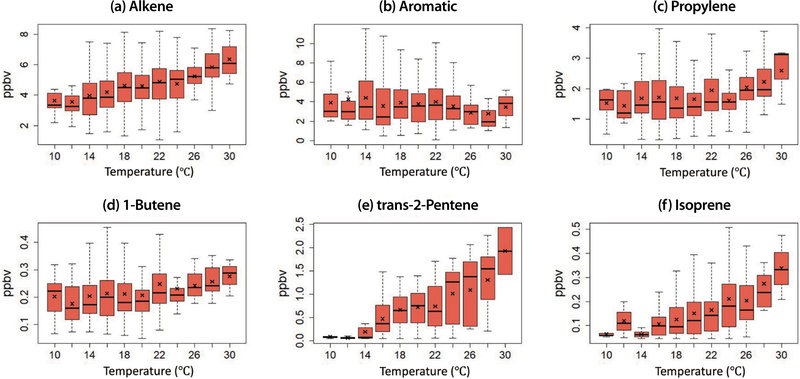
Concentration depended on temperature in May~June: (a) Alkene, (b) Aromatic, (c) Propylene, (d) 1-Butene, (e) trans-2-Pentene, and (f) Isoprene.
3. 4 VOCs 배출원 분석
VOCs 종들 간의 상관계수는 배출원과 대기의 노화 정도를 추정하는 데 유용하게 사용된다(Wang et al., 2014). Benzene은 상대적으로 대기 수명이 긴 반면(~7 days), toluene, ethylbenzene, xylene은 약 2일로 짧다(Debevec et al., 2017). Toluene/Benzene 비율(T/B ratio)은 대기 수명의 차이에 따른 공기궤의 aging 정도를 나타내는 동시에 교통 배출의 지표로 사용되어왔다. T/B ratio가 1.5~4.3 범위면 traffic이, 10 이상이면 strong solvent가 지배적인 것으로 알려져 있으며 그 외에는 non-traffic으로 구분할 수 있다(Simpson et al., 2020; Song et al., 2018; Kim et al., 2016; Wang et al., 2014; Zheng et al., 2013; Yuan et al., 2010; Gelencsér et al., 1997). 본 연구에서 평균 T/B ratio는 5~6월에 3.1, 11월에 4.6으로 초겨울에 약간 더 높았다. 이는 11월 낮은 benzene 농도에 의한 것으로 보이며, 두 기간 모두 2018~2019년의 11.9에 비해 매우 낮았다(Kang et al., 2022). 이는 장기적으로 toluene의 농도 감소에 기인한 것으로 판단된다. 선행 연구에서는 toluene이 서울 남서쪽의 외곽 지역에서 유입되었을 가능성을 보였는데 (Lee et al., 2024; Lee et al., 2023b), 본 연구에서도 역시 유사한 결과를 보였다(그림 7). 환경부의 PAMS 측정망 VOC 측정 결과는 부천을 포함한 서울 서부 지역의 toluene 농도가 감소하고 있음을 보인다(Park et al., 2025).
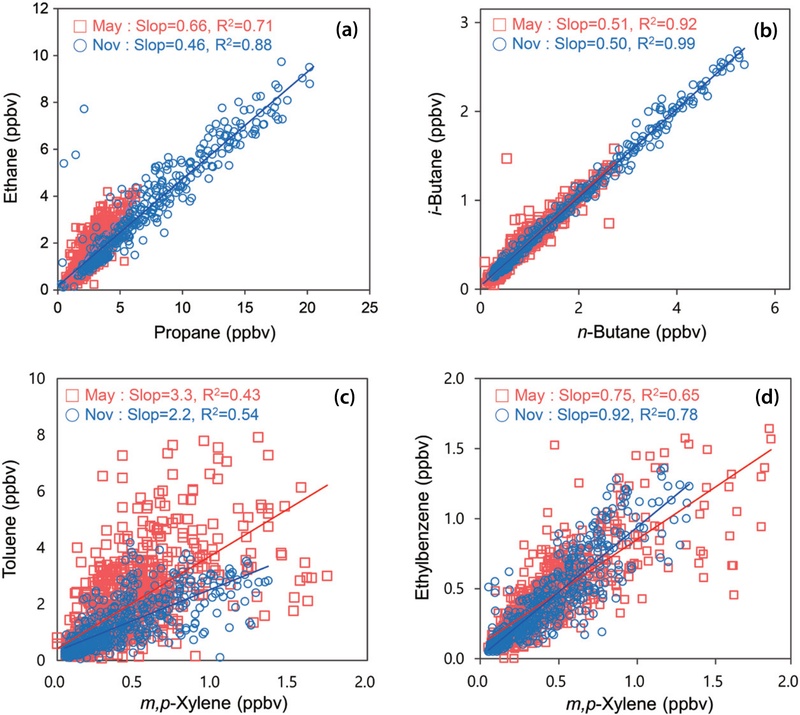
Correlation between (a) ethane and propane, (b) i-butane and n-butane, (c) toluene and m,p-xylene, (d) ethylbenzene and m,p-xylene (red: May~June, blue: November).
Ethane과 propane은 R2가 5~6월에 0.71, 11월에 0.88로 매우 높은 상관성을 보였다(그림 7a). 이들은 LNG나 LPG 연료 연소 시 주로 배출되며(Simpson et al., 2020; Na et al., 2004), lifetime이 ethane은 약 1개월, propane은 약 1주일 정도이다. Propane/Ethane 비는 5~6월에 0.66이고 11월에 0.46으로 11월이 더 낮아 광화학 activity를 고려하더라도 추운 계절에 연소 배출 영향에 의한 것임을 알 수 있다.
i-Butane/n-Butane 비는 gasoline의 옥탄가 증가 시 달라지는데, Vehicle emission (0.2~0.3), LPG vehicle exhaust (0.46), Natural gas emission 및 산업용 LPG (0.6~1.0)로(Li et al., 2022; Zhao et al., 2016) 이 비는 최근 수십 년간 0.6 정도로 비교적 일정하게 유지되며 계절에 따라 변하지 않는다고 보고되었다(Ge et al., 2024; Ahmed et al., 2021). 이는 도심 및 상업 지역에서 자동차 및 LPG/LNG 배출 특성을 반영하기 때문이며 본 연구 결과에서도 i-butane/n-butane 비는 5~6월과 11월 모두 약 0.5로(그림 7b), 2016년 KORUS AQ 캠페인 기간의 값(0.53)과 유사하다(Simpson et al., 2020). 이와 더불어 ethane, propane, n/i-butane, n/i-pentane 등 C2-C5 alkane이 NO2와의 상관관계가 매우 좋아 측정 지역에서 자동차 배출원의 특성을 잘 보여준다고 할 수 있다. Toluene과 xylene 등의 aromatic VOCs는 자동차 배출원 외에도 산업용제 등에 많이 사용된다 (Zhang et al., 2024; Wang et al., 2023). Toluene은 benzene과 상관성은 좋지 않지만, xylene과는 양호한 상관관계를 보인다(그림 7c). 5~6월에는 toluene의 농도가 더 높아 toluene/m,p-xylene 기울기가 증가하였다. Ethylbenzene과 m,p-xylene은 배출원이 동일하나 대기 중 lifetime이 ethylbenzene이 약 1.7일, m,p-xylene이 14~30시간으로, ethylbenzene/m,p-xylene 비가 1 이상일 때 공기궤는 광화학적으로 노화되었다고 진단한다. 그림 7d에서와 같이 ethylbenzene/m,p-xylene 비는 5~6월에 0.75, 11월에 0.92로 두 계절 모두 1 이하였다. 5~6월에 m,p-xylene의 농도가 산발적으로 증가하여 온도가 높은 기간에 배출 증가를 유추할 수 있다.
VOCs의 검출율이 전체 기간에 대해 50% 이상이며 공통성이 0.6 이상인 29종의 VOCs와 NO2, CO의 농도를 변수로 적용하여 주성분 분석을 수행하였고 이를 기반으로 VOCs의 배출원 요인을 분석하였다. PCA 결과, 총 5개의 성분이 분산의 65.2%를 설명했으며(표 3) 이를 통해 fuel combustion & evaporation, Vehicle exhaust, Solvents (printing/painting/laundry), off-road/heavy duty vehicle, Mixed combustion-related/Evaporative 5개의 배출원을 구분하였다.
Principal component analysis of VOCs measured in Seoul during May~June and November 2022.
요인 1은 ethane, propane, n/i-butane, ethylene, acetylene, NO2, CO 등이 높은 적재값을 보여 LPG, LNG를 포함한 연소 기원 및 증발 배출로 분류하였다. Ethylene, acetylene은 주로 차량 내부 엔진 연소와 차량 배기가스에서 배출되며(Xu et al., 2017; Nelson and Quigley, 1984), ethane, propane, n-butane은 천연가스인 LNG (liquefied natural gas)와 LPG (liquefied petroleum gas)의 구성성분으로(Na and Kim, 2007), LPG는 압축 천연가스(CNG) 차량에서 주로 사용되며 서울 대부분의 버스와 택시가 CNG 연료를 사용한다(Zhang et al., 2021). 여기에 i-pentane 역시 가솔린 증발 배출로 발생하여 요인 1을 fuel combustion & evaporation 기원으로 구분하였으며 전체 데이터 분산에서 약 20%를 차지한다.
요인 2는 alkene의 기여가 뚜렷해 propylene, cis-2-butene, 1-butene, trans-2-butene과 n-pentane이 주요 인자로 구분되었다. Alkene은 주로 차량 연소 과정에서 배출되며(Wang et al., 2017), butene은 차량 연료 시스템에서의 누출에 의해 주로 배출되므로 (Lau et al., 2010), 요인 2는 vehicle exhaust로 분류하였다. 요인 1과 2는 모두 자동차 등 연료 사용과 관련된 연소 및 증발 배출을 반영하며, 단일 배출원으로 명확한 구분은 어려운 것으로 나타났다. 다만 요인 1은 light alkane류가 NO2, CO와 분류되어 고온 연소 과정에서 생성되고 대기 반응성이 낮아 상대적으로 수명이 긴 VOCs의 특성을 보인다. 반면 요인 2는 C3-C4 olefins류가 높은 적재값을 보여 반응성 높은 VOCs가 우세한 특성을 반영하는 것으로 사료된다(Baudic et al., 2016).
요인 3은 toluene, m,p-xylene, ethylbenzene, styrene, n-nonane과 같은 aromatic VOCs와 높은 탄화수소의 n-alkane이 주요 인자이다. Toluene은 여러 산업 분야에서 사용되는 유기용제와 페인트의 주성분으로 알려져 있다(Chan et al., 2006). 특히 서울에서는 toluene이 painting과 printing 관련 용제 사용에서 높은 기여를 보이고, ethylbenzene 및 nonane 등 high alkane은 인쇄 및 세탁 관련된 배출원의 영향이 크다고 보고되고 있어(Lee et al., 2024), 요인 3은 solvents (printing/painting/laundry)로 구분하였다. 이는 전체 데이터 분산에서 약 11.8%를 차지한다.
요인 4는 n-octane, n-heptane, 3-methylhexane, o-xylene이 주요 인자로 높은 적재값을 보였다. n-octane과 n-heptane은 가솔린의 대표적인 alkane 성분으로, 옥탄가는 엔진 노킹 방지 성능과 밀접한 관련이 있는 것으로 알려져 있다(Zhen et al., 2017). 이러한 고탄소수 alkane류는 차량의 연소 과정뿐만 아니라 주유 및 운행 후 증발 배출에서도 중요한 기여를 한다. 또한 3-methylhexane은 최근 연구에서 연료 증발 배출(evaporative emission)의 지표물질로 제시되었으며(Sultana and Hoover, 2024; Dreessen et al., 2023), o-xylene 역시 교통 관련 VOCs 요인에서 빈번하게 동반되는 방향족 화합물로 차량 배출가스 및 연료 증발 모두에 영향을 받는다. 본 요인에서 주로 분리된 VOCs 조성은 도로주행 승용차에 비해 장시간 운행되고 연료소비가 큰 off-road 장비 및 heavy-duty vehicle의 배출 특성과 유사하며(Che et al., 2023; Zhao et al., 2016), 이에 따라 요인 4는 off-road/heavy-duty vehicle과 연관된 연료 연소 및 증발 배출 요인으로 해석된다.
요인 5는 약 9%의 설명력을 갖고 있으며 benzene, n-hexane, methylcyclohexane의 적재값이 뚜렷하게 높았다. 이 물질들은 주로 가솔린 연료의 연소 및 증발 과정에서 발생하며, 연소 및 증발 기원의 혼합형 배출원(mixed combustion-related/evaporative source)으로 분류하였다. 해당 요인은 주로 오후 시간대에 농도가 증가하고, 서울 중심부 이동 시에 상승하는 경향을 보여, 교통 활동이 활발한 지역에서 road emission과 evaporative emission이 복합적으로 작용한 결과로 판단된다(Kim et al., 2020; Liu et al., 2017; Borbon et al., 2013). 요인 4와 5는 모두 교통 관련 요인과 용매 사용 등이 혼합되어 나타난 결과로 통계적으로 분리되지만 실제 배출 특성은 상호 연관되어 있다고 볼 수 있다.
위와 같이 서울의 VOCs 배출원은 크게 교통 요인(요인 1, 요인 2)과 용매 사용(요인 3)으로 구분되어 각각 34.4%, 11.8%를 설명하고 있으며, 특히 도로와 관련된 비연소성 혼합 배출 영향(요인 4, 요인5)도 약 19%로 서울의 주요 VOCs 배출원임을 알 수 있다. 이는 향후 VOCs 배출 관리 및 이차오염물질 제어에 어려움을 시사하며, 비연소성 배출원 관리를 포함하는 통합적 접근이 필요함을 암시한다.
3. 5 VOCs의 O3과 PM2.5 생성 기여도
본 연구에서 측정된 VOCs로부터 오존생성기여도(OFP)와 이차 유기에어로졸 생성기여도(SOAFP)를 산출하였다(그림 8). OFP는 5~6월 평균 68.0 ppbv, 11월 평균 52.0 ppbv로 광화학반응이 활발한 5~6월과 주간 시간대에는 실제 오존 농도와 유사한 경향을 보였다. 2016년 서울에서 수행된 연구에서 aromatic이 OFP에 주요하게 기여한 것과는 달리(Lee et al., 2024; Simpson et al., 2020) 본 연구에서는 alkene이 가장 큰 기여를 보였다. 5~6월과 11월의 alkene 기여율은 각각 63% (43.0 ppbv), 56% (30.4 ppbv)였으며 aromatic은 각각 21% (14.2 ppbv), 27% (14.5 ppbv), alkane은 각각 16% (10.8 ppbv), 17% (9.2 ppbv)였다(Ring et al., 2023; Zheng et al., 2021; Simpson et al., 2020; Xu et al., 2017). 주요 기여 VOCs는 propylene, acetylene, ethylene, toluene, m/p-xylene이었으며, 특히 5~6월에 propylene, trans-2-butene, trans-2-pentene, cis-2-butene 등 butene 화합물, 11월에는 ethylene의 영향이 상대적으로 크게 나타났다.
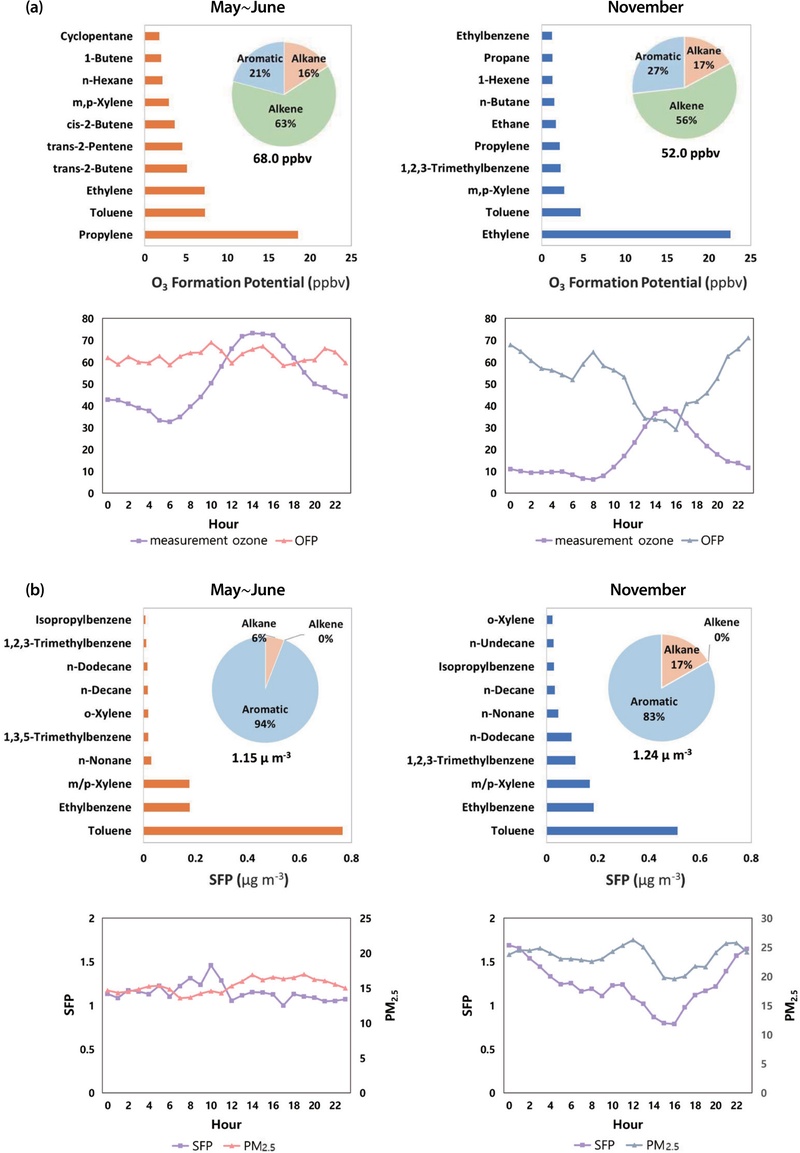
(a) Top 10 VOCs with the highest (a) Ozone Formation Potential and (b) Secondary Organic Aerosol Formation Potential during May~June and November 2022. Their diurnal variations are presented with diurnal variations in O3 and PM2.5. concentrations and VOCs compositions.
SOAFP는 이차생성의 시·공간적 경향을 추정하는 유용한 지표로 활용될 수 있다(Derwent et al., 2010). SOAFP는 5~6월과 11월에 각각 15.0 µg m-3, 14.5 µg m-3로, TVOC는 5~6월에 비해 11월이 높았음에도 SOAFP는 5~6월에 더 높았다. SOAFP에 대한 종별 기여도는 95% 이상이 aerosol yield 값이 높은 aromatic VOCs이다. 우리나라에서 PM2.5의 조성은 여름철에 유기 성분의 비율이 높고 겨울철에는 무기염 성분의 비율이 높다(Lee et al., 2023a; Kim et al., 2020). SOAFP 값과 PM2.5의 농도는 광화학작용이 활발한 여름철 낮 시간대에 유사한 값을 보였다. SOA 생성을 VOCs 기반의 SOAFP 값으로 설명하기에는 한계가 있으나, 이러한 분포는 광화학이 활발한 시기에는 VOCs를 통해 SOA 생성을 제어할 수 있음을 의미한다. 두 기간 모두 toluene, benzene, ethylbenzene, m/p-xylene, styrene이 SOAFP의 96% 이상을 차지하므로 SOA 저감을 위해서는 BTEX의 배출 관리가 중요함을 시사한다.
4. 결 론
본 연구는 서울 도심에서 SIJAQ 캠페인 기간인 2022년 5~6월과 11월 동안 측정된 56종 휘발성유기화합물(VOCs)의 조성, 분포 특성, 배출원 및 광화학 반응성을 종합적으로 분석하였다. 측정된 VOCs 중 검출 빈도 50% 이상인 30종 중 상위 15종이 전체 TVOC의 약 80% 이상을 차지하였다. Alkane은 두 계절 모두에서 가장 큰 비중(약 55~60%)을 차지하였고, alkene과 aromatic은 여름철에 상대적으로 비율이 높았다. 2016년 KORUS-AQ 캠페인과 비교할 때, 동일한 계절에서 서울 지역의 TVOC 평균 농도가 약 50% 이상 감소하여 최근 수년간 VOCs의 감소가 확인되었다. VOCs는 계절적·기상적 요인에 따라 배출 특성의 차이가 나타났다. 여름철에는 남서풍 및 동풍 계열, 겨울철에는 북풍 계열에서 농도가 높았다. Propylene, trans-2-pentene 등 alkene은 온도와 뚜렷한 양의 상관성을 보였으며, 광화학 반응이 활발한 시기 및 낮 시간대에 농도가 증가하였다.
배출원 특성을 분석한 결과, VOCs는 크게 (1) Fuel combustion & evaporation, (2) Vehicle exhaust, (3) Solvents (printing/painting/laundry), (4) Off-road/heavy duty vehicle, (5) Mixed combustion-related/evaporative 등 다섯 가지 요인으로 구분되었다. 특히 차량 및 연료 연소 기원이 전체 분산의 약 34%를 차지하여 도시 VOCs의 주요 배출원으로 확인되었다. T/B ratio는 2018~2019년에 비해 감소하였고 여름철에 교통 관련 배출의 지배적인 영향을 시사하였다.
MIR 계수를 적용한 OFP는 5~6월 평균 68.0 ppbv과 11월 평균 52.0 ppbv로 산정되었다. 과거 연구에서는 aromatic VOCs가 주요 기여원으로 제시된 것과 달리, 본 연구에서는 alkene, 특히 propylene과 ethylene 등이 OFP의 약 60%를 차지하였다. SOAFP는 두 계절 모두 aromatic VOCs가 95% 이상을 차지하였으며, PM2.5 농도와 유사한 일변화를 보여 광화학이 활발한 시기에는 VOCs 저감이 중요하며 특히 toluene과 xylene의 관리가 SOA 저감에도 효과적임을 시사한다.
결론적으로, 서울의 VOCs 농도는 전반적으로 감소 추세에 있으나 여전히 O3 및 SOA 형성에 핵심적인 역할을 보여주고 있다. 본 연구에서는 기온 상승 시 alkene의 농도가 유의하게 증가하는 경향이 확인되었으며, 이는 여름철 폭염과 같이 기후변화로 인한 온도 상승이 반응성이 높은 VOCs의 배출과 광화학 반응을 촉진할 가능성을 시사한다. 특히, toluene, xylene과 같이 aromatic은 O3 생성과 SOA 형성 모두에 높은 반응성과 기여도를 보여, 계절 및 시간대에 따라 alkene과 함께 주요한 광화학 전구물질로 작용하였다. 따라서 향후 도시대기질 관리를 위해서는 계절별 VOCs 특성을 반영한 관리 전략이 필요하다. 이러한 결과는 기후변화에 따른 VOCs 배출 특성 변화를 고려한 통합적 대기질 관리 정책 수립에 과학적 근거를 제공한다.
Acknowledgments
이 본 연구는 국립환경과학원(대기질 국제공동조사 연구(SIJAQ II) -지상 및 항공관측 중심으로- : NIER-2022-04-02-038)과 한국연구재단(RS-2025-00573406)의 지원을 받아 수행되었습니다.
References
-
Ahmed, M., Rappenglück, B., Das, S., Chellam, S. (2021) Source apportionment of volatile organic compounds, CO, SO2 and trace metals in a complex urban atmosphere, Environmental Advances, 6, 100127.
[https://doi.org/10.1016/j.envadv.2021.100127]

-
An, J., Wang, J., Zhang, Y., Zhu, B. (2017) Source apportionment of volatile organic compounds in an urban environment at the Yangtze River Delta, China, Archives of Environmental Contamination and Toxicology, 72, 335-348.
[https://doi.org/10.1007/s00244-017-0371-3]
-
Atkinson, R. (2000) Atmospheric chemistry of VOCs and NOx, Atmospheric Environment, 34(12-14), 2063-2101.
[https://doi.org/10.1016/S1352-2310(99)00460-4]
-
Atkinson, R., Arey, J. (2003) Gas-phase tropospheric chemistry of biogenic volatile organic compounds: A review, Atmospheric Environment, 37(Supplement 2), S197-S219.
[https://doi.org/10.1016/S1352-2310(03)00391-1]
-
Badol, C., Borbon, A., Locoge, N., Leonardis, T., Galloo, J.-C. (2004) An automated monitoring system for VOC ozone precursors in ambient air: Development, implementation and data analysis, Analytical and Bioanalytical Chemistry, 378(7), 1815-1827.
[https://doi.org/10.1007/s00216-003-2474-0]
-
Baudic, A., Gros, V., Sauvage, S., Locoge, N., Sanchez, O., Sarda-Estève, R., Kalogridis, C., Petit, J.-E., Bonnaire, N., Baisnée, D. (2016) Seasonal variability and source apportionment of volatile organic compounds (VOCs) in the Paris megacity (France), Atmospheric Chemistry and Physics, 16(18), 11961-11989.
[https://doi.org/10.5194/acp-16-11961-2016]
-
Borbon, A., Gilman, J.B., Kuster, W.C., Grand, N., Chevaillier, S., Colomb, A., Dolgorouky, C., Gros, V., Lopez, M., Sarda-Estève, R. (2013) Emission ratios of anthropogenic volatile organic compounds in northern mid-latitude megacities: Observations versus emission inventories in Los Angeles and Paris, Journal of Geophysical Research: Atmospheres, 118(4), 2041-2057.
[https://doi.org/10.1002/jgrd.50059]
-
Carter, W.P.L. (1994) Development of ozone reactivity scales for volatile organic compounds, Journal of the Air & Waste Management Association, 44(7), 881-899.
[https://doi.org/10.1080/1073161X.1994.10467290]
- Carter, W.P.L. (2009) Updated maximum incremental reactivity scale and hydrocarbon bin reactivities for regulatory applications (Final report for California Air Resources Board Contract No. 07-339), California Air Resources Board. https://ww2.arb.ca.gov/sites/default/files/classic/research/apr/past/07-339.pdf
-
Chan, L.Y., Chu, K.W., Zou, S.C., Chan, C.Y., Wang, X.M., Barletta, B., Blake, D.R., Guo, H., Tsai, W.Y. (2006) Characteristics of nonmethane hydrocarbons (NMHCs) in industrial, industrial-urban, and industrial-suburban atmospheres of the Pearl River Delta region of south China, Journal of Geophysical Research: Atmospheres, 111(D11), D11304.
[https://doi.org/10.1029/2005JD006481]
-
Che, H., Shen, X., Yao, Z., Wu, B., Gou, R., Hao, X., Cao, X., Li, X., Zhang, H., Wang, S., Chen, Z. (2023) Real-world emission characteristics and inventory of volatile organic compounds originating from construction and agricultural machinery, Science of The Total Environment, 894, 164993.
[https://doi.org/10.1016/j.scitotenv.2023.164993]
-
Cheng, L., Fu, L., Angle, R.P., Sandhu, H.S. (1997) Seasonal variations of volatile organic compounds in Edmonton, Alberta, Atmospheric Environment, 31(2), 239-246.
[https://doi.org/10.1016/1352-2310(96)00170-7]
- Chow, J.C., Watson, J.G. (1998) Guideline on speciated particulate monitoring (Report prepared for U.S. Environmental Protection Agency), Desert Research Institute. http://www.epa.gov/ttn/amtic/files/ambient/pm25/spec/drispec.pdf, (20 March 2002).
-
Debevec, C., Sauvage, S., Gros, V., Sciare, J., Pikridas, M., Stavroulas, I., Salameh, T., Leonardis, T., Gaudion, V., Depelchin, L. (2017) Origin and variability in volatile organic compounds observed at an Eastern Mediterranean background site (Cyprus), Atmospheric Chemistry and Physics, 17(18), 11355-11388.
[https://doi.org/10.5194/acp-17-11355-2017]
-
Derwent, R.G., Jenkin, M.E., Utembe, S.R., Shallcross, D.E., Murrells, T.P., Passant, N.R. (2010) Secondary organic aerosol formation from a large number of reactive man-made organic compounds, Science of The Total Environment, 408(16), 3374-3381.
[https://doi.org/10.1016/j.scitotenv.2010.04.013]
-
Dreessen, J., Ren, X., Gardner, D., Green, K., Stratton, P., Sullivan, J.T., Delgado, R., Dickerson, R.R., Woodman, M., Berkoff, T. (2023) VOC and trace gas measurements and ozone chemistry over the Chesapeake Bay during OWLETS-2, 2018, Journal of the Air & Waste Management Association, 73(3), 178-199.
[https://doi.org/10.1080/10962247.2022.2136782]
-
Eun, D.-M., Han, Y.-S., Nam, I., Chang, Y., Lee, S., Park, J.-H., Gong, S.Y., Youn, J.-S. (2024) Ambient volatile organic compounds in the Seoul metropolitan area of South Korea: Chemical reactivity, risks and source apportionment, Environmental Research, 251(Pt 2), 118749.
[https://doi.org/10.1016/j.envres.2024.118749]
-
Fanizza, C., Incoronato, F., Baiguera, S., Schiro, R., Brocco, D. (2014) Volatile organic compound levels at one site in Rome urban air, Atmospheric Pollution Research, 5(2), 303-314.
[https://doi.org/10.5094/APR.2014.036]
-
Ge, Y., Solberg, S., Heal, M.R., Reimann, S., van Caspel, W., Hellack, B., Salameh, T., Simpson, D. (2024) Evaluation of modelled versus observed non-methane volatile organic compounds at European Monitoring and Evaluation Programme sites in Europe, Atmospheric Chemistry and Physics, 24(13), 7699-7729.
[https://doi.org/10.5194/acp-24-7699-2024]
-
Gelencsér, A., Siszler, K., Hlavay, J. (1997) Toluene-benzene concentration ratio as a tool for characterizing the distance from vehicular emission sources, Environmental Science & Technology, 31(10), 2869-2872.
[https://doi.org/10.1021/es970004c]
-
Ghirardo, A., Lindstein, F., Koch, K., Buegger, F., Schloter, M., Albert, A., Michelsen, A., Winkler, J.B., Schnitzler, J.-P., Rinnan, R. (2020) Origin of volatile organic compound emissions from subarctic tundra under global warming, Global Change Biology, 26(3), 1908-1925.
[https://doi.org/10.1111/gcb.14935]
-
Guo, H., Wang, T., Louie, P.K.K. (2004) Source apportionment of ambient non-methane hydrocarbons in Hong Kong: Application of a principal component analysis/absolute principal component scores (PCA/APCS) receptor model, Environmental Pollution, 129(3), 489-498.
[https://doi.org/10.1016/j.envpol.2003.11.006]
-
Huang, J., Yuan, Z., Duan, Y., Liu, D., Fu, Q., Liang, G., Li, F., Huang, X. (2022) Quantification of temperature dependence of vehicle evaporative volatile organic compound emissions from different fuel types in China, Science of The Total Environment, 813, 152661.
[https://doi.org/10.1016/j.scitotenv.2021.152661]
-
Intergovernmental Panel on Climate Change (IPCC) (2007) Climate Change 2007: The Physical Science Basis (Contribution of Working Group I to the Fourth Assessment Report), Cambridge University Press.
[https://doi.org/10.1017/CBO9780511546013]
-
Jeong, Y.-M., Lee, S.-H., Lee, H.-W., Jeon, W.-B. (2012) Numerical study on the process analysis of ozone production due to emissions reduction over the Seoul Metropolitan Area, Journal of Environmental Science International, 21(3), 339-349, (in Korean with English abstract).
[https://doi.org/10.5322/JES.2012.21.3.339]
-
Jolliffe, I.T. (2002) Principal component analysis (2nd ed.), Springer.
[https://doi.org/10.1007/b98835]
-
Kaiser, H.F. (1958) The varimax criterion for analytic rotation in factor analysis, Psychometrika, 23(3), 187-200.
[https://doi.org/10.1007/BF02289233]
-
Kang, S., Kim, J.-A., Lee, M., Park, J., Jeon, E., Shim, M., Shin, Y. (2022) An analysis of the temporal variability in volatile organic compounds (VOCs) within megacity Seoul and an identification of their sources, Atmospheric Pollution Research, 13(3), 101338.
[https://doi.org/10.1016/j.apr.2022.101338]
-
Kim, H., Gil, J., Lee, M., Jung, J., Whitehill, A., Szykman, J., Lee, G., Kim, D.-S., Cho, S., Ahn, J.-Y. (2020) Factors controlling surface ozone in the Seoul Metropolitan Area during the KORUS-AQ campaign, Elementa: Science of the Anthropocene, 8, 46.
[https://doi.org/10.1525/elementa.444]
-
Kim, S., Sanchez, D., Wang, M., Seco, R., Jeong, D., Hughes, S., Barletta, B., Blake, D.R., Jung, J., Kim, D., Lee, G., Lee, M., Ahn, J., Lee, S., Cho, G., Sung, M., Lee, Y., Kim, D.B., Kim, Y., Woo, J., Jo, D., Park, R., Park, J., Hong, Y., Hong, J. (2016) OH reactivity in urban and suburban regions in Seoul, South Korea - an East Asian megacity in a rapid transition, Faraday Discussions, 189, 231-251.
[https://doi.org/10.1039/C5FD00230C]
-
Kim, S.-J., Lee,S.-J., Lee, H.-Y., Park, H.-J., Kim, C.-H., Lim, H.-J., Lee, S.-B., Kim, J.Y., Schlink, U., Choi, S.-D. (2021) Spatial-seasonal variations and source identification of volatile organic compounds using passive air samplers in the metropolitan city of Seoul, South Korea, Atmospheric Environment, 246, 118136.
[https://doi.org/10.1016/j.atmosenv.2020.118136]
-
Kim, Y.P., Lee, G. (2018) Trend of air quality in Seoul: Policy and science, Aerosol and Air Quality Research, 18(9), 2141-2156.
[https://doi.org/10.4209/aaqr.2018.03.0081]
-
Lau, A.K.H., Yuan, Z., Yu, J.Z., Louie, P.K.K. (2010) Source apportionment of ambient volatile organic compounds in Hong Kong, Science of The Total Environment, 408(19), 4138-4149.
[https://doi.org/10.1016/j.scitotenv.2010.05.025]
-
Lee, H., Gil, J., Lee, M. (2023a) Characteristics of PM2.5 composition and precursor gases in urban Seoul during 2021-2022, Journal of Korean Society for Atmospheric Environment, 39(4), 525-534, (in Korean with English abstract).
[https://doi.org/10.5572/KOSAE.2023.39.4.525]
-
Lee, J., Lee, M., Chang, L., Shin, S.-A., Kim, K., Choi, Y., Lim, H., Choi, S.-D., Lee, G. (2024) Assessment of VOCs emission inventory in Seoul through spatiotemporal observations using passive and online PAMS measurements, Atmospheric Environment, 338, 120857.
[https://doi.org/10.1016/j.atmosenv.2024.120857]
-
Lee, Y., Won, S.R., Shin, H.J., Kim, D.G., Lee, J.Y. (2023b) Seasonal characteristics of volatile organic compounds in Seoul, Korea: Major sources and contribution to secondary organic aerosol formation, Aerosol and Air Quality Research, 23, 220429.
[https://doi.org/10.4209/aaqr.220429]
-
Li, C., Liu, Y., Cheng, B., Zhang, Y., Liu, X., Qu, Y., An, J., Kong, L., Zhang, Y., Zhang, C., Tan, Q., Feng, M. (2022) A comprehensive investigation on volatile organic compounds (VOCs) in 2018 in Beijing, China: Characteristics, sources and behaviours in response to O3 formation, Science of The Total Environment, 806, 150247.
[https://doi.org/10.1016/j.scitotenv.2021.150247]
-
Liu, C., Ma, Z., Mu, Y., Liu, J., Zhang, C., Zhang, Y., Liu, P., Zhang, H. (2017) The levels, variation characteristics, and sources of atmospheric non-methane hydrocarbon compounds during wintertime in Beijing, China, Atmospheric Chemistry and Physics, 17(17), 10633-10649.
[https://doi.org/10.5194/acp-17-10633-2017]
-
Liu, Y., Wang, H., Jing, S., Peng, Y., Gao, Y., Yan, R., Wang, Q., Lou, S., Cheng, T., Huang, C. (2021) Strong regional transport of volatile organic compounds (VOCs) during wintertime in Shanghai megacity of China, Atmospheric Environment, 244, 117940.
[https://doi.org/10.1016/j.atmosenv.2020.117940]
-
Mo, Z., Shao, M., Lu, S., Niu, H., Zhou, M., Sun, J. (2017) Characterization of non-methane hydrocarbons and their sources in an industrialized coastal city, Yangtze River Delta, China, Science of The Total Environment, 593, 641-653.
[https://doi.org/10.1016/j.scitotenv.2017.03.123]
-
Na, K., Kim, Y.P. (2007) Chemical mass balance receptor model applied to ambient C2-C9 VOC concentration in Seoul, Korea: Effect of chemical reaction losses, Atmospheric Environment, 41(32), 6715-6728.
[https://doi.org/10.1016/j.atmosenv.2007.04.054]
-
Na, K., Kim, Y.P., Moon, I., Moon, K.-C. (2004) Chemical composition of major VOC emission sources in the Seoul atmosphere, Chemosphere, 55(4), 585-594.
[https://doi.org/10.1016/j.chemosphere.2004.01.010]
-
Nelson, P.F., Quigley, S.M. (1984) The hydrocarbon composition of exhaust emitted from gasoline fuelled vehicles, Atmospheric Environment, 18(1), 79-87.
[https://doi.org/10.1016/0004-6981(84)90230-0]
-
Pandis, S.N., Harley, R.A., Cass, G.R., Seinfeld, J.H. (1992) Secondary organic aerosol formation and transport, Atmospheric Environment. Part A. General Topics, 26(13), 2269-2282.
[https://doi.org/10.1016/0960-1686(92)90358-R]
-
Park, H.-S., Kim, H.-R., Park, H.-Y., Lee, B.-R., Choi, H.-J., Im, H.-J., Park, C.-O., Park, G.-H., Park, J.-S., Kim, D.-S. (2022) Characteristics of high ozone concentration in Gwangyang Bay Area: Based on cluster analysis, Journal of Korean Society for Atmospheric Environment, 38(2), 188-202, (in Korean with English abstract).
[https://doi.org/10.5572/KOSAE.2022.38.2.188]
-
Park, S.Y., Jang, H., Kim, K.R., Ha, H.J., Choi, Y., Kwon, S.M., Lee, C.M. (2025) Estimation of potentially toxic substances and health risks in VOCs in urban areas of Seoul, Water, Air, & Soil Pollution, 236(9), 548.
[https://doi.org/10.1007/s11270-025-08170-0]
- Purdue, L.J., Dayton, D.-P., Rice, J., Bursey, J. (1991) Technical assistance document for sampling and analysis of ozone precursors (EPA-600/8-91/215), U.S. Environmental Protection Agency. https://nepis.epa.gov/Exe/ZyPURL.cgi?Dockey=P100AJKP.TXT
-
Rasulov, B., Hüve, K., Bichele, I., Laisk, A., Niinemets, Ü. (2010) Temperature response of isoprene emission in vivo reflects a combined effect of substrate limitations and isoprene synthase activity: A kinetic analysis, Plant Physiology, 154(3), 1558-1570.
[https://doi.org/10.1104/pp.110.162081]
-
Ring, A.M., Dickerson, R.R., Sebol, A.E., Ren, X., Benish, S.E., Salawitch, R.J., Galasyn, A., Miller, P.J., Canty, T.P. (2023) Anthropogenic VOCs in the Long Island Sound, NY airshed and their role in ozone production, Atmospheric Environment, 296, 119583.
[https://doi.org/10.1016/j.atmosenv.2023.119583]
- Shin, H.-J., Kim, J.-C., Kim, Y.-P. (2011) Quality assurance and quality control method for volatile organic compounds measured in the photochemical assessment monitoring station, Particle and Aerosol Research, 7(1), 31-45, (in Korean with English abstract). https://www.kci.go.kr/kciportal/ci/sereArticleSearch/ciSereArtiView.kci?sereArticleSearchBean.artiId=ART001545739
-
Simpson, I.J., Blake, D.R., Blake, N.J., Meinardi, S., Barletta, B., Hughes, S.C., Fleming, L.T., Crawford, J.H., Diskin, G.S., Emmons, L.K., Fried, A., Guo, H., Peterson, D.A., Wisthaler, A., Woo, J.-H., Barré, J., Gaubert, B., Kim, J., Kim, M.J., Kim, Y., Knote, C., Mikoviny, T., Pusede, S.E., Schroeder, J.R., Wang, Y., Wennberg, P.O., Zeng, L. (2020) Characterization, sources and reactivity of volatile organic compounds (VOCs) in Seoul and surrounding regions during KORUS-AQ, Elementa: Science of The Anthropocene, 8, 37.
[https://doi.org/10.1525/elementa.434]
-
Song, C., Liu, B., Daily, Q., Li, H., Mao, H. (2019a) Temperature dependence and source apportionment of volatile organic compounds (VOCs) at an urban site on the North China Plain, Atmospheric Environment, 207, 167-181.
[https://doi.org/10.1016/j.atmosenv.2019.03.030]
-
Song, M., Tan, Q., Feng, M., Qu, Y., Liu, X., An, J., Zhang, Y. (2018) Source apportionment and secondary transformation of atmospheric nonmethane hydrocarbons in Chengdu, Southwest China, Journal of Geophysical Research: Atmospheres, 123(17), 9741-9763.
[https://doi.org/10.1029/2018JD028479]
-
Song, S.-K., Shon, Z.-H., Kang, Y.-H., Kim, K.-H., Han, S.-B., Kang, M., Bang, J.-H., Oh, I.-B. (2019b) Source apportionment of VOCs and their impact on air quality and health in the megacity of Seoul, Environmental Pollution, 247, 763-774.
[https://doi.org/10.1016/j.envpol.2019.01.102]
-
Stocker, T.F., Qin, D., Plattner, G.-K., Tignor, M., Allen, S.K., Boschung, J., Nauels, A., Xia, Y., Bex, V., Midgley, P.M. (Eds.). (2014) Climate Change 2013: The Physical Science Basis (Contribution of Working Group I to the Fifth Assessment Report), Cambridge University Press.
[https://doi.org/10.1017/CBO9781107415324]
-
Sultana, D., Hoover, S. (2024) Analysis of gasoline-related pollutant exposures and risks in California between 1996 and 2014, Journal of Exposure Science & Environmental Epidemiology, 34(3), 518-528.
[https://doi.org/10.1038/s41370-023-00615-0]
-
Wang, C.-T., Baek, B.H., Vizuete, W., Engel, L.S., Xing, J., Green, J., Serre, M., Strott, R., Bowden, J., Woo, J.-H. (2023) Spatiotemporally resolved emissions and concentrations of styrene, benzene, toluene, ethylbenzene, and xylenes (SBTEX) in the US Gulf region, Earth System Science Data, 15(11), 5261-5279.
[https://doi.org/10.5194/essd-15-5261-2023]
-
Wang, H., Qiao, Y., Chen, C., Lu, J., Dai, H., Qiao, L., Lou, S., Huang, C., Li, L., Jing, S. (2014) Source profiles and chemical reactivity of volatile organic compounds from solvent use in Shanghai, China, Aerosol and Air Quality Research, 14(1), 301-310.
[https://doi.org/10.4209/aaqr.2013.03.0064]
-
Wang, H.-L., Jing, S.-A., Lou, S.-R., Hu, Q.-Y., Li, L., Tao, S.-K., Huang, C., Qiao, L.-P., Chen, C.-H. (2017) Volatile organic compounds (VOCs) source profiles of on-road vehicle emissions in China, Science of The Total Environment, 607-608, 253-261.
[https://doi.org/10.1016/j.scitotenv.2017.07.001]
-
Wu, W., Fu, T.M., Arnold, S.R., Spracklen, D.V., Zhang, A., Tao, W., Wang, X., Hou, Y., Mo, J., Chen, J., Li, Y., Feng, X., Lin, H., Huang, Z., Zheng, J., Shen, H., Zhu, L., Wang, C., Ye, J., Yang, X. (2024) Temperature-dependent evaporative anthropogenic VOC emissions significantly exacerbate regional ozone pollution, Environmental Science & Technology, 58(12), 5430-5441.
[https://doi.org/10.1021/acs.est.3c09122]
-
Xu, Z., Huang, X., Nie, W., Chi, X., Xu, Z., Zheng, L., Sun, P., Ding, A. (2017) Influence of synoptic condition and holiday effects on VOCs and ozone production in the Yangtze River Delta region, China, Atmospheric Environment, 168, 112-124.
[https://doi.org/10.1016/j.atmosenv.2017.08.035]
-
Yeo, M.J., Kim, Y.P. (2021) Long-term trends of surface ozone in Korea, Journal of Cleaner Production, 294, 125352.
[https://doi.org/10.1016/j.jclepro.2020.125352]
-
Yuan, B., Shao, M., Lu, S., Wang, B. (2010) Source profiles of volatile organic compounds associated with solvent use in Beijing, China, Atmospheric Environment, 44(15), 1919-1926.
[https://doi.org/10.1016/j.atmosenv.2010.02.014]
-
Yun, C., Kim, J., Lee, J., Lee, J., Lee, H., Park, S., Cho, H. (2024) Nocturnal downward transport of NO3 radical from the residual layer to a surface site by the mountain breeze in Seoul, South Korea, Atmospheric Environment, 321, 120345.
[https://doi.org/10.1016/j.atmosenv.2024.120345]
-
Zhang, B., Zhang, D., Dong, Z., Song, X., Zhang, R., Li, X. (2024) The variations in volatile organic compounds based on the policy change for Omicron in the traffic hub of Zhengzhou, Atmospheric Chemistry and Physics, 24(23), 13587-13601.
[https://doi.org/10.5194/acp-24-13587-2024]
-
Zhang, Q., Sun, L., Wei, N., Wu, L., Mao, H. (2021) The characteristics and source analysis of VOCs emissions at roadside: Assess the impact of ethanol-gasoline implementation, Atmospheric Environment, 263, 118670.
[https://doi.org/10.1016/j.atmosenv.2021.118670]
-
Zhao, Y., Nguyen, N.T., Presto, A.A., Hennigan, C.J., May, A.A., Robinson, A.L. (2016) Intermediate volatility organic compound emissions from on-road gasoline vehicles and small off-road gasoline engines, Environmental Science & Technology, 50(8), 4554-4563.
[https://doi.org/10.1021/acs.est.5b06247]
-
Zhen, X., Wang, Y., Liu, D. (2017) An overview of the chemical reaction mechanisms for gasoline surrogate fuels, Applied Thermal Engineering, 124, 1257-1268.
[https://doi.org/10.1016/j.applthermaleng.2017.06.101]
-
Zheng, H., Kong, S., Chen, N., Niu, Z., Zhang, Y., Jiang, S., Yan, Y., Qi, S. (2021) Source apportionment of volatile organic compounds: Implications to reactivity, ozone formation, and secondary organic aerosol potential, Atmospheric Research, 249, 105344.
[https://doi.org/10.1016/j.atmosres.2020.105344]
-
Zheng, J., Yu, Y., Mo, Z., Zhang, Z., Wang, X., Yin, S., Peng, K., Yang, Y., Feng, X., Cai, H. (2013) Industrial sector-based volatile organic compound (VOC) source profiles measured in manufacturing facilities in the Pearl River Delta, China, Science of The Total Environment, 456, 127-136.
[https://doi.org/10.1016/j.scitotenv.2013.03.055]
강소현 (고려대학교 이과대학 지구환경과학과 석사, 국립환경과학원 기후탄소연구부 기후변화연구과 전문위원) (thgusrkd77@korea.ac.kr)
이미혜 (고려대학교 이과대학 지구환경과학과 교수) (meehye@korea.ac.kr)
이강웅 (한국외국어대학교 환경학과 교수) (gwlee@hufs.ac.kr)
장임석 (한중환경협력센터 연구관) (lschang@korea.kr)
신선아 (국립환경과학원 대기환경연구부 환경위성센터 연구관) (sunashin5@korea.kr)
김주애 (고려대학교 이과대학 지구환경과학과 연구교수, 고려대학교 기초과학연구원) (alal78@korea.ac.kr)