
울산 지역 PM2.5 유기성분 특성과 배출원 기여도 분석

Abstract
Organic compounds, such as polycyclic aromatic hydrocarbons (PAHs) and fatty acids (FAs), are emitted from specific sources and can serve as molecular markers for PM2.5 source apportionment. In this study, the characteristics and sources of PM2.5 and 57 associated organic species (OS) were investigated in Ulsan, Korea. The OS exhibited significant correlations with PM2.5 and organic carbon, indicating that they can serve as effective tracers of PM2.5 high-pollution episodes. FAs and n-alkanes were dominant in spring, reflecting mixed influences from industrial activities and biogenic emissions, whereas levoglucosan concentrations were elevated in fall, highlighting a strong impact of biomass burning. Positive Matrix Factorization (PMF) was applied under two scenarios: one using major PM2.5 components and the other incorporating both major components and organic species. The PMF results identified secondary inorganic aerosol as the largest contributor to PM2.5, followed by biomass burning, industrial activities, fossil fuel combustion, and natural sources. When 21 organic tracers were included, the PMF analysis further resolved secondary and primary organic aerosol sources and distinguished biomass-burning contributions into local and long-range transported sources. This source separation was further supported by diagnostic ratios of PAHs. Overall, these results demonstrate that integrating organic molecular markers into receptor modeling substantially improves PM2.5 source resolution and provides quantitative evidence for the combined effects of primary emissions, secondary formation, and regional transport in an industrialized coastal city.
Keywords:
PM2.5, Organic species, Organic marker, Receptor model, Ulsan1. 서 론
국내에서는 다양한 배출 규제와 환경정책의 시행으로 초미세먼지 (PM2.5) 질량농도가 꾸준히 감소하고 있으나, 여전히 기준치를 초과하는 고농도 사례가 빈번하게 발생하고 있어 지속적인 관심이 필요하다. PM2.5는 토양과 해염 등 자연적 배출원과 차량 배출, 산업공정, 연소 등 다양한 인위적 활동에서 1차 배출되며 (Park et al., 2020; Wang et al., 2013; Querol et al., 2006), 황산화물 (SOX), 질소산화물 (NOX), 휘발성유기화합물 (Volatile Organic Compounds: VOCs) 등의 기체상 전구물질의 대기 중 광화학 반응을 통해 2차 생성된다 (Lee et al., 2025; Heo et al., 2016; Tao et al., 2014). PM2.5의 발생원과 생성 과정을 규명하기 위해서는 화학 조성을 분석할 필요가 있으며, 대표적인 주요 성분으로는 무기이온, 유기탄소 (Organic Carbon: OC), 금속 등이 있다.
유기 에어로졸 (Organic Aerosol: OA)은 1,000종 이상의 개별 유기성분 (Organic Species: OS)으로 구성되어 있으며, 유기성분 자료는 PM2.5 배출원을 추정하고 기여도를 평가하는 데 활용될 수 있다 (Schauer et al., 2002; Rogge et al., 1993). 비극성 유기성분인 다환방향족탄화수소 (Polycyclic Aromatic Hydrocarbons: PAHs)는 생체 연소, 화석연료 연소, 차량 배출 등 불완전 연소 과정에서 배출되며 (Li et al., 2018), 이러한 오염원 영향을 규명하기 위해 진단비를 활용할 수 있다 (Choi et al., 2012). 또한, 디카복실산 (Dicarboxylic Acids: DCAs)은 VOCs의 광화학 반응을 통해 생성되는 2차 유기 에어로졸의 지시자로 활용되며 (Liu et al., 2011), 레보글루코산 (levoglucosan)은 대표적인 생체 연소 지시자로서 생체 연소의 직접적인 영향을 나타낸다 (Simoneit et al., 1999). 해외 선행연구에서는 PM2.5 유기성분 자료를 수용모델 (Positive Matrix Factorization: PMF)의 입력자료로 활용하여 배출원 기여도를 평가하였다 (Jaeckels et al., 2007). 국내 선행연구에서도 서울과 배경 지역인 안면도의 PM2.5 유기성분을 분석하여 주요 오염원 기여도를 산정하고 배출특성의 변화를 분석하였다 (Han et al., 2023, 2018).
국내 최대의 산업도시인 울산시는 다양한 대기오염 관리 정책을 통해 미세먼지 배출을 저감하고 있으나 (NIER, 2025), 최근 몇 년간 전국 최고 수준의 미세먼지 농도가 단기간에 빈번하게 관측되고 있다. 특히, 중국 등 외부로부터의 장거리 이동 영향이 상대적으로 적은 여름철에도 고농도 사례가 발생하고 있어 (Lee et al., 2023), 제조업 연소, 비도로 이동 오염원 (선박·항공·기차 등), 생산공정 등 지역 산업단지 배출뿐만 아니라, 광화학반응을 통한 2차 생성의 기여도를 함께 고려할 필요가 있다. 기존에 울산에서 수행된 미세먼지 성분 연구로는 교외, 주거, 산단 지역에서 중금속과 PAHs를 모니터링한 연구 (Lee et al., 2018), 교외 지역에서 미세먼지 이온 성분을 분석한 연구 (Do et al., 2021), 영남권 대기환경연구소의 실시간 측정자료를 활용하여 이온, 탄소, 금속 성분의 오염 특성을 파악한 연구가 있다 (Lee et al., 2023). 그러나 배출원 규명을 위해 미세먼지의 유기성분을 분석하고 이를 바탕으로 오염원별 기여도를 정량적으로 평가한 연구는 매우 부족한 실정이다.
본 연구에서는 울산 지역의 PM2.5 시료를 대상으로 유기성분을 분석하였다. 유기성분 조성과 진단비를 분석하여 오염원을 규명하고, PMF 수용모델을 활용하여 주요 배출원의 정량적 기여도를 평가하였다.
2. 연구 방법
2. 1 시료채취
고용량 대기시료 채취기(High-volume air sampler, HV-RW, SIBATA, Japan)에 PM2.5 임팩터(Impactor for HV, SIBATA, Japan)를 장착하여 울산시 울산과학기술원(UNIST) 옥상에서 2019년 봄(5월 13일~6월 6일)과 가을(10월 4일~11월 2일)에 일별로 23시간 연속으로 시료를 채취하였다. 시료채취 지점은 울산 주요 산업단지로부터 약 15 km 북서쪽에 위치하여 산단 배출원의 광역적 영향을 받는다. 또한, 국도 24호선 및 울산고속도로로부터 직선 거리 1 km 이내에 위치하므로 차량 배출 영향권에 속하며, 주변 농업활동과 소규모 주거지에서 배출된 오염물질의 영향도 예상된다. 아울러 인근 산림에 의한 식생 기원 배출 영향까지 포함하는 입지 조건은 도농공 복합도시로서의 울산의 대기질 특성을 종합적으로 반영하기에 적합하다. 봄철 시료채취 기간에는 북서풍과 남동풍의 영향을 동시에 받았고 가을철에는 북풍과 북동풍이 우세하였으므로, 시료채취 기간 전반적으로 장거리 이동과 산단 배출의 영향을 받은 것으로 추정된다 (그림 1).
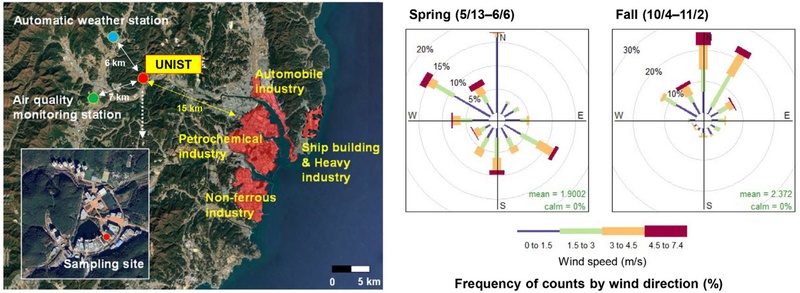
Location of the sampling site at UNIST and wind rose diagrams for Ulsan, South Korea, during the sampling periods. The locations of the automatic weather station and the air quality monitoring station are also shown.
시료채취 전, 석영섬유필터(Quartz Fiber Filter: QFF; QR-100, SIBATA, Japan)를 400℃에서 12시간 가열하여 불순물을 제거하였으며, 채취 후 폴리에틸렌 지퍼백에 밀봉하여 진공 데시케이터에 보관하였다.
2. 2 기기분석
비극성 및 극성물질을 포함한 총 57종의 유기성분 분석을 위해 대체표준물질(phenanthrene-d10, fluoranthene-d10, chrysene-d12, perylene-d12, benzo (g,h,i) perylene-d12, tetracosane-d50, triacontane-d62, hexatriacontane-d74, succinic acid-d6, levoglucosan-d7, myristic acid-d27)을 시료에 첨가한 후, 혼합용매(다이클로로메테인 : 메탄올=3 : 1, v/v)를 이용하여 필터 시료를 초음파 추출하였다. 추출액을 PTFE 주사기 필터로 여과한 뒤, 터보뱁 농축기(Turbo-Vap II, Biotage, USA)와 질소 농축기(MGS-2200, Eyela, Japan)를 이용하여 500 μL까지 최종 농축하였다. 기체크로마토그래프/질량분석기(Gas Chromatograph/Mass Spectrometer: GC/MS, 7890A/5975C, Agilent Technologies, USA)를 이용하여 비극성 화합물을 분석하였으며, 분석대상물질은 16종 PAHs(fluorene (Flu), phenanthrene (Phe), anthracene (Ant), fluoranthene (Flt), pyrene (Pyr), benz(a)anthracene (BaA), chrysene (Chr), benzo(b)fluoranthene (BbF), benzo(e)pyrene (BeP), benzo(a)pyrene (BaP), perylene (Per), indeno(1,2,3-cd)pyrene (IcdP), dibenzo(a,h)anthracene (DahA), benzo(g,h,i) perylene (BghiP), coronene (Cor), 1,3,5-triphenylbenzene (TPB))와 17종 직선형 알케인(n-alkanes) (C20-C36)이었다.
극성 화합물의 경우, 최종 농축액 중 50 μL를 분취하여 유도체화를 진행한 후 GC/MS로 분석하였다. 유도체화를 위해 분취액을 완전히 증발시킨 후 N,O-Bis (trimethylsilyl)trifluoroacetamide (BSTFA) 50 μL와 pyridine 50 μL를 첨가하고, 75℃에서 90분간 가열하여 유도체 반응을 진행하였다. 시료를 12시간 이상 방냉한 후 GC/MS를 이용하여 9종 지방산 (Fatty Acids: FAs; dodecanoic acid, myristic acid, palmitoleic acid, palmitic acid, oleic acid, stearic acid, eicosanoic acid, docosanoic acid, tetracosanoic acid), 13종 디카복실산(DCAs; malonic acid, maleic acid, succinic acid, fumaric acid, glutaric acid, adipic acid, pimelic acid, phthalic acid, isophthalic acid, terephthalic acid, azelaic acid, sebacic acid, 2,3-naphthalenedicarboxylic acid), 2종 당류(sugars; levoglucosan, mannosan)를 분석하였다.
2. 3 정도관리
정도관리(Quality Assurance/Quality Control: QA/QC)를 위해 방법검출한계(Method Detection Limit: MDL) 산정, 바탕 시료 분석, 회수율 평가를 수행하였다. MDL은 QFF 공시료에 표준물질을 주입한 후 실제 시료와 동일한 절차로 분석하였으며, 7회 반복 측정 결과의 표준편차에 3.14를 곱하여 산출하였다. 유기성분 그룹별 MDL은 PAHs 0.002~0.04 ng/m3, 알케인 0.004~0.09 ng/m3, 지방산 0.04~0.46 ng/m3, 디카복실산 0.03~0.22 ng/m3, 당류 0.04~0.05 ng/m3의 범위였다. 그룹별 평균 회수율은 PAHs 84%, 알케인 89%, 지방산 72%, 디카복실산 77%, 당류 83%였다. 실험과정의 오염 확인을 위해 실험실 바탕시료를 분석하여 실제 시료의 농도 보정에 활용하였다.
2. 4 수용모델링
PM2.5의 오염원 기여도를 산정하기 위해 미국 환경보호청(United States Environmental Protection Agency: US EPA)에서 개발한 PMF 모델(version 5.0)을 활용하였다. PMF 분석에서는 유기성분 농도자료와 함께 영남권 대기환경연구소에서 실시간 측정한 PM2.5 구성성분(5종 이온, 2종 탄소, 14종 금속) 자료를 함께 활용하였다. 유기성분 지시자 추가에 따른 PM2.5 오염원 기여도의 변화를 파악하기 위해 두 조건에서 PMF 모델링을 수행하여 결과를 비교하였다. 첫 번째 조건에서는 이온, 금속, 탄소성분 자료만을 활용하여 PMF 모델링을 수행하였으며, 두 번째 조건에서는 PM2.5 성분 자료와 함께 유기성분 지시자를 함께 입력자료로 활용하여 모델링을 수행하였다.
두 번째 조건에서 전체 유기성분 자료를 모두 입력할 경우, 요인 분리의 안정성이 저하될 수 있으므로, 농도 수준, 검출률, 오염원 등을 고려하여 21종(PAHs 7종, 알케인 4종, 지방산 2종, 디카복실산 7종, 레보글루코산) 유기성분 자료를 입력하였다. 농도 및 불확도 자료는 US EPA 가이드라인에 따라 전처리하였다(US EPA, 2014). 입력 화학종의 선정과 최적 요인 수 결정을 위해 반복적으로 모델을 실행하였으며, 신호대 잡음비, 관측값과 예측값의 상관관계 등 여러 결과를 종합적으로 고려하였다.
3. 결과 및 고찰
3. 1 미세먼지, 유기탄소, 유기성분 시계열 분석
PM2.5와 OC 및 유기성분 그룹별 농도 추세를 그림 2에 나타내었다. 봄철 PM2.5의 평균 농도(21.5 μg/m3)는 가을철 평균 농도(9.4 μg/m3)보다 통계적으로 유의하게 높았다(Mann-Whitney Rank Sum test, p<0.01). 탄소성분과 총 유기성분(Σ57 OS) 또한 봄에 각각 3.3 μg/m3과 0.6 μg/m3, 가을에 1.5 μg/m3과 0.4 μg/m3으로, 모두 봄에 유의하게 높은 수준을 보였다(p<0.01). 봄철 시료채취 기간(5월 13일~6월 6일)에는 남동풍의 영향이 뚜렷하여 인근 산단의 영향을 받은 것으로 판단되며, 북서풍에 의한 장거리 이동과 복합적으로 작용하여 PM2.5와 OS 농도가 증가한 것으로 해석된다. 일별 농도 추세의 경우, PM2.5 농도 증가 시 OC 농도가 함께 증가하였으며, OS의 일별 농도도 유사한 상승 추세를 확인하였다. 이를 통해 본 연구에서 분석한 유기화합물이 PM2.5와 OC의 고농도 사례와 밀접한 관련이 있음을 확인하였다.
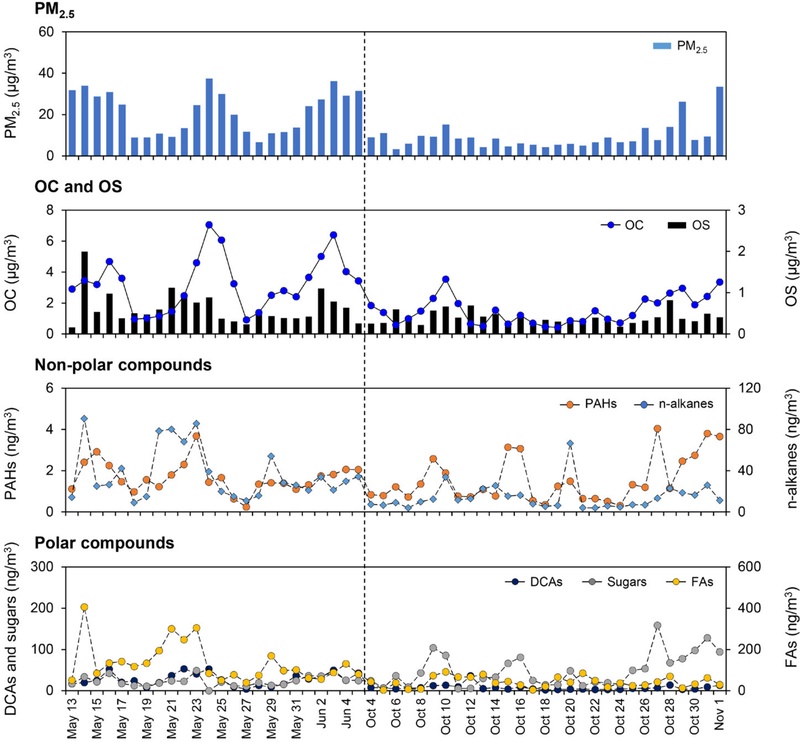
Temporal trends of PM2.5, OC, OS, and individual OS groups of non-polar and polar compounds in Ulsan during the spring (May 13~June 6) and fall (October 4~November 2).
PM2.5, OC, OS 간의 상관성을 확인하기 위해 비모수 상관분석을 수행하였으며, PM2.5와 OC는 높은 상관성을 보였다(r=0.881, p<0.01). OS는 PM2.5 (r=0.476)와 OC (r=0.548)와 모두 통계적으로 유의한 상관관계를 보였으며, 선행연구에서 보고된 서울 OS-OC 상관관계(r=0.569)와 유사한 수준이었다(Lee et al., 2022). 이 상관분석에 사용한 PM2.5와 OC 농도는 울산시 성안동에 위치한 영남권 대기환경연구소에서 준실시간으로 측정한 자료이며, 본 연구의 OS 분석 자료는 약 10 km 떨어진 UNIST에서 측정한 자료이므로 상관계수가 다소 낮게 나타난 것으로 해석된다. PM2.5 내 유기물질(Organic Matter: OM)은 일반적으로 OC에 환산계수 1.4를 곱하여 추정하며(Chow et al., 2015), 이를 기준으로 산정한 OM 대비 OS의 농도 비율은 봄철 12.8%, 가을철 18.9%로 나타났다. 이는 개별 유기성분 자료가 유기성 에어로졸 오염 특성을 해석하는 데 중요한 정보를 제공할 수 있다는 것을 의미한다. 또한, 봄철에는 알케인과 지방산 농도가 PM2.5 고농도 시기에 같이 증가하는 경향을 보였으며, 가을철 고농도 PM2.5 관측일(10월 26일, 28일, 29일, 11월 1일)에는 당류가 높은 농도 수준을 보였다. 이는 해당 유기화합물이 울산의 PM2.5 오염에 주요한 기여를 하고 있음을 시사한다. PAHs의 농도추세는 봄철에 PM2.5 농도 변화와 유사한 경향을 보였으나, 가을철에는 PM2.5 농도가 낮은 기간에 PAHs 농도가 급증하는 현상이 관찰되어 국지적인 생체 연소 등 추가적인 오염원의 영향을 받은 것으로 판단된다(Shin et al., 2022). 2차 유기에어로졸의 지시자로 알려진 디카복실산의 경우, 상대적으로 기온이 높은 봄철(봄: 20.1℃, 가을: 15.3℃)에는 PM2.5 농도와 유사한 추세를 보였으나, 가을철에는 전반적으로 낮은 수준을 유지하였다.
3. 2 유기성분 농도 분포 특성
울산 지역의 OS 농도는 봄에 224 ng/m3, 가을에 115 ng/m3으로, 봄철에 약 1.9배 높았다. 봄철 유기성분 중에서 지방산(135 ng/m3, 60%)이 가장 높은 농도를 보였으며, 알케인(36.8 ng/m3, 17%), 디카복실산(27.8 ng/m3, 12%), 당류(23.2 ng/m3, 10%), PAHs (1.66 ng/m3, 1%) 순이었다(그림 3). 지방산과 알케인은 화석연료 연소뿐만 아니라 생물 기원에서도 발생하는 것으로 알려져 있으며(Rogge et al., 1993), 교외지역에 위치한 시료채취 지점 특성상 인근 자연 발생원의 직접적인 영향을 받은 것으로 해석된다. 대기 중 디카복실산은 이소프렌(isoprene)과 모노테르펜(monoterpene) 등의 전구물질이 광화학 반응을 거쳐 2차 생성되며(Liu et al., 2011), 봄철 디카복실산의 평균 농도는 27.8 ng/m3로 가을(7.63 ng/m3)에 비해 약 3.6배 높았다. 이는 상대적으로 높은 기온에 의해 2차 생성의 영향이 증가한 것으로 판단된다. 반면, 가을에는 당류가 가장 큰 비율을 차지하였으며(49.3 ng/m3, 43%), 다음으로 지방산(42.0 ng/m3, 37%)>알케인(14.3 ng/m3, 12%)>디카복실산 (7.63 ng/m3, 7%)>PAHs(1.55 ng/m3, 1%) 순이었다. 당류는 생체 연소에서 직접적으로 배출되는 것으로 알려져 있으며(Simoneit et al., 1999), 특히 레보글루코산의 농도는 가을(41.1 ng/m3)에 매우 높게 나타났다. 이는 가을철 농업 잔재물 연소 등의 직접적인 영향으로 추정된다(Jung et al., 2014). PAHs의 계절 평균 농도는 봄철 1.66 ng/m3와 가을철 1.55 ng/m3로 유사한 수준을 보였다.
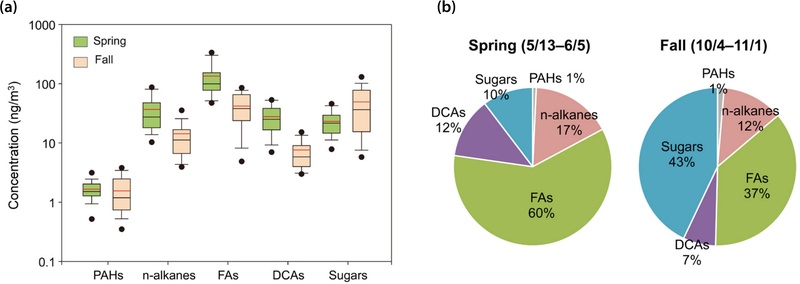
Seasonal comparison of PAHs, n-alkanes, FAs, DCAs, and sugars in spring and fall: (a) box plots of daily concentrations and (b) pie charts of compositional profiles.
유기성분 그룹별 개별물질의 구성비를 파악하기 위해 물질별 전체 기간 평균 농도를 표 1에 제시하였다. PAHs 중에서 BbF (0.35 ng/m3, 21%)와 BaP (0.18 ng/m3, 12%)를 포함한 고분자량 PAHs (BbF~TPB)의 비율이 72%로서, 난방 등 화석연료 연소기원의 영향이 뚜렷하였다(Simoneit et al., 1999). 알케인은 C27, C29, C31 순으로 높은 비율을 보였으며, 식물성 왁스에서 기인한 생물기원 특성이 우세한 것으로 해석된다(Rogge et al., 1993). 지방산의 경우에는 포화지방산인 팔미트산(palmitic acid)과 스테아르산(stearic acid)이 각각 48%와 40%를 차지하였으며, 이 물질들은 식물성 왁스와 생체 연소에서 배출되는 것으로 알려져 있다(Simoneit et al., 1999). 디카복실산에서는 산화도가 높은 2차 생성 지시자로 알려진 말론산(malonic acid: 69%)과 숙신산(succinic acid: 6.7%)의 비율이 가장 높았다. 숙신산에 비해 말론산의 비율이 높았으므로 1차 배출의 영향은 제한적이며, 광화학 산화와 2차 생성의 영향이 우세한 것으로 해석할 수 있다(Kawamura and Bikkina, 2016).

Mean concentrations of the target organic species during the overall sampling period.
3. 3 유기성분 진단비 분석
본 연구 분석결과와 선행연구의 입자상 시료 분석 결과의 진단비를 비교하여, PM2.5의 오염기원을 판별하였다. 화석연료의 세부 배출원을 분류하는 데 활용되는 PAHs 진단비 (Flt/(Flt+Pyr), IcdP/(IcdP+BghiP))를 계산하였다(그림 4a). Flt/(Flt+Pyr) 진단비는 봄과 가을에 유사한 범위(0.36~0.54)를 보였으며, IcdP/(IcdP+BghiP) 진단비의 범위는 봄(0.52~0.91)이 가을(0.30~0.67)보다 크게 나타났다. 선행연구의 평균 진단비와 비교하면(Sheesley et al., 2011), 봄철 시료는 가을철 시료보다 생체 연소의 영향이 상대적으로 뚜렷하였으며, 가을철에는 생체 및 석탄 연소의 영향이 함께 나타났다. 반면에 석유 연소의 진단비 범위와는 큰 차이를 보여, 본 연구에서는 고체연료 연소의 영향이 강한 것으로 확인되었다.
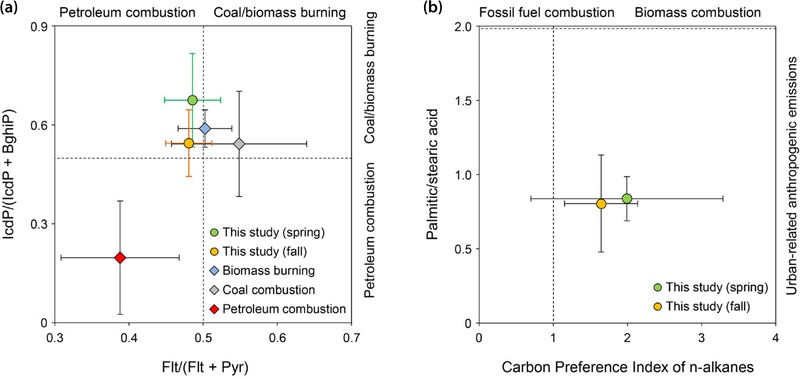
Scatter plots of diagnostic ratios for PM2.5: (a) Flt/(Flt+Pyr) versus IcdP/(IcdP+BghiP) compared with previous studies and (b) Carbon Preference Index of n-alkanes (CPI) versus the palmitic to stearic acid ratio. Error bars indicate the standard deviations.
생물기원과 화석연료 연소 배출원을 구분하기 위해 알케인 농도 자료를 이용하여 탄소선호지수(Carbon Preference Index: CPI)를 계산하였다(그림 4b). 생물기원 배출의 경우, 일반적으로 홀수 탄소수를 가진 알케인이 짝수 탄소수 알케인보다 높은 비율을 보인다(Yue and Fraser, 2004). 해당 오염원을 평가하기 위해 선행연구에서 주로 활용되는 고분자(C25~C33) 범위의 홀수/짝수 탄소수 농도비를 이용하여 CPI를 산정한 결과, 봄에는 1.2~7.3, 가을에는 0.9~3.4의 범위를 보였다. 선행연구에서는 화석연료 연소 시 CPI가 약 1.0, 생체 연소에서는 1.0~2.7, 생물기원 배출에서는 10 이상으로 보고되었다(Simoneit et al., 1999; Rogge et al., 1993). 본 연구의 평균 CPI는 봄과 가을 모두 1보다 크므로 생체 연소기원 효과가 강한 것으로 해석할 수 있다. 지방산의 경우, 생물기원과 인위적 배출의 진단비로 활용되는 팔미트산/스테아르산 농도비를 계산한 결과, 봄철 0.83±0.13, 가을철 0.81±0.33으로 유사한 수준을 보였다. 선행연구에서는 팔미트산/스테아르산 비율이 생물기원 배출에서는 4 이상, 생체 연소 기원에서 2~4, 도심의 인위적 배출(조리 배출과 비산 먼지 등)에서는 2 이하의 범위를 보이는 것으로 보고되었다(Balla et al., 2018; Mu et al., 2021). 따라서 본 연구결과는 도심 활동과 관련된 배출원의 영향을 반영하는 것으로 판단된다.
3. 4 오염원 기여도 산정
PM2.5의 오염원을 정량적으로 평가하기 위해 PMF 모델링을 수행하였으며, PM2.5 구성성분(5종 이온, 2종 탄소, 14종 금속)을 입력자료로 활용한 프로파일 결과를 그림 5에 나타내었다. 총 8개 오염원으로 구분되었으며, 이들 오염원은 크게 2차 무기에어로졸(Secondary Inorganic Aerosol: SIA), 산업활동, 연소기원, 자연기원으로 분류할 수 있다. 황산염(SO42-), 질산염(NO3-), 암모늄(NH4+)이 높은 비율을 보이는 2차 무기에어로졸(39.3%)이 가장 높은 기여도를 보였으며, OC, EC, K의 농도와 비율이 높은 생체 연소 또한 큰 기여도(23.6%)를 나타냈다. 연소 관련 배출원의 경우, As와 Pb의 비율이 높은 석탄 연소(1.4%)와 V과 Ni이 우세한 석유 연소(9.0%) 배출원으로 구분되었다. 또한, 산업활동 배출원은 Cr, Mn, Fe 비율이 높은 산단 배출원(4.4%)과 Cu 관련 배출원(6.5%)으로 나뉘었다. 자연기원의 경우, Na와 Cl의 비율이 높은 해염(5.5%)과 K, Ca, Ti의 비율이 높은 토양 기원(10.3%) 배출원으로 분류되었다.
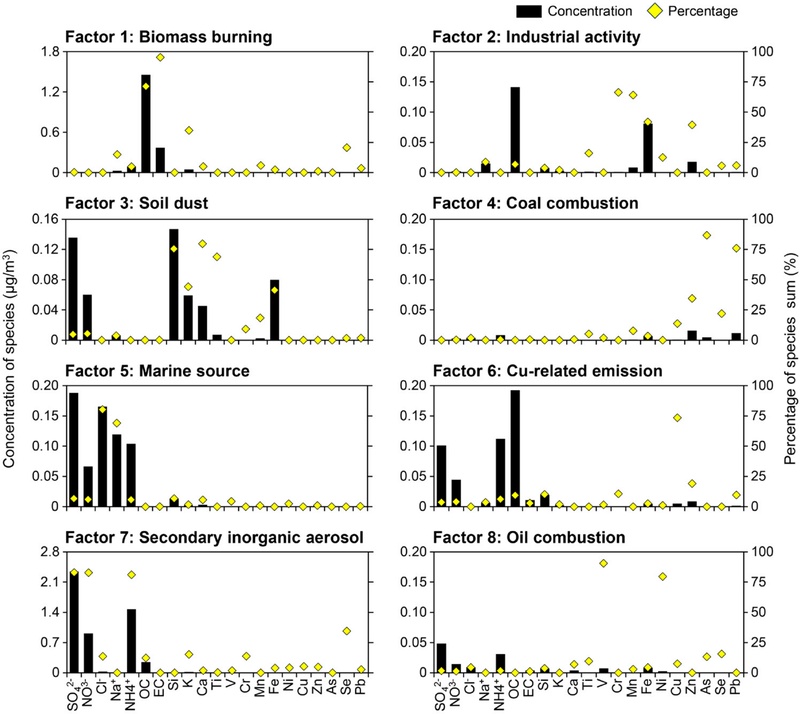
PMF profiles of eight factors representing PM2.5 sources. Black bars (left y-axis) indicate the concentrations of individual chemical species, while yellow diamond symbols (right y-axis) indicate their percentage contributions.
유기성분 21종 자료의 포함 여부에 따른 PMF 결과를 비교하였다 (표 2). 유기성분을 추가로 고려한 PMF 모델링 결과에서는 2개의 오염원이 추가되어 총 10개의 오염원으로 분류되었다. 2차 생성 관련 오염원의 경우, 2차 무기에어로졸뿐만 아니라 2차 유기에어로졸 배출원을 분류하였고, 추가로 1차 유기 에어로졸 배출원도 확인하였다. 또한, 생체 연소 배출원은 유기성분 자료를 활용함으로써 지역 배출과 장거리 이동 영향으로 구분할 수 있었으며, 두 조건의 PMF 모델링에서 생체 연소의 PM2.5 총 기여도는 유사하였다. 첫 번째 조건에서 확인된 Cu 관련 배출원은 유기성분 자료를 추가함으로써 산업활동 배출원에 포함되었다. 이외의 연소 관련 배출원과 자연 기원 배출원은 두 PMF 모델링 결과에서 배출원 분류와 기여도가 전반적으로 유사한 경향을 보였다.
Comparison of PMF results for PM2.5 source contributions with and without organic species.
유기성분 자료를 포함한 PMF 모델링 결과, 2차 유기에어로졸, 1차 유기에어로졸, 지역 배출 생체연소, 장거리 이동 생체연소, 자연기원 배출원에서 유기성분의 기여도가 높았다(그림 6). 2차 유기에어로졸 배출원은 PM2.5 전체 오염원의 12.5%를 차지하였으며, 해당 배출원에서는 디카복실산 성분들이 높은 기여도를 보였다. 특히, 높은 산화도의 유기에어로졸 지시자로 알려진 말론산과 숙신산은 각각 67%와 60%의 기여도를 보여, 2차 생성의 영향이 뚜렷하였다(Kawamura and Bikkina, 2016). 1차 유기에어로졸 배출원의 경우에는 이온과 금속성분의 기여도는 매우 낮았으며, 알케인과 지방산이 주요 성분으로 나타났다. 해당 성분들은 생체연소와 화석연료 연소에서 배출되는 것으로 알려져 있으며, 연소 배출원의 특성을 평가하기 위한 CPI 분석 결과 또한 두 연소 배출원의 복합적인 영향을 받은 것으로 나타났다(그림 7a). 해당 연소 기원 유기에어로졸의 화학적 노화 특성을 파악하기 위해 PAHs인 BaP와 BeP의 진단비를 활용하였다. 선행연구에서는 BeP/BaP 비가 클수록 대기 중 체류 시간이 길고 장거리 이동 영향이 뚜렷하며, 비가 작으면 직접적인 배출 영향으로 보고하였다(Thang et al., 2020; Lee et al., 2011). 연소 기원 유기에어로졸 배출원의 BeP/BaP 비는 0.23으로 매우 작은 수준을 보여, 연소 과정에서 직접 배출된 1차 유기에어로졸의 특성을 확인하였다(그림 7b). 또한, 생체연소와 관련해서는 두 개의 배출원으로 분리되었으며, 배출원 1에서는 OC, EC, K, 배출원 7에서는 PAHs와 레보글루코산이 주요 지시자로 확인되었다. 두 생체연소 배출원을 세분화하기 위해 PAHs 진단비(BeP/BaP)를 활용하여 지역 배출과 장거리 이동 영향을 구분하였다 (그림 7b). 본 연구에서 배출원 1과 7의 BeP/BaP 비는 각각 1.68과 0.17로 나타났으며, 이를 바탕으로 배출원 1은 지역 배출의 영향을 반영한 생체연소 배출원으로, 배출원 7은 장거리 이동의 영향이 우세한 생체연소 배출원으로 판단하였다. 자연기원 배출원에서는 Na+와 Cl-의 기여도가 높았으며, 동시에 지방산 성분도 높은 비중을 보여 생물기원 배출의 영향을 추가로 받은 것으로 해석된다.
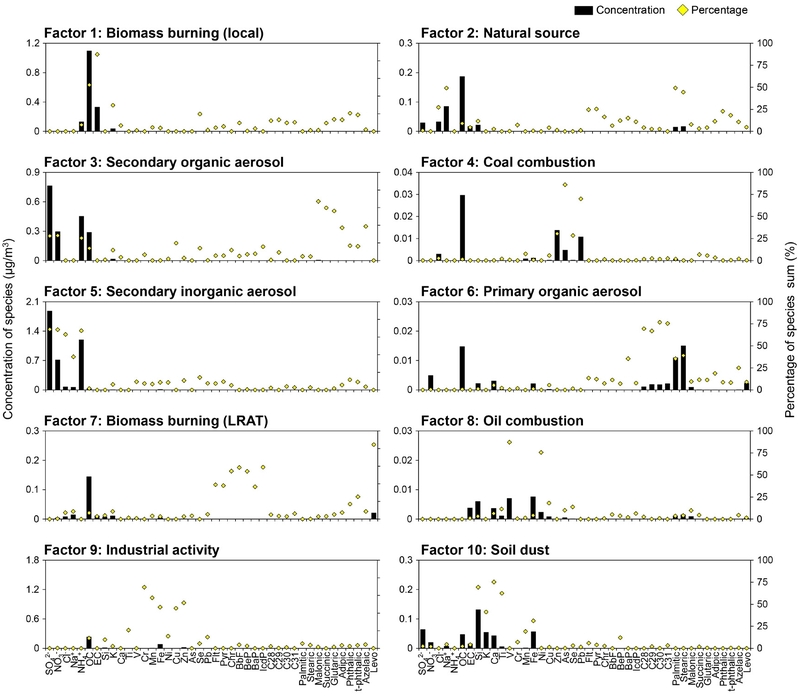
PMF profiles of 10 factors representing PM2.5 sources using 21 organic species as input data. Black bars (left y-axis) indicate the concentrations of the individual chemical species, while yellow diamond symbols (right y-axis) indicate their percentage contributions.
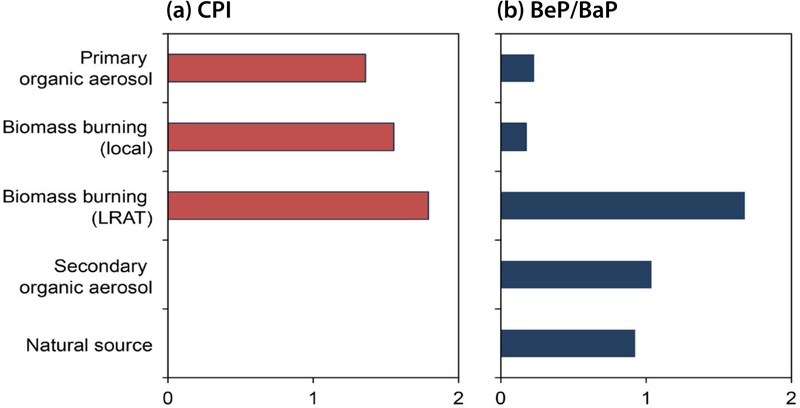
Diagnostic ratios of source factors derived from the PMF results: (a) CPI calculated using C29-C31 and (b) BeP/BaP. Factors with total contributions of less than 10% of the organic species used in the diagnostic ratios were excluded.
4. 결 론
본 연구에서는 울산 지역 PM2.5의 유기성분 오염 특성을 파악하고, 유기성분 자료를 PMF 수용모델에 적용하여 주요 배출원의 기여도를 정량적으로 평가하였다. OS는 PM2.5 및 OC와 고농도 사례에서 유사한 일별 추세를 보였으며, 이들 간의 유의한 상관성은 유기성분이 PM2.5 오염 특성과 밀접하게 연관되어 있음을 나타낸다. 봄철에는 지방산과 알케인이 높은 비율을 보였으며, 그룹별 조성 비율을 계산하여 산업단지 배출과 교외 생물기원의 복합적인 영향을 파악하였다. 가을철에는 레보글루코산 농도가 뚜렷하게 증가하여 농업 잔재물 소각 등 생체연소의 영향이 우세함을 확인하였다. PAHs, 알케인, 지방산의 진단비 분석 결과, 울산 지역에서는 계절별로 화석연료 연소, 생체연소, 도심 배출의 영향이 다른 양상으로 PM2.5 오염에 기여하고 있음을 확인하였다.
PM2.5 오염원 기여도를 평가하기 위해 PMF 모델링을 수행한 결과, 주요 배출원은 2차 무기에어로졸, 연소기원, 산업활동, 자연기원으로 구분되었다. 기본 PM2.5 구성성분 자료를 활용한 분석에서는 2차 무기에어로졸이 가장 큰 기여를 보였으며, 생체연소 또한 중요한 배출원으로 확인되었다. 유기성분을 추가한 PMF 분석을 통해 유기에어로졸 관련 배출원을 추가로 분류하였다. 유기성분 진단비 분석을 통해 유기에어로졸 배출원을 구체화하였으며, 생체연소 배출원을 지역 배출과 장거리 이동의 두 요인으로 세분화하였다. 이와 같이 유기성분 자료를 활용한 PMF 수용 모델링을 통해, 기존 이온/금속 성분 중심의 분석만으로는 구분하기 어려운 유기 에어로졸 및 연소기원 배출 특성을 규명할 수 있었다.
이러한 결과는 울산과 같은 대규모 산업도시에서 1차 배출, 2차 생성, 장거리 이동의 정량적 기여를 평가하기 위한 기초자료로 활용될 수 있으며, 향후 미세먼지 저감 정책과 배출원 관리 전략 수립에 과학적 근거를 제공할 수 있다.
Acknowledgments
본 연구는 한국연구재단(RS-2023-00209329, RS-2020-NR049578, 2020R1A6A1A03040570)의 지원으로 수행되었습니다.
References
-
Balla, D., Voutsa, D., Samara, C. (2018) Study of polar organic compounds in airborne particulate matter of a coastal urban city, Environmental Science and Pollution Research, 25, 12191-12205.
[https://doi.org/10.1007/s11356-017-9993-2]

-
Choi, S.-D., Ghim, Y.S., Lee, J.Y., Kim, J.Y., Kim, Y.P. (2012) Factors affecting the level and pattern of polycyclic aromatic hydrocarbons (PAHs) at Gosan, Korea during a dust period, Journal of Hazardous Materials, 227-228, 79-87.
[https://doi.org/10.1016/j.jhazmat.2012.05.012]
-
Chow, J.C., Lowenthal, D.H., Chen, L.W., Wang, X., Watson, J.G. (2015) Mass reconstruction methods for PM2.5: a review, Air Quality, Atmosphere & Health, 8, 243-263.
[https://doi.org/10.1007/s11869-015-0338-3]
-
Do, T.V., Vuong, Q.T., Choi, S.-D. (2021) Day-night variation and size distribution of water-soluble inorganic ions in particulate matter in Ulsan, South Korea, Atmospheric Research, 247, 105145.
[https://doi.org/10.1016/j.atmosres.2020.105145]
-
Han, S., Lee, J.Y., Lee, J., Heo, J., Jung, C.H., Kim, E.-S., Kim, Y.P. (2018) Estimation of the source contributions for carbonaceous aerosols at a background site in Korea, Asian Journal of Atmospheric Environment, 12, 311-325.
[https://doi.org/10.5572/ajae.2018.12.4.311]
-
Han, S., Park, Y., Noh, N., Kim, J.-H., Kim, J.-J., Kim, B.-M., Choi, W. (2023) Spatiotemporal variability of the PM2.5 distribution and weather anomalies during severe pollution events: observations from 462 air quality monitoring stations across South Korea, Atmospheric Pollution Research, 14, 101676.
[https://doi.org/10.1016/j.apr.2023.101676]
-
Heo, J., Adams, P.J., Gao, H.O. (2016) Public health costs of primary PM2.5 and inorganic PM2.5 precursor emissions in the United States, Environmental Science & Technology, 50, 6061-6070.
[https://doi.org/10.1021/acs.est.5b06125]
-
Jaeckels, J.M., Bae, M.-S., Schauer, J.J. (2007) Positive matrix factorization (PMF) analysis of molecular marker measurements to quantify the sources of organic aerosols, Environmental Science & Technology, 41, 5763-5769.
[https://doi.org/10.1021/es062536b]
-
Jung, J., Lee, S., Kim, H., Kim, D., Lee, H., Oh, S. (2014) Quantitative determination of the biomass-burning contribution to atmospheric carbonaceous aerosols in Daejeon, Korea, during the rice-harvest period, Atmospheric Environment, 89, 642-650.
[https://doi.org/10.1016/j.atmosenv.2014.03.010]
-
Kawamura, K., Bikkina, S. (2016) A review of dicarboxylic acids and related compounds in atmospheric aerosols: molecular distributions, sources and transformation, Atmospheric Research, 170, 140-160.
[https://doi.org/10.1016/j.atmosres.2015.11.018]
-
Lee, J.Y., Kim, Y.P., Kang, C.-H. (2011) Characteristics of the ambient particulate PAHs at Seoul, a mega city of Northeast Asia in comparison with the characteristics of a background site, Atmospheric Research, 99, 50-56.
[https://doi.org/10.1016/j.atmosres.2010.08.029]
-
Lee, S.-J., Cho, I.-G., Lee, H.-Y., Ju, J.-T., Shin, H.-J., Choi, S.-D. (2025) Development of a comprehensive air risk index and its application to high spatial-temporal health risk assessment in a large industrial city, Environmental Pollution, 367, 125545.
[https://doi.org/10.1016/j.envpol.2024.125545]
- Lee, S.-J., Kim, S.-J., Park, M.-K., Cho, I.-G., Lee, H.-Y., Choi, S.-D. (2018) Contamination characteristics of hazardous air pollutants in particulate matter in the atmosphere of Ulsan, Korea, Journal of the Korean Society for Environmental Analysis, 21, 281-291, (in Korean with English Abstract). https://www.jeaht.org/upload/pdf/jksea-21-4-281.pdf
-
Lee, S.-J., Lee, H.-Y., Kim, S.-J., Kang, H.-J., Kim, H., Seo, Y.-K., Shin, H.-J., Ghim, Y.S., Song, C.-K., Choi, S.-D. (2023) Pollution characteristics of PM2.5 during high concentration periods in summer and winter in Ulsan, the largest industrial city in South Korea, Atmospheric Environment, 292, 119418.
[https://doi.org/10.1016/j.atmosenv.2022.119418]
-
Lee, Y., Teng, Z., Kim, K.A., Lee, K.Y., Park, S., Lee, J.I. (2022) Characteristics of organic compounds in PM2.5 at Seosan: comparison of organic compounds in PM2.5 at Seoul, Journal of Korean Society of Environmental Engineers, 44, 150-160, (in Korean with English Abstract).
[https://doi.org/10.4491/KSEE.2022.44.5.150]
-
Li, P., Sato, K., Hasegawa, H., Huo, M., Minoura, H., Inomata, Y., Take, N., Yuba, A., Futami, M., Takahashi, T., Kotake, Y. (2018) Chemical characteristics and source apportionment of PM2.5 and long-range transport from Northeast Asia continent to Niigata in eastern Japan, Aerosol and Air Quality Research, 18, 938-956.
[https://doi.org/10.4209/aaqr.2017.05.0181]
-
Liu, S., Day, D.A., Shields, J.E., Russell, L.M. (2011) Ozone-driven daytime formation of secondary organic aerosol containing carboxylic acid groups and alkane groups, Atmospheric Chemistry and Physics, 11, 8321-8341.
[https://doi.org/10.5194/acp-11-8321-2011]
-
Mu, L., Li, X., Li, Y., Liu, X., Bai, H., Li, X., Liu, T. (2021) Molecular distribution, seasonal variations, and sources of typical polar organics in PM2.5 from Jinzhong, China, ACS Earth and Space Chemistry, 5, 663-675.
[https://doi.org/10.1021/acsearthspacechem.0c00350]
- National Institute of Environmental Research (NIER) (2025) Clean Air Policy Support System (CAPSS): National Air Pollutant Emission Inventory, South Korea. https://www.air.go.kr/capss/emission/year.do?menuId=29
-
Park, E.H., Heo, J., Kim, H., Yi, S.M. (2020) Long term trends of chemical constituents and source contributions of PM2.5 in Seoul, Chemosphere, 251, 126371.
[https://doi.org/10.1016/j.chemosphere.2020.126371]
-
Querol, X., Zhuang, X., Alastuey, A., Viana, M., Lv, W., Wang, Y., Lopez A., Zhu Z., Wei H., Xu S. (2006) Speciation and sources of atmospheric aerosols in a highly industrialised emerging mega-city in central China, Journal of Environmental Monitoring, 8, 1049-1059.
[https://doi.org/10.1039/B608768J]
-
Rogge, W.F., Mazurek, M.A., Hildemann, L.M., Cass, G.R., Simoneit, B.R. (1993) Quantification of urban organic aerosols at a molecular level: identification, abundance and seasonal variation, Atmospheric Environment, 27, 1309-1330.
[https://doi.org/10.1016/0960-1686(93)90257-Y]
-
Schauer, J.J., Kleeman, M.J., Cass, G.R., Simoneit, B.R. (2002) Measurement of emissions from air pollution sources. C1-C32 organic compounds from gasoline-powered motor vehicles, Environmental Science & Technology, 36, 1169-1180.
[https://doi.org/10.1021/es0108077]
-
Sheesley, R.J., Andersson, A., Gustafsson, Ö. (2011) Source characterization of organic aerosols using Monte Carlo source apportionment of PAHs at two South Asian receptor sites, Atmospheric Environment, 45, 3874-3881.
[https://doi.org/10.1016/j.atmosenv.2011.01.031]
-
Shin, S.M., Kim, J.Y., Lee, J.Y., Kim, D.-S., Kim, Y.P. (2022) Enhancement of modeling performance by including organic markers to the PMF modeling for the PM2.5 at Seoul, Air Quality, Atmosphere & Health, 15, 91-104.
[https://doi.org/10.1007/s11869-021-01087-7]
-
Simoneit, B.R., Schauer, J.J., Nolte, C., Oros, D.R., Elias, V.O., Fraser, M., Rogge, W., Cass, G.R. (1999) Levoglucosan, a tracer for cellulose in biomass burning and atmospheric particles, Atmospheric Environment, 33, 173-182.
[https://doi.org/10.1016/S1352-2310(98)00145-9]
-
Tao, J., Gao, J., Zhang, L., Zhang, R., Che, H., Zhang, Z., Lin, Z., Jing, J., Cao, J., Hsu, S.C. (2014) PM2.5 pollution in a megacity of southwest China: source apportionment and implication, Atmospheric Chemistry and Physics, 14, 8679-8699.
[https://doi.org/10.5194/acp-14-8679-2014]
-
Thang, P.Q., Kim, S.-J., Lee, S.-J., Kim, C.H., Lim, H.-J., Lee, S.-B., Kim, J.Y., Vuong, Q.T., Choi, S.-D. (2020) Monitoring of polycyclic aromatic hydrocarbons using passive air samplers in Seoul, South Korea: Spatial distribution, seasonal variation, and source identification, Atmospheric Environment, 229, 117460.
[https://doi.org/10.1016/j.atmosenv.2020.117460]
- United States Environmental Protection Agency (US EPA) (2014) EPA Positive Matrix Factorization (PMF) 5.0 Fundamentals and user guide. https://www.epa.gov/sites/default/files/2015-02/documents/pmf_5.0_user_guide.pdf
-
Wang, J., Jin, L., Gao, J., Shi, J., Zhao, Y., Liu, S., Jin, T., Bai, Z., Wu, C.Y. (2013) Investigation of speciated VOC in gasoline vehicular exhaust under ECE and EUDC test cycles, Science of the Total Environment, 445-446, 110-116.
[https://doi.org/10.1016/j.scitotenv.2012.12.044]
-
Yue, Z.W., Fraser, M.P. (2004) Characterization of nonpolar organic fine particulate matter in Houston, Texas, Aerosol Science and Technology, 38, 60-67.
[https://doi.org/10.1080/02786820390229444]
이호영 (울산과학기술원 지구환경도시건설공학과 박사) (hylee@unist.ac.kr)
이상진 (울산과학기술원 지구환경도시건설공학과 박사) (lsjin1347@unist.ac.kr)
김성준 (울산과학기술원 지구환경도시건설공학과 박사) (kimsj88@unist.ac.kr)
고민지 (울산과학기술원 지구환경도시건설공학과 석박사통합과정) (min6246@unist.ac.kr)
이지이 (이화여자대학교 환경공학과 교수) (yijiyi@ewha.ac.kr)
최성득 (울산과학기술원 지구환경도시건설공학과 교수) (sdchoi@unist.ac.kr)