
대구 성서산업단지 상공 PM1 화학성분 및 VOCs의 수직 분포 특성: 항공관측 기반 오전-오후 사례 연구
 ; Beomkeun Seo1) ; Minyoung Sung2) ; Seokwon Kang3) ; Jihoon Son3) ; Jinsoo Choi2) ; Junyoung Ahn2) ; Junseok Lee4) ; Jongho Kim1) ; Taehyung Lee3)
; Jinsoo Park2), *
; Beomkeun Seo1) ; Minyoung Sung2) ; Seokwon Kang3) ; Jihoon Son3) ; Jinsoo Choi2) ; Junyoung Ahn2) ; Junseok Lee4) ; Jongho Kim1) ; Taehyung Lee3)
; Jinsoo Park2), *
Copyright © 2026 Korean Society for Atmospheric Environment
This is an Open Access article distributed under the terms of the Creative Commons Attribution-NoDerivatives 4.0 International (CC BY-ND 4.0) License, which permits copying and redistribution in any medium or format, provided the original work is properly cited. The License does not permit modification, adaptation, translation, transformation, or the creation of derivative works.
Abstract
This study presents an aircraft-based case study of the vertical distributions of PM1 chemical composition and selected volatile organic compounds (VOCs) over the Seongseo Industrial Complex in Daegu, South Korea, on 23 April 2022. Non-refractory PM1 and VOCs were measured using HR-ToF-AMS and PTR-ToF-MS, respectively, during the morning (RF1; 340~1,600 m) and afternoon (RF2; 340~2,400 m) flights. Vertical profiles were constructed using 100 m altitude bins. The boundary-layer structure was diagnosed from temperature and relative humidity profiles, and the entrainment zone was identified at approximately 1,100~1,200 m in the morning and 2,000~2,100 m in the afternoon, indicating substantial daytime mixed-layer growth. Mean PM1 concentrations increased from 4.22±3.98 µg/m3 in the morning to 9.85±4.27 µg/m3 in the afternoon. The vertical distribution shifted from a lower-level accumulation structure in the morning to an elevated maximum at 1,200~1,600m in the afternoon. Organic aerosol was the dominant PM1 component at all altitudes and accounted for most of the afternoon enhancement. Elemental analysis showed lower O/C and higher H/C ratios in the afternoon, suggesting a greater contribution of freshly emitted primary organic aerosol. Nitrate and ammonium increased together within the same altitude range, implying enhanced formation or partitioning of ammonium nitrate in the developed mixed layer, whereas sulfate showed relatively smooth vertical variability, consistent with a stronger regional background influence. VOCs also changed from lower-level enhancements in the morning to vertically extended distributions in the afternoon. Acetone showed the largest increase, while toluene and MEK reflected primary industrial plume influences. These results demonstrate that vertical pollution heterogeneity over the industrial area is governed by boundary-layer growth, vertical redistribution, and local emissions. The findings provide useful observational constraints for air quality model evaluation and support time-dependent emission management strategies for industrial complexes.
Keywords:
Aircraft observations, PM1 chemical composition, Volatile organic compounds (VOCs), Boundary-layer, Vertical distribution1. 서 론
대기 중 휘발성유기화합물(volatile organic compounds, VOCs)은 유기에어로졸 입자와 오존과 같은 2차 대기오염물질 형성의 핵심 전구물질로서(Hallquist et al., 2009; Kroll and Seinfeld, 2008), 시정장애 및 인체 건강에 부정적인 영향으로 관리 중요성이 지속적으로 강조되고 있다(Hyslop, 2009; Kampa and Castanas, 2008). VOCs는 대기 중에서 산화 반응을 통해 산소화 휘발성유기화합물과 2차 유기에어로졸을 생성함으로써, 질량 농도 증가뿐 아니라 산화 수준과 원소 조성 변화를 유도하는 중요한 역할을 한다(Sun et al., 2016; Heald et al., 2010; Atkinson and Arey, 2003). 이와 같이 VOCs의 산화 과정과 2차 대기오염물질 형성 메커니즘은 비교적 잘 알려져 있으나, 실제 대기 환경에서 배출원 특성과 기상 조건이 결합된 상황에서 이들 물질이 시간적·공간적으로 어떻게 진화하는지에 대해서는 여전히 불확실성이 존재한다. 이러한 한계를 극복하기 위해서는 지상 및 항공관측, 위성 자료를 아우르는 종합적인 관측을 통해 고농도 사례 발생 시 VOCs와 2차 생성물의 거동을 실증적으로 규명할 필요가 있다(NIER, 2020).
지난 2016년 5월부터 6월까지 한반도와 인근 해역에서 수행된 한·미 공동 대기질 관측 캠페인(Korea-United Air Quality Study, KORUS-AQ)은 우리나라를 포함한 동아시아 지역의 고농도 PM2.5 및 오존 발생 원인을 규명하기 위해 설계 및 수행되었다(NIER, 2020). 관측 결과에 따르면, 서울 수도권의 대기 환경은 질소산화물이 과잉된 조건에서 VOCs에 의해 오존 생성이 제한되는 현상(VOC-limited regime)이 빈번하게 나타나는 것으로 보고되었다. 특히 방향족 VOCs는 기존 배출 목록에서 과소평가된 것으로 나타났으며, 실제 대기 중 오존 생성 잠재력에 대한 기여가 매우 큰 것으로 분석되었다(Simpson et al., 2020). 톨루엔(toluene)은 교통, 산업 활동 및 용제 사용 등 다양한 인위적 배출원을 반영하는 대표적인 지표 물질로 확인되었으며, 단시간 농도 변동성과 공간적 이질성을 효과적으로 포착할 수 있는 것으로 보고되었다. 이러한 특성으로 인해 KORUS-AQ 연구에서는 톨루엔이 도심 및 산업 지역 배출 특성을 진단하는 핵심 물질로 활용되었다(Simpson et al., 2020). KORUS-AQ 기간 동안 관측된 PM1에서 유기성분은 전체 질량의 약 40~60%를 차지하는 주요 성분으로 나타났으며, 고농도 사례에서는 2차 생성 유기에어로졸(secondary organic aerosol, SOA)이 지배적인 비중을 보였다. 이는 대기 중 유기 에어로졸이 주로 1차 배출이 아닌 광화학 반응에 의해 형성됨을 시사한다(Nault et al., 2018). KORUS-AQ 종합 분석 결과는 대도시 및 산업 혼합 지역에서 오존과 PM1 유기성분을 동시에 저감하기 위해서는 질소산화물 저감뿐만 아니라 방향족 VOCs와 OVOCs를 포함한 VOCs 저감 전략이 필수적임을 명확히 보여준다(Crawford et al., 2021; NIER, 2020).
KORUS-AQ의 주요 과학적 성과는 행성경계층(planetary boundary layer, PBL)을 포함한 대류권 전반에서 대기오염물질의 수직 및 공간 분포를 파악할 수 있는 항공관측을 통해 도출되었다(Park et al., 2023b). 우리나라에서는 항공 기반 대기질 관측 역량 강화를 위해 2018년부터 국립환경과학원의 대기질 항공관측 플랫폼(Seo et al., 2019)과 국립기상과학원의 기상항공기 플랫폼(Li et al., 2019b; Jung et al., 2018)을 구축·운영하고 있다. 기상청 산하 국립기상과학원의 기상항공기 플랫폼은 기상 및 기후변화와 관련된 연구를 중심으로 구축·운영되고 있으며, 드롭존데 관측을 통한 대기 구조 분석(Jung et al., 2018), 인공강우 실험(Jung et al., 2021), 그리고 서해상에서의 블랙카본 수직 분포 특성 분석(Kang et al., 2021) 등 다양한 연구가 수행되어 왔다.
국립환경과학원의 대기질 항공관측 플랫폼은 대기 오염물질의 특성 규명에 특화된 체계로서, 실시간 고해상도 측정 장비를 탑재하여 석유화학단지(Kim et al., 2022a; Sarkar et al., 2021), 화력발전소(Wong et al., 2024), 생물성 연소원(Ban et al., 2024), 수도권 상공(Kim et al., 2022b), 서해상 장거리 이동 오염물질(Park et al., 2025) 등 다양한 배출원 및 수송 환경을 대상으로 연구를 수행해 왔다. 그러나 이러한 기존 항공관측 연구의 주요 초점은 대형 점오염원, 서해상을 통한 장거리 오염물질 유입, 또는 수도권 상공의 광역 분포 특성 규명에 맞추어져 있었으며, 일반 제조업 중심의 복합 산업단지 상공을 대상으로 한 항공관측 연구는 상대적으로 제한적이었다.
본 연구에서는 이러한 연구 공백을 보완하기 위해 일반 산업단지 상공을 대상으로 항공관측을 수행하였으며, 산업 활동 특성이 뚜렷한 오전과 오후 시간대를 구분하여 PM1 화학성분과 휘발성유기화합물(VOCs)의 수직 분포 및 그 변화 특성을 중점적으로 고찰하였다.
2. 연구 방법
2. 1 연구 지역 및 특징
그림 1에 연구 지역인 대구 성서산업단지를 나타냈다. 그림 1(b)에 나타난 바와 같이, 성서산업단지는 해발고도 20~50 m 내외의 저지대에 위치하며, 서쪽과 북쪽은 낙동강 및 금호강 수계에 인접해 있다. 반면 산업단지의 동남쪽과 북쪽에는 상대적으로 고도가 높은 산지 지형이 분포하여, 성서산업단지는 하천과 산지 사이의 평탄한 저지대에 놓인 형태를 보인다. 지형적으로 대구광역시는 팔공산과 비슬산으로 둘러싸인 내륙 분지 지형을 가진 도시로, 대기 확산이 제한되고 오염물질이 하층 대기에 체류하기 쉬운 기상·지형적 특징을 지닌다(Kim et al., 2019; Song and Yoon, 1996). 이러한 분지 구조는 주간 기온 상승에 따라 대기 정체와 혼합층 발달이 동시에 나타나는 특성을 보이며, 지역 대기오염 현상은 PBL의 열역학적 및 역학적 구조에 의해 크게 영향을 받는 것으로 보고되고 있다(Kim et al., 2024; Li et al., 2019a; Han et al., 2018). 또한 혼합층은 오염물질과 수증기를 가두어 액상 반응 및 비균질 반응을 촉진함으로써 오염을 더욱 심화시킬 수 있다(Ma et al., 2017).
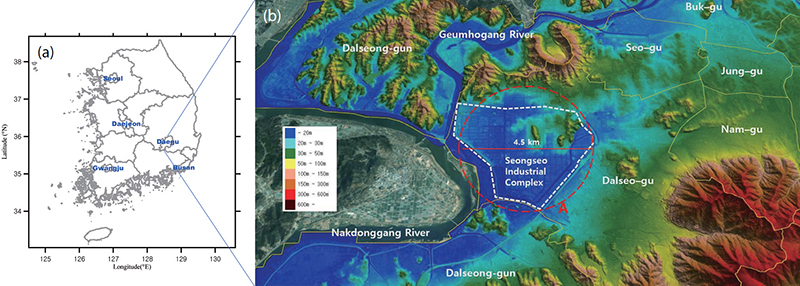
Study area overview: (a) location of Daegu within South Korea and (b) detailed topographic map of the Daegu highlighting the Seongseo Industrial Complex (A).
성서산업단지는 기계, 섬유, 전기·전자, 운송 장비, 석유화학 등 다양한 업종의 사업장이 집적된 대구광역시 대표 산업단지로, 입주 기업 수가 가장 많고 부지 면적도 약 10.3 km2로 가장 넓다(DMC, 2025). 2018년부터 2021년까지 화학물질안전원의 화학물질 배출·이동량 정보(Pollutant Release and Transfer Register, PRTR)에 따르면, 성서산업단지는 toluene과 MEK를 포함한 용제 및 공정 기인 VOC 배출이 두드러지는 지역이다(NICS, 2026). 이와 관련된 PRTR 기반의 연도별 상세 배출량 비교 자료는 보충자료에 제시하였다(표 S1). 이러한 대구 산업단지 지역은 비산단지역에 비해 방향족 VOCs 농도가 현저히 높고, 풍속 감소 시 VOCs 농도가 증가하는 특성을 보이는 것으로 조사되었으며(Yu et al., 2019; Kim et al., 2014), 최근 대구 달성군에 위치한 산업단지를 대상으로 VOCs 분포 특성을 조사한 결과 일부 암유발물질의 농도가 높게 나타나 건강 피해가 우려된다(Min et al., 2025).
이와 같은 대구광역시의 지형적 특징과 성서산업단지의 화학물질 배출 현황을 종합적으로 고려하여, 일반 산업단지 가운데 성서산업단지를 항공관측 연구지역으로 선정하였다.
2. 2 항공관측 및 비행경로
본 연구에 사용된 항공관측은 21인승 Beechcraft B1900D를 기반으로 구축된 대기질 항공관측 플랫폼을 활용하여 수행하였다. 해당 플랫폼은 가스상 및 입자상 대기오염물질을 동시에 측정할 수 있도록 개조 및 검증되었으며, 이전 국내 항공관측 연구에서 활용된 시스템과 동일한 구성으로 운영되었다(Ban et al., 2024; Wong et al., 2024; Kim et al., 2022a; Sarkar et al., 2021; Seo et al., 2019). 항공기에는 외부 공기를 안정적으로 흡입할 수 있도록 설계된 전용 흡입구(inlet)가 장착되었으며, 모든 측정 자료는 GPS 기반 시간 정보와 동기화하여 기록되었다(Park et al., 2023b; Seo et al., 2019).
항공관측의 공간적 범위는 성서산업단지 경계선과 주변 지형을 고려하여 직경 4.5 km의 관측경로를 수립하였다(그림 1(b)의 A). 최초 연구 비행은 2022년 4월 22일과 23일 양 이틀을 계획하였으나, 4월 22일의 경우 안개와 구름의 영향으로 비행을 진행하지 못하였고, 4월 23일 항공관측 기상 조건이 호전되어 오전과 오후에 관측을 수행하였다(표 1). 충남 태안 한서대학교를 기착지로 전체 비행경로와 대구 성서산업단지 상공에서 관측한 자세한 경로를 그림 2에 나타냈다. 대구 성서산업단지 상공에서 비행은 오전 10:15~10:50, 오후 2:40~3:20에 해당한다. 오전 비행에서는 약 340~1,600 m, 오후 비행에서는 340~2,400 m 범위에서 상승·하강 비행을 수행하여 오염물질의 고도별 분포와 수직 구조를 파악하였다. 오전과 오후의 고도 범위를 다르게 설정한 것은 기온 상승에 따라 오전 대비 오후에 PBL이 확장되는 특성을 반영하기 위함으로, 항공관측 시 획득된 기온·습도 등 기상 정보와 측정 장비의 실시간 농도 분포를 종합적으로 고려하여 비행 고도를 결정하였다.

Summary of the research flights.
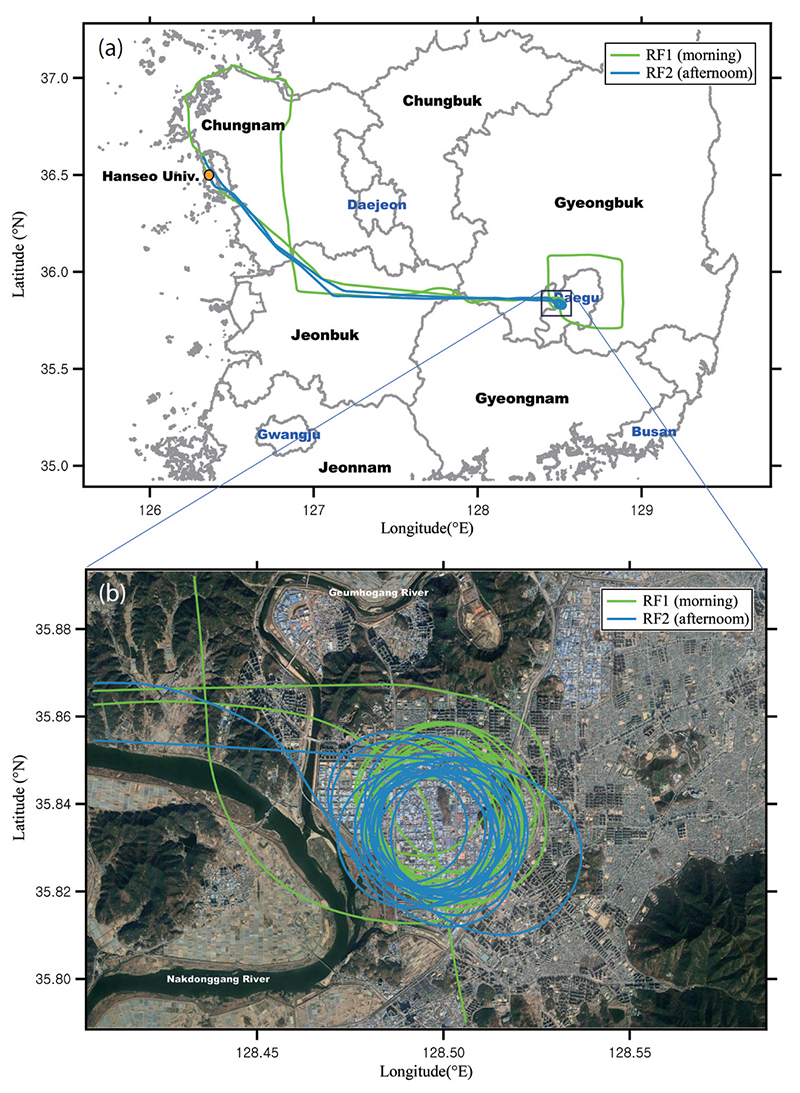
Overview of aircraft observation flight paths: (a) round-trip route from Hanseo university Taean airfield to Daegu and (b) detailed spiral flight patterns over the Seongseo industrial complex during RF1 (morning) and RF2 (afternoon).
2. 3 PM1 측정 분석
High Resolution - Time of Flight - Aerosol Mass Spectrometer(HR-ToF-AMS, AERODYNE, U.S.A.)를 이용하여 PM1 화학성분을 측정하였으며, 항공관측을 위한 Fast Mass Spectrum(FMS) 방법을 적용하였고, 세부 측정 사양은 표 2에 기술하였다(Drewnick et al., 2005). FMS 방법은 1 Hz 간격으로 질량스펙트럼을 수집하는 방식이며, 지상에서 관측하는 방법과 시간 분해능에 차이가 있다(Kimmel et al., 2011). HR-ToF-AMS는 측정 전 유량 교정, 이온화효율 교정, 입자크기 교정을 수행하였다(Park et al., 2023b; DeCarlo et al., 2006). 수집된 자료는 IGOR Pro 상용 소프트웨어(Wavemetrics, USA) 기반에서 ToF-AMS Toolkit(Version UMR 1.65B, HR 1.25B)를 이용하여 처리하였으며, CDCE(Chemical Dependence Collection Efficiency)를 적용하여 유기성분, 질산염, 황산염, 암모늄 및 염소 성분의 최종 농도를 산정하였다(Middlebrook et al., 2012). 유기성분은 원소분석을 통해 원소비(O/C, H/C)를 산정하여 산화 수준을 파악하였다(Canagaratna et al., 2015; Aiken et al., 2008).
Summary of HR-ToF-AMS analytical conditions for the aircraft measurement.
2. 4 VOCs 측정 분석
Proton Transfer Reaction - Time of Flight - Mass Spectrometer(PTR-ToF-MS, IONICON, Austria)를 이용하여 VOCs를 측정하였으며(Jordan et al., 2009), 표 3과 같이 항공관측을 위한 방법을 적용하였다(Müller et al., 2014). 측정 대상 물질은 2021년 우리나라 전체, 대구광역시, 그리고 성서산업단지가 위치한 달서구에서 동시에 대기배출량이 가장 많은 toluene을 우선 고려하였다. 이와 함께 달서구에서 화학물질 가운데 4순위로 집계되었지만, VOCs 중에서는 toluene 다음으로 대기배출량이 높은 methyl ethyl ketone(MEK)를 포함하였다(NICS, 2026). 이외에 PRTR에 집계되지 않았지만, 자동차 배출가스 및 화학 산업 공정에서 불완전 연소의 부산물로 직접 배출되는 acetaldehyde(Liu et al., 2022)와 대기 중 풍부하게 존재하는 산화된 VOCs 지표 물질로 활용되는 acetone을 포함하였다(표 4).
Summary of PTR-ToF-MS analytical conditions for the aircraft measurement.
PTR-ToF-MS (8000) intensity of VOCs compounds.
VOCs 물질별 교정은 캐니스터에 가압된 1 ppm 표준물질(VOCs mixture, IONICON)을 이용하여 Gas Calibration Unit(GCU, IONICON, Austria)를 통해 단계적으로 희석하여 개별 물질에 대한 검량선을 작성하여 농도를 산정하였다(Shin et al., 2024; Park et al., 2018). 표 4에 VOCs 분석 항목에 대하여, 물질별 분류(aldehyde, ketone, aromatic) 및 표준가스에 대한 이온의 감도(intensity, ncps)를 제시하였으며 물질별 교정값은 유의한 수준(R2≥0.999)으로 나타났다.
2. 5 항공기상 자료 및 위치 정보 측정
항공기상 자료와 GPS 정보는 Aircraft Integrated Meteorological Measurement System-20 (AIMM-30, Aventech, Canada)를 이용하였다. 실시간 기온, 상대습도, 풍향 및 풍속이 동시에 수집되었으며, 이들 자료는 항공기 탑재 기상 센서를 통해 측정되었다(Seo et al., 2019). 항공기상 자료는 오전과 오후의 연직 구조 차이, 혼합층 발달, 그리고 오염물질의 수직 확산 특성을 해석하는 데 활용되었다.
3. 결 과
3. 1 항공관측 개관
그림 3에 대구 성서산업단지 상공에서 수행한 항공관측의 오전(RF1)과 오후(RF2) 비행 동안의 전체 측정 결과를 제시하였다. 표 5에는 연구 결과를 대산석유화학단지 항공관측 사례(Kim et al., 2022a)와 비교 정리하였다. 이와 함께 그림 S1과 S2에는 PM1 화학성분과 VOCs의 공간 분포를 보충자료로 제시하였다. 항공관측 비행 고도는 오전 340~1,600 m, 오후 340~2,400 m 범위에서 수행되었으며, 오전에는 동풍(E), 오후에는 남동풍(SE)이 우세하게 나타났다. 평균 풍속은 오전 3.47±0.70 m/s, 오후 4.05±0.87 m/s로 오후에 다소 증가하였다. 기온과 상대습도는 오전 13.15±1.24°C, 31.57±19.82%, 오후 14.18±4.14°C, 44.68±15.46%로 오후에 높은 기온과 습도 조건이 형성되었음을 보여준다.
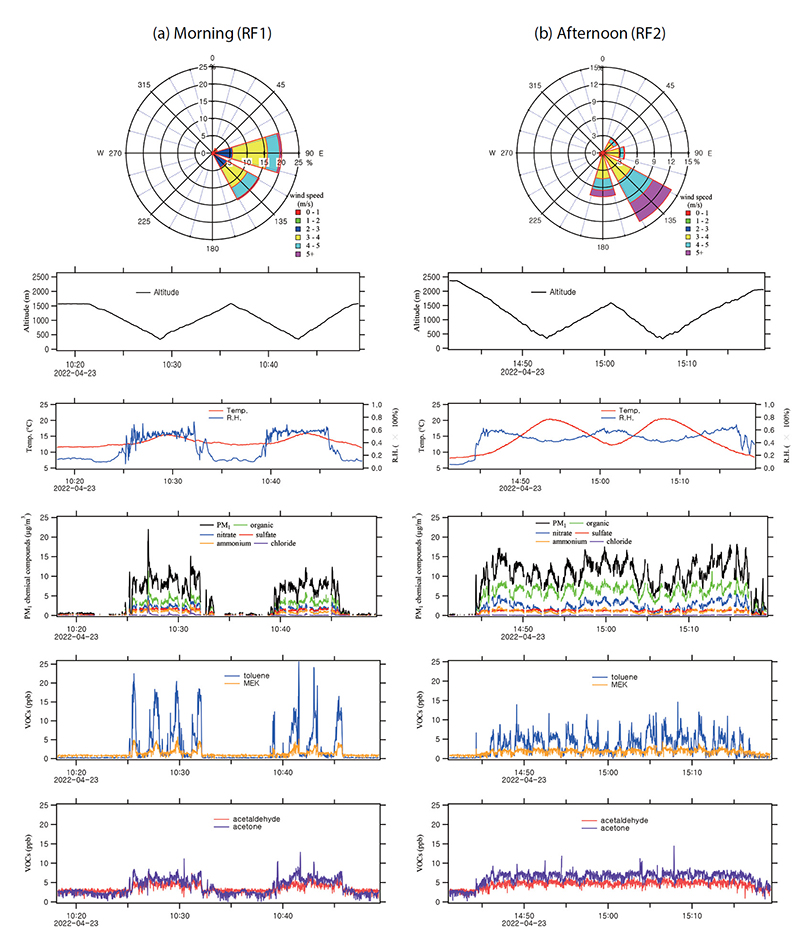
Integrated time series of wind patterns, altitude, meteorological parameters, PM1 chemical composition, and selected VOCs measured during morning (RF1) and afternoon (RF2) aircraft observations over the Seongseo industrial complex, Daegu.
Comparison of meteorological conditions, PM1 chemical composition, and selected VOC concentrations measured over the Seongseo Industrial Complex (morning and afternoon flights) and the Daesan Petrochemical Complex (downwind and upwind conditions).
유기성분, 질산염, 황산염, 암모늄 및 염소 성분을 합한 PM1 평균 농도는 오전 4.22±3.98 µg/m3에서 오후 9.85±4.27 µg/m3로 2배 이상 증가하였다. PM1 농도 수준은 HR-ToF-AMS로 관측한 지상관측 사례와 비교해 보면, 오전 관측 자료는 청정한 시기에 관측된 2018년 여름 수원 6.9 µg/m3(Park et al., 2019), 2018년 가을 서울 5.6 µg/m3(Song et al., 2021)와 유사하고, 오전과 오후 모두 오염 수준이 높은 안산 산업단지에서 관측한 2021년 봄 37.2 µg/m3, 여름 24.9 µg/m3보다 낮은 범위에 수렴한다(Park et al., 2023b). 안산 산업단지의 PM1 농도가 상대적으로 높은 것은 산업 활동과 도시 배출의 직접적인 영향을 받는 지상관측 특성이 강하기 때문으로 해석된다. HR-ToF-AMS를 이용한 지상관측 자료는 주로 1분 또는 5분 시간해상도의 고정지점 측정값이며 본 연구 결과는 1초 간격으로 획득한 항공관측 자료를 전체 비행 고도 범위에 대해 평균한 값이다. 따라서 두 자료는 관측 플랫폼, 시간해상도 및 공간 대표성에서 차이가 있어 직접적인 정량 비교에는 한계가 있으나, 농도 수준의 상대적 범위를 판단하는 데 참고할 수 있다.
PM1 화학성분은 가운데 유기성분은 오전 1.93±1.77 µg/m3, 오후 5.59±2.31 µg/m3로 PM1 증가의 주요 기여 성분으로 작용하였으며, 2016년 봄철 KORUS-AQ 항공관측 결과(NIER, 2020) 및 최근 안산 도심에서 관측한 유기성분이 주도하는 결과와 같은 경향이다(Park et al., 2023b). 그러나 대산 석유화학단지 상공의 풍하 방면에서 측정된 PM1은 질산염(4.8±2.1 µg/m3)이 유기성분(4.3±1.2 µg/m3)보다 높고 PM1 질량농도 증가에 가장 큰 기여 물질로서, 성서산업단지 상공의 PM1 구성과 다른 특성을 나타낸다. 이 결과는 다양한 제조업(기계, 섬유, 전기·전자 등)으로 구성된 성서산업단지와 석유화학업종이 밀집된 대산석유화학단지 두 산업단지에서 오염물질의 배출 특성에 차이를 반영한다. 유기성분의 원소 조성을 나타내는 지표인 O/C(oxygen to carbon atomic ratio)와 H/C(hydrogen to carbon atomic ratio)를 살펴보면, O/C는 오전 0.94±0.45, 오후 0.66±0.22로 감소하였고, H/C는 오전 1.35±0.37, 오후 1.57±0.16으로 증가하였다. 오전과 오후에 유기성분의 산화 및 휘발 수준이 변화하고 있음을 보여준다. 일반적으로 O/C는 유기성분의 산화 정도를, H/C는 수소화 정도 또는 HOA(hydrocarbon-like organic aerosol) 특성을 반영하는 지표로 활용된다(Canagaratna et al., 2015). 따라서 오후에 나타난 O/C 감소와 H/C 증가 경향은 유기성분이 오전보다 덜 산화되고 상대적으로 1차 배출 기원의 영향을 더 크게 받았음을 시사한다(Park et al., 2023a; Kim et al., 2017; Canagaratna et al., 2015). 유기성분의 OM/OC는 PM1의 유기물질(organic matter, OM)에 대한 유기탄소(organic carbon, OC)의 비율을 의미하는 무차원 지표이며, 일반적으로 산화가 진행될수록 -OH, -COH, -COOH 등의 산소함유 작용기가 증가함에 따라 그 값도 커지는 경향을 보인다(Canagaratna et al., 2015). 본 연구에서 OM/OC는 오전 2.26±0.30, 오후 2.04±0.12로 나타나 오후가 오전보다 다소 낮은 경향을 보였으나, 이는 농도가 아닌 비율 지표이며 평균값 차이도 크지 않으므로 뚜렷한 감소로 단정하기보다는 조성 변화의 경향으로 해석하는 것이 적절하다. 유기성분의 O/C, H/C 및 OM/OC 결과를 종합하면, 오전에는 상대적으로 산화된 유기성분의 기여가 크고, 오후에는 성서산업단지의 1차 배출 유기성분 영향이 보다 뚜렷해진 것으로 판단된다.
VOCs 가운데 인위적 VOCs로 toluene과 MEK를 산화된 VOCs로 acetaldehyde, acetone을 측정하였다. 측정한 VOCs는 오전보다 오후 비행에서 농도 수준이 모두 증가하였으며, PM1과 동일한 증가 경향을 나타냈다. VOCs 농도 수준은 오전과 오후 acetone이 가장 높았고, 다음으로 acetaldehyde, toluene, MEK 순서를 나타냈다. 특히 acetone은 오전 3.81±2.02 ppb에서 오후 6.05±1.82 ppb로 증가 폭이 가장 크게 나타났다. PTR-ToF-MS를 이용하여 산업단지 인근 안산에서 봄철 측정된 결과에서도 acetone은 7.76±4.36 ppb로 전체 VOCs 15종 가운데 methanol 다음의 두 번째로 높은 성분이었다(Shin et al., 2024). 우리나라 5개 주요 산업단지에서 측정한 사례에서도 acetone은 시화·반월이 6.14 ppb로 유해대기오염물질 35종과 오존전구물질 56종 가운데 가장 높은 농도를 보였다(Chae et al., 2024). 안산 및 시화·반월 사례와 견주어 성서산업단지에서도 acetone은 VOCs 농도를 견인하는 주요 물질로 확인된다.
Acetone과 함께 acetaldehyde는 carbonyl 화합물에 해당하는 산화 VOC로 오전 3.44±1.02 ppb, 오후 4.42±0.96 ppb로 acetone 다음으로 높은 수준을 나타냈다. 오염도가 높은 안산 산업단지 인근 5.37±2.09 ppb와 대산석유화학단지 주변 6.74±7.03 ppb보다 낮지만, 여름철 청정한 수준의 서울 도심의 1.23±0.97 ppb보다 높은 수준에 해당한다(Park et al., 2018). Acetone과 acetaldehyde는 공식 통계자료인 PRTR을 통해 대구 지역에서 대기배출량은 등록 자료가 없다(NICS, 2026). 즉, PRTR 자료에 공식 등록된 대기배출량은 없으나, 이는 보고 기준 이하이거나 비점오염원 배출 가능성이 있다. 그러나 acetaldehyde는 화학 산업 플랜트, 연소 관련 공정 및 자동차 등에서 직접 대기로 배출되는 불완전 연소 생성물임을 고려하면(Liu et al., 2022; Atkinson, 2000), 성서산업단지에 입주한 기업의 다양한 제조공정과 주변의 이동오염원에서 배출되었을 것으로 추정할 수 있다.
방향족 화합물의 toluene은 오전 2.47±4.50 ppb, 오후 3.22±2.56 ppb로 나타났으며, 대산 석유화학단지 풍하 방면에서 관측된 1.60±0.4 ppb보다 높은 수준이다(Kim et al., 2022a). 우리나라 대규모 산업단지에서 흡착관과 GC-MS를 이용하여 측정 분석한 유해 대기오염물질 가운데 toluene 평균 농도를 살펴보면, 여수·광양 0.93 ppb(n=280), 포항 1.91 ppb(n=224), 대산 0.89 ppb(n=252), 울산·온산 1.15 ppb(n=252), 시화·반월 5.69 ppb(n=168)이며(Chae et al., 2024), 성서산업단지에서 측정한 오전과 오후의 toluene 농도 수준은 시화·반월산업단지보다는 낮지만, 여수·광양, 포항, 대산, 울산·온산보다 높은 수준에 분포하는 것을 알 수 있다. 다만 여기에서 비교한 농도 수준은 시공간적인 차이가 있음에 주의할 필요가 있다. MEK는 측정한 VOCs 가운데 가장 낮은 수준이었으며, 오전 1.29±0.87 ppb, 오후 1.77±0.65 ppb로 오후에 증가하였다. Toluene과 MEK는 대구 성서산업단지(달서구)에서 대기배출량이 많은 상위 물질이며, 2021년 toluene 567,779 kg/year(1위)와 MEK 120,234 kg/year(3위) 대기배출량 비율은 약 4.72이다(표 S1). 성서산업단지 상공에서 관측한 Toluene(ppb)/MEK(ppb) 비는 오전 1.91, 오후 1.82로 2021년 대기배출량 비율과 차이가 있으나, toluene의 대기배출량이 높다는 것을 확인할 수 있다.
다만, 본 연구는 동일 일자 내 오전과 오후 두 차례 비행에 기반한 결과로, 장기 평균적 특성을 대표한다고 보기에는 한계가 있다. 또한 항공관측 자료는 수직 평균값을 포함하므로 지상 고정관측과 직접 비교에는 주의가 필요하다. 따라서 향후 반복 관측과 지상 자료의 병행 분석을 통해 시공간적 대표성을 보완할 필요가 있다.
3. 2 산업단지 상공 고도별 분포 특성
성서산업단지 상공에서 관측된 PM1 및 VOCs 수직 분포 특성을 살펴보기 위하여, 기온 및 상대습도 프로파일을 기반으로 대기경계층(planetary boundary layer, PBL)과 자유대기(free troposphere, FT)를 구분하였다. PBL과 FT 사이에서 온위(potential temperature)와 습도의 급격한 변화가 나타나는 전이구간을 유입층(Entrainment Zone, EZ)으로 정의할 수 있다(Kang et al., 2021; Li et al., 2019b). 본 연구에서는 온위 자료가 제한되어 상대습도의 급격한 감소 구간을 EZ의 지표로 활용하였다. 기온과 상대습도에 대한 수직 분포를 그림 4의 (a)와 (b)에 나타냈다. 기온은 오전과 오후 모두 고도가 증가함에 따라 감소하였다. 오전과 오후의 하층(약 300~800 m)에서 온도 분포는 오후가 높았으며, 이는 일사에 의한 지표 가열 효과가 반영된 결과로 볼 수 있다. 상대습도는 기온과 다른 양상을 나타냈다. 오전의 경우 고도 증가에 따라 상대습도가 점진적으로 감소하였지만, 오후에는 고도에 따라 함께 증가하며 1,800~1,900 m 구간 이후 급격히 감소하였다. 본 연구에서는 상대습도의 급격한 감소 구간을 PBL과 FT의 전이구간으로 추정하였으며, 오전 1,100~1,200 m, 오후 2,000~2,100 m로 확인된다. 이 추정치는 도시 지역인 서울과 부산 지역을 대상으로 년 중 PBL 고도 변화를 분석한 사례에서 4월 평균 1,800 m 범위를 나타낸 결과에 수렴한다(Kim et al., 2024).
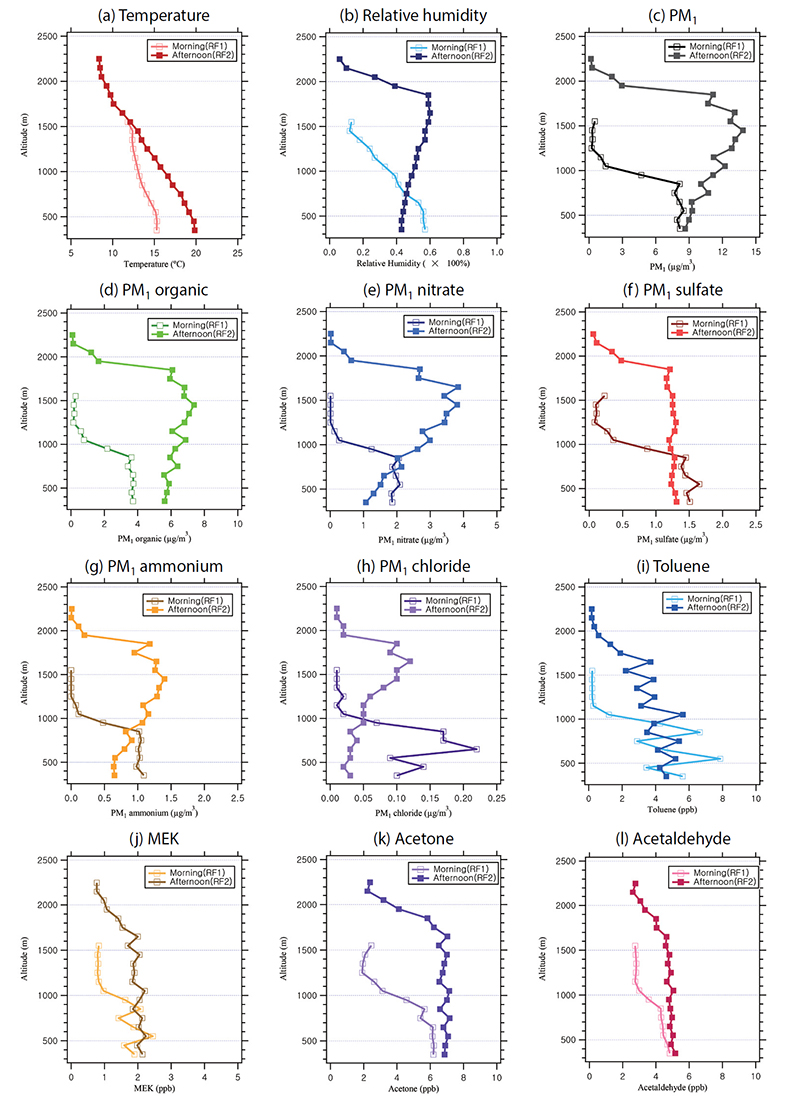
Vertical profiles of mean temperature, humidity, PM1 chemical components (organic, nitrate, sulfate, ammonium, chloride) and VOCs (toluene, MEK, acetone, acetaldehyde) in 100 m altitude bins measured during morning (RF1) and afternoon (RF2) aircraft observations over the Seongseo Industrial Complex.
그림 4의 (c)~(h)는 PM1과 화학성분(유기성분, 질산염, 황산염, 암모늄, 염소 성분)의 100 m 간격의 평균 수직 분포를 보여준다. 오전에는 800~1,000 m 구간을 경계로 하층 중심의 분포를 나타내고, 오후에는 1,800~2,000 m까지 확장된 특징을 나타낸다. PM1 농도는 오전 400~800 m에서 7.65~8.51 µg/m3 범위에서 일정한 수준을 유지하였으며, 800~900 m 구간을 지나며 급격히 감소하여 고도 1,000 m 이상에서는 1.49 µg/m3보다 낮은 수준이었다. 오후에는 1,200~1,600 m에서 최대농도 구간(12.71~13.84 µg/m3)이 형성되었으며, 전 고도 구간에서 오전 대비 높은 농도 수준을 유지하였다.
유기성분은 오전과 오후 PM1 수직 분포에서 농도 증가의 주요 기여 성분으로 파악된다(그림 S3). 오전에는 고도 800 m 이내에서 일정한 수준(3.41~3.74 µg/m3)을 유지하였으며, 오후에는 1,400~1,600 m 구간에서 최대농도 구간(6.78~7.38 µg/m3)이 형성되었다. 유기성분의 증가 폭이 가장 크다는 점은 PM1 질량 증가가 유기물 중심으로 이루어졌음을 나타낸다. 질산염은 오전에 하층에서 상대적으로 높은 값을 보였으나, 오후에는 중층에서 뚜렷한 농도 증가가 나타났다. 특히 1,400~1,600 m 고도에서 최대농도 수준이 관측되었으며, 암모늄과 동반 증가 양상을 보였다. 한편, 같은 고도 구간에서 황산염도 함께 존재하였으나, 고도별 변동성은 상대적으로 완만한 특징을 나타냈다. 황산염은 대체로 비휘발성이며 상대적으로 안정한 물질이며(Vasilakos et al., 2018), 질산염은 주로 준휘발성인 NH4NO3 형태로 존재하여 온도, 상대습도, 에어로졸 pH 및 액상수분 조건에 따라 입자상 분배가 민감하게 달라질 수 있다(Wu et al., 2022; Nenes et al., 2020). 따라서 본 연구에서 관측된 질산염과 암모늄의 동반 증가는 해당 고도에서 질산암모늄(NH4NO3)의 형성, 즉 2차 생성 또는 가스-입자 분배에 따른 입자상 전환 가능성을 시사한다. 염소 성분은 전체 PM1 구성 중 가장 낮은 농도 분포(<0.25 µg/m3)를 나타냈다. 다른 성분들과 달리 오전 600~700 m 구간에서 급격히 증가하는 현상이 나타났는데, 혼합층 내부에서 특정 연소 배출 플룸의 직접적인 영향을 받은 것으로 추정된다.
그림 4의 (i)~(l)은 toluene, MEK, acetone, acetaldehyde의 분포를 나타낸다. VOCs는 PM1 화학성분과 마찬가지로 오전에는 하층 중심으로 분포하였으나, 오후에는 중·상층까지 분포가 확장되어 혼합층 발달에 따라 연직 분포 범위가 달라지는 경향을 보였다. Toluene은 산업단지 배출 특성을 반영하는 대표적인 1차 방향족 VOC로서, 오전에는 혼합층 내부 하층에서 상대적으로 높은 농도가 관측되고 고도 증가에 따라 감소하는 경향을 보였다. 반면 오후에는 toluene 농도 분포가 수직 확장되었으며, 산업단지 배출 플룸이 오후에 상층으로 확산되었음을 시사한다. MEK 역시 산업단지에서 배출되는 인위적 VOC로, toluene과 유사하게 오전에는 하층 중심 분포를 보이며 오후에는 중층까지 확장되는 경향을 나타냈다. MEK는 toluene에 비해 농도 수준이 낮고 변동 폭이 상대적으로 작게 나타났다. 이는 두 물질의 배출 규모 차이와 함께 대기 중 반응 및 확산 특성의 차이가 복합적으로 작용한 결과로 볼 수 있다. Acetone은 비교적 수명이 길고 광역적 배경 및 광화학 영향이 큰 산화 VOC로서(Singh et al., 1994), 오전과 오후 모두에서 상대적으로 높은 농도 수준을 보였다. 특히 오후에는 혼합층 발달과 함께 중층까지 농도가 일정 수준에서 유지되는 안정된 경향이 나타났다. Acetaldehyde는 반응성이 큰 carbonyl 화합물로 1차 배출과 2차 생성의 영향을 동시에 받을 수 있는데 오전에는 하층 중심 분포를 보였으며, 오후에는 acetone과 유사한 수직 분포 경향을 보였다.
경계층 이론에 따르면, 오전에서 오후에 걸쳐 혼합층이 성장하면 지표 부근에서 배출된 오염물질은 난류 혼합에 의해 상층으로 재분포되며, 혼합층 상단 인접 구간에서는 상대적으로 농도가 강화되는 구조가 형성될 수 있다(Stull, 1988). 그림 3의 시계열을 보면, 오전에는 항공기 고도가 낮아져 성서산업단지 상공을 통과하는 구간에서 PM1과 toluene, MEK 등의 농도가 단속적이고 국지적인 피크 형태로 뚜렷하게 증가하여 산업단지 플룸의 직접 영향이 비교적 명확하게 나타났다. 반면 오후에는 산업단지 상공과 주변 지역의 구분이 뚜렷하지 않을 정도로 PM1 및 VOCs의 농도 증가가 보다 넓은 구간에서 연속적으로 관측되었으며, 이는 오전에 비해 오염물질이 수직·수평으로 더 광범위하게 확산되었음을 시사한다. 보충자료의 그림 S1과 S2에서도 오전에는 성서산업단지 상공의 제한된 영역에서 고농도 구간이 국지적으로 분포한 반면, 오후에는 고농도 영역이 비행 경로 전반으로 확장되어 보다 연속적인 분포로 전환되는 특징이 확인되었다. 그러므로 성서산업단지 상공에서 오전과 오후에 관측한 PM1 및 VOCs의 수직 확장 특성은 혼합층 성장과 EZ 인접 구간에서의 수직 재분포, 그리고 산업단지 배출 영향이 복합적으로 작용한 결과로 해석할 수 있다. 그러나 본 연구에서 제시한 혼합층 및 EZ 추정은 상대습도 수직 구조를 기반으로 한 진단적 접근에 해당하며, 온위 기반의 정량적 경계층 산정이 병행되지 못한 한계가 있다. 또한 오전과 오후 비행의 최대고도 범위가 달라 중·상층 농도 구조 비교 시 관측 범위 차이에 따른 영향이 존재할 수 있다. 그러므로 향후 연구에서는 기압 자료를 활용한 온위 기반 PBL 산정, 항공관측 및 지상관측 자료와의 통합 분석을 통해 혼합층 성장과 오염물질 수직 분포의 정량적 관계를 규명할 필요가 있다.
4. 결론 및 고찰
본 연구에서는 2022년 4월 23일 대구 성서산업단지 상공에서 항공관측을 수행하여 오전과 오후 시간대에 따른 PM1 화학성분 및 VOCs의 수직 분포 특성을 분석하였으며, 주요 결과를 정리하면 다음과 같다.
기온 및 상대습도 수직 프로파일을 기반으로 혼합층(PBL) 구조를 진단한 결과, 상대습도의 급격한 감소 구간은 오전 약 1,100~1,200 m, 오후 약 2,000~2,100 m에서 나타나 오후에 혼합층이 뚜렷하게 확장된 것으로 확인되었다. 이는 분지 지형을 가진 대구 지역에서 주간 일사에 따른 지표 가열과 난류 혼합 강화가 혼합층 발달을 유도하였음을 시사한다.
PM1 평균 농도는 오전 4.22±3.98 µg/m3에서 오후 9.85±4.27 µg/m3로 약 2배 이상 증가하였다. 수직 분포 측면에서 오전에는 800~1,000 m 이하 하층 중심의 축적형 구조를 보인 반면, 오후에는 약 1,200~1,600 m 구간에서 최대농도(13.84 µg/m3)가 형성되고 1,800~2,000 m까지 확장되는 구조가 나타났다. PM1 화학성분의 구성은 유기성분의 비중이 가장 높고 다음으로 질산염, 황산염, 암모늄, 염소 성분 순서를 나타냈으며, 오전과 오후 전 고도에서 유기성분이 비중이 가장 높은 특징을 나타냈다. 유기성분은 PM1 증가를 주도한 주요 성분으로, 오후 1,400~1,600 m에서 최대(7.38 µg/m3)를 나타냈다. 유기성분에 대한 원소분석을 통해 파악한 산화(O/C) 및 휘발(H/C) 수준을 통해 오전보다 오후에 성서산업단지 상공에서 1차로 배출된 유기성분의 영향이 증가한 것으로 파악되었다. 질산염과 암모늄은 오후 동일 고도 구간에서 동반 증가하여 질산암모늄 형태의 2차 생성 가능성을 시사하였다. 반면 황산염은 상대적으로 완만한 수직 분포를 보여 광역적 배경 기여 가능성이 큰 것으로 해석된다. 염소 성분은 전체 PM1 구성 중 가장 낮은 농도를 보였으나, 오전 600~700 m에서 국지적 증가가 관측되어 혼합층 내부에서 특정 연소 배출 플룸의 직접적 영향 가능성이 제기된다.
VOCs 또한 오전에는 하층 중심 분포, 오후에는 중·상층으로 확장되는 구조를 나타냈다. VOCs 농도 수준은 acetone>acetaldehyde>toluene>MEK 순으로 나타났으며, 특히 acetone은 오전(3.81±2.02 ppb) 대비 오후(6.05±1.82 ppb)에 가장 큰 증가 폭을 보여 성서산업단지 상공에서 지배적인 산화 VOC로 확인되었다. 성서산업단지에서 대기배출량이 높은 toluene과 MEK는 오전 비행에서 특정 고도 구간에서 반복적인 농도 증가가 나타나 배출원 플룸의 영향을 반영한 것으로 판단된다. 반면 acetone과 acetaldehyde는 비교적 높은 농도 수준을 유지하면서 중층까지 확장되는 특징을 보여, 광역적 배경 농도 및 광화학 반응의 영향을 동시에 반영하는 것으로 해석된다. 특히 시계열 및 고도별 분포를 종합하면, 오전에 하층에 축적되거나 배출된 PM1 및 VOCs가 오후에는 혼합층 발달과 난류 혼합의 영향으로 중·상층까지 재분포되며, 수직·수평으로 보다 넓은 공간 범위에 영향을 미친 것으로 해석된다. 이는 산업단지 배출의 영향이 오전의 국지적 축적 단계에서 오후의 광범위한 확산 단계로 전환될 수 있음을 보여준다.
종합하면, 오전과 오후의 PM1 화학성분과 VOCs 수직 분포 변화는 혼합층 성장과 유입층(EZ) 인접 구간에서의 수직 재분포, 그리고 산업단지 배출 특성이 복합적으로 작용한 결과로 이해할 수 있다. 특히 오전에 배출되거나 축적된 오염물질이 오후에는 보다 넓은 고도와 공간 범위로 확산된다는 점은, 산업단지 배출 영향이 지표면 인근에 국한되지 않고 시간대에 따라 상공까지 확대될 수 있음을 시사한다. 이는 지상관측만으로는 파악하기 어려운 산업단지 상공의 수직 이질성과 시간대별 확산 특성을 항공관측을 통해 실증적으로 제시하였다는 점에서 의미가 있다. 비록 본 연구는 오전·오후 2회 비행 사례에 대한 분석이라는 제한점이 있으나, 확보된 항공관측 자료는 향후 대기질 모델 검증과 지상관측 자료 보완에 활용될 수 있으며, 산업단지 영향 평가의 정밀도 향상과 시간대별 배출 관리 정책 수립에 기초자료로 기여할 수 있다. 또한 향후에는 보다 충분한 항공관측 기간을 확보하여 산업단지 상공 관측을 확대하고, 지상관측과 병행함으로써 배출 및 확산 특성을 종합적으로 분석할 필요가 있다.
Acknowledgments
본 연구는 환경부의 재원으로 국립환경과학원의 지원을 받아 수행된 과제의 일부 결과이며, 이에 감사드립니다(입체관측사업: NIER-2022-01-01-100).
References
-
Aiken, A.C., DeCarlo, P.F., Kroll, J.H., Worsnop, D.R., Huffman, J.A., Docherty, K.S., Ulbrich, I.M., Mohr, C., Kimmel, J.R., Sueper, D., Sun, Y., Zhang, Q., Trimborn, A., Northway, M., Ziemann, P.J., Canagaratna, M.R., Onasch, T.B., Alfarra, M.R., Prevot, A.S.H., Dommen, J., Duplissy, J., Metzger, A., Baltensperger, U., Jimenez, J.L. (2008) O/C and OM/OC Ratios of Primary, Secondary, and Ambient Organic Aerosols with High-Resolution Time-of-Flight Aerosol Mass Spectrometry, Environmental Science & Technology, 42(12), 4478-4485.
[https://doi.org/10.1021/es703009q]

-
Atkinson, R. (2000) Atmospheric chemistry of VOCs and NOx, Atmospheric Environment, 34, 2063-2101.
[https://doi.org/10.1016/S1352-2310(99)00460-4]
-
Atkinson, R., Arey, J. (2003) Atmospheric degradation of volatile organic compounds, Chemical Reviews, 103(12), 4605-1638.
[https://doi.org/10.1021/cr0206420]
-
Ban, J., Park, T., Kang, S., Choi, S., Wong, G., Choi, J., Seo, B.-K., Kim, S., Ahn, J., Lim, Y., Sung, M., Jung, S., Jung, J., Kim, H., Park, S.-M., Lee, J., Kim, J., Kim, J., Park, S.B., Park, J., Lee, T. (2024) Impact of biomass burning on air quality: A case study of the agricultural region in South Korea, Atmospheric Environment, 339, 120864.
[https://doi.org/10.1016/j.atmosenv.2024.120864]
-
Canagaratna, M.R., Jimenez, J.L., Kroll, J.H., Chen, Q., Kessler, S.H., Massoli, P., Hildebrandt Ruiz, L., Fortner, E., Williams, L.R., Wilson, K.R., Surratt, J.D., Donahue, N.M., Jayne, J.T., Worsnop, D.R. (2015) Elemental ratio measurements of organic compounds using aerosol mass spectrometry: Characterization, improved calibration, and implications, Atmospheric Chemistry and Physics, 15(1), 253-272.
[https://doi.org/10.5194/acp-15-253-2015]
-
Chae, J.-S., Chae, J.-S., Jeon, J.-M., Kang, B.-W., Kim, J.-H., Moon, K.-J., Park, G.-T., Kang, D.-I. (2024) The Study on Emission Characteristics of Gas-phase Hazardous Air Pollutants Generated at the Large-scale Industrial Complexes, Journal of Korean Society for Atmospheric Environment, 40(1), 27-47, (in Korean with English abstract).
[https://doi.org/10.5572/KOSAE.2024.40.1.27]
-
Crawford, J.H., Ahn, J.-Y., Al-Saadi, J., Chang, L., Emmons, L.K., Kim, J., Lee, G., Park, J.-H., Park, R.J., Woo, J.H., Song, C.-K., Hong, J.-H., Hong, Y.-D., Lefer, B.L., Lee, M., Lee, T., Kim, S., Min, K.-E., Yum, S.S., Shin, H.J., Kim, Y.-W., Choi, J.-S., Park, J.-S., Szykman, J.J., Long, R.W., Jordan, C.E., Simpson, I.J., Fried, A., Dibb, J.E., Cho, S.Y., Kim, Y.P. (2021) The Korea-United States Air Quality (KORUS-AQ) field study, Elementa: Science of the Anthropocene, 9(1), 1-27.
[https://doi.org/10.1525/elementa.2020.00163]
- Daegu Metropolitan City (DMC) (2025) Status of industrial complexes in Daegu. https://www.daegu.go.kr/eco/index.do?menu_id=00001149, (accessed on Jan. 3, 2026).
-
DeCarlo, P.F., Kimmel, J.R., Trimborn, A., Northway, M.J., Jayne, J.T., Aiken, A.C., Gonin, M., Fuhrer, K., Horvath, T., Docherty, K.S., Worsnop, D.R., Jimenez, J.L. (2006) Field-deployable, high-resolution, time-of-flight aerosol mass spectrometer, Analytical Chemistry, 78(24), 8281-8289.
[https://doi.org/10.1021/ac061249n]
-
Drewnick, F., Hings, S.S., DeCarlo, P., Jayne, J.T., Gonin, M., Fuhrer, K., Weimer, S., Jimenez, J.L., Demerjian, K.L., Borrmann, S., Worsnop, D.R. (2005) A new time-of-flight aerosol mass spectrometer (TOF-AMS) instrument description and first field deployment, Aerosol Science and Technology, 39(7), 637-658.
[https://doi.org/10.1080/02786820500182040]
-
Hallquist, M., Wenger, J.C., Baltensperger, U., Rudich, Y., Simpson, D., Claeys, M., Dommen, J., Donahue, N.M., George, C., Goldstein, A.H., Hamilton, J.F., Herrmann, H., Hoffmann, T., Iinuma, Y., Jang, M., Jenkin, M.E., Jimenez, J.L., Kiendler-Scharr, A., Maenhaut, W., McFiggans, G., Mentel, Th. F., Monod, A., Prévôt, A.S.H., Seinfeld, J.H., Surratt, J.D., Szmigielski, R., Wildt, J. (2009) The formation, properties and impact of secondary organic aerosol: Current and emerging issues, Atmospheric Chemistry and Physics, 9, 5155-5236.
[https://doi.org/10.5194/acp-9-5155-2009]
-
Han, S., Liu, J., Hao, T., Zhang, Y., Li, P., Yang, J., Wang, Q., Cai, Z., Yao, Q., Zhang, M., Wang, X. (2018) Boundary layer structure and scavenging effect during a typical winter haze-fog episode in a core city of BTH region, China, Atmospheric Environment, 179, 187-200.
[https://doi.org/10.1016/j.atmosenv.2018.02.023]
-
Heald, C.L., Kroll, J.H., Jimenez, J.L., Docherty, K.S., DeCarlo, P.F., Aiken, A.C., Chen, Q., Martin, S.T., Farmer, D.K., Artaxo, P. (2010) A simplified description of the evolution of organic aerosol composition in atmosphere, Geophysical Research Letters, 37, L08803.
[https://doi.org/10.1029/2010GL042737]
-
Hyslop, N. (2009) Impaired visibility: the air pollution people see, Atmospheric Environment, 43(1), 182-195.
[https://doi.org/10.1016/j.atmosenv.2008.09.067]
-
Jordan, A., Haidacher, S., Hanel, G., Hartungen, E., Märk, L., Seehauser, H., Schottkowsky, R., Sulzer, P., Märk, T.D. (2009) A high resolution and high sensitivity proton-transfer-reaction time-of-flight mass spectrometer (PTR-TOF-MS), International Journal of Mass Spectrometry, 286(2-3), 122-128.
[https://doi.org/10.1016/j.ijms.2009.07.005]
-
Jung, S.P., Lee, C.K., Kim, J.H., Yang, H.J., Yun, J.H., Ko, H.J., Hong, S.E., Kim, S.B. (2018) Thermodynamic characteristics of snowfall clouds using dropsonde data during ICE-POP 2018, Atmosphere, 30(1), 31-46, (in Korean with English abstract).
[https://doi.org/10.14191/Atmos.2020.30.1.031]
-
Jung, W., Chang, K.-H., Ko, A.-R., Ku, J.M., Ro, Y., Chae, S., Cha, J.W., Lee, C. (2021) Meteorological conditions for the cloud seeding experiment by aircraft in Korea, Journal of Environmental Science International, 30(12), 1027-1039, (in Korean with English abstract).
[https://doi.org/10.5322/JESI.2021.30.12.1027]
-
Kampa, M., Castanas, E. (2008) Human health effects of air pollution, Environmental Pollution, 151(2), 362-367.
[https://doi.org/10.1016/j.envpol.2007.06.012]
-
Kang, Y., Lim, S., Lee, M., Yoo, H.-J. (2021) Vertical distributions of refractory black carbon over the yellow sea during the spring 2020, Journal of Korean Society for Atmospheric Environment, 37(5), 710-728, (in Korean with English abstract).
[https://doi.org/10.5572/KOSAE.2021.37.5.710]
-
Kim, D., Son, K., Baek, S. (2019) A study on the development of Daegu air pollution map based on geographic information system, Journal of Daegu Gyeongbuk Studies, 18(3), 25-47, (in Korean with English abstract).
[https://doi.org/10.23029/jdgs.2019.18.3.25]
-
Kim, E.-K., Song, H.-B., Park, M.-S., Lim, J.-K., Kwon, J.-D., Choi, S.-J., Park, S.-K., Han, G.-H. (2014) The concentrations of ambient VOCs at industrial complex area in Daegu city, Journal of Korean Society of Environmental Engineers, 36(7), 498-505, (in Korean with English abstract).
[https://doi.org/10.4491/KSEE.2014.36.7.498]
-
Kim, H., Choi, J., Ahn, J., Kim, J., Lee, T., Cho, S., Park, J. (2022b) A Study on the Characteristics of Aerosol Chemical Components Over the Seoul Air-Shed ( I ) - Chemical Evolution of PM-1.0, Journal of the Korean Society of Urban Environment, 22(2), 91-99, (in Korean with English abstract).
[https://doi.org/10.33768/ksue.2022.22.2.91]
-
Kim, H., Park, J., Choi, J., Choi, S., Ahn, J., Kim, J., Cho, S. (2022a) A Study on the Characteristics of Aerosol Chemical Components Over the Large Emission Sources in Chungcheongnam-do, Journal of the Korean Society of Urban Environment, 22(3), 119-128, (in Korean with English abstract).
[https://doi.org/10.33768/ksue.2022.22.3.119]
- Kim, J.-H., Park, J.-S., Choi, J.-S., Park, J.-S., Park, S.-M., Song, I.-H., Shin, H.-J., Ahn, J.-Y., Kim, S.-D. (2017) A Study on the Characteristics of PM1.0 and source of organic components during summertime at Seoul and Baengnyeong Island, Journal of Korean Society of Urban Environment, 17(3), 213-220, (in Korean with English abstract).
-
Kim, M.-S., Oh, S.-S., Park, M.-S., Kang, M., Um, J., Jo, H.-Y., Kim, C.-H. (2024) Characteristics of Seasonal Variations of Planetary Boundary Layer Heights in Busan: A Comparative Study of Busan vs. Seoul Metropolitan Area (VI), Journal of Environmental Science International, 33(12), 883-889, (in Korean with English abstract).
[https://doi.org/10.5322/JESI.2024.33.12.883]
-
Kimmel, J.R., Farmer, D.K., Cubison, M.J., Sueper, D., Tanner, C., Nemitz, E., Worsnop, D.R., Gonin, M., Jimenez, J.L. (2011) Real-time aerosol mass spectrometry with millisecond resolution, International Jounal of Mass Spectrometry, 303(1), 15-26.
[https://doi.org/10.1016/j.ijms.2010.12.004]
-
Kroll, J.H., Seinfeld, J.H. (2008) Chemistry of secondary organic aerosol: Formation and evolution of low-volatility organics in the atmosphere, Atmospheric Environment, 42(16), 3593-3624.
[https://doi.org/10.1016/j.atmosenv.2008.01.003]
- Li, S., Goo, T.-Y., Moon, H., Labzovskii, L., Kenea, S.T., Oh, Y.-S., Lee, H., Byun, Y.-H. (2019b) Airborne In-Situ Measurement of CO2 and CH4 in Korea: Case Study of Vertical Distribution Measured at Anmyeon-Do in Winter, Atmosphere, 29(5), 511-523.
-
Li, X., Hu, X.-M., Ma, Y., Wang, Y., Li, L., Zhao, Z. (2019a) Impact of planetary boundary layer structure on the formation and evolution of air-pollution episodes in Shenyang, Northeast China, Atmospheric Environment, 214, 116850.
[https://doi.org/10.1016/j.atmosenv.2019.116850]
-
Liu, Q., Gao, Y., Huang, W., Ling, Z., Wang, Z., Wang, X. (2022) Carbonyl compounds in the atmosphere: A review of abundance, source and their contributions to O3 and SOA formation, Atmospheric Research, 274(15), 106184.
[https://doi.org/10.1016/j.atmosres.2022.106184]
-
Ma, Q., Wu, Y., Zhang, D., Wang, X., Xia, Y., Liu, X., Tian, P., Han, Z., Xia, X., Zhang, R. (2017) Roles of regional transport and heterogeneous reactions in the PM2.5 increase during winter haze episodes in Beijing, Science of The Total Environment, 599-600, 246-253.
[https://doi.org/10.1016/j.scitotenv.2017.04.193]
-
Middlebrook, A.M., Bahreini, R., Jimenez, J.L., Canagaratna, M.R. (2012) Evaluation of composition-dependent collection efficiencies for the Aerodyne aerosol mass spectrometer using field data, Aerosol Science and Technology, 46(3), 258-271.
[https://doi.org/10.1080/02786826.2011.620041]
-
Min, G., Lee, S., Kim, D., Choe, Y., Shin, J., Yang, W. (2025) Health Risk Assessment and Source Tracking of Hazardous Air Pollutants in the Dalseong-gun Industrial Complex of Daegu, Journal of Environmental Health Sciences, 51(1), 29-37, (in Korean with English abstract).
[https://doi.org/10.5668/JEHS.2025.51.1.29]
-
Müller, M., Mikoviny, T., Feil, S., Haidacher, S., Hanel, G., Hartungen, E., Jordan, A., Märk, L., Mutschlechner, P., Schottkowsky, R., Sulzer, P., Crawford, J.H., Wisthaler, A. (2014) A compact PTR-ToF-MS instrument for airborne measurements of volatile organic compounds at high spatiotemporal resolution, Atmospheric Measurement Techniques, 7, 3763-3772.
[https://doi.org/10.5194/amt-7-3763-2014]
- National Institute of Chemical Safety (NICS) (2026) Ministry of Climate, Energy and Environment, Republic of Korea. Chemical Information System. https://icis.mcee.go.kr/, (accessed on Jan. 2, 2026).
- National Institute of Environmental Research (NIER) (2020) KORUS-AQ final science synthesis report (NIER-GP 2020-121). Incheon, Republic of Korea. https://espo.nasa.gov/sites/default/files/documents/5858210.pdf, (accessed on Jan. 2, 2026).
-
Nault, B.A., Campuzano-Jost, P., Day, D.A., Schroder, J.C., Anderson, B., Beyersdorf, A.J., Blake, D.R., Brune, W.H., Choi, Y., Corr, C.A., de Gouw, J.A., Dibb, J., DiGangi, J.P., Diskin, G.S., Fried, A., Huey, L.G., Kim, M.J., Knote, C.J., Lamb, K.D., Lee, T., Park, T., Pusede, S.E., Scheuer, E., Thornhill, K.L., Woo, J.H., Jimenez, J.L. (2018) Secondary organic aerosol production from local emissions dominates the organic aerosol budget over Seoul, South Korea, during KORUS-AQ, Atmospheric Chemistry and Physics, 18, 17769-17800.
[https://doi.org/10.5194/acp-18-17769-2018]
-
Nenes, A., Pandis, S.N., Weber, R.J., Russell, A. (2020) Aerosol pH and liquid water content determine when particulate matter is sensitive to ammonia and nitrate availability, Atmospheric Chemistry and Physics, 20(5), 3249-3258.
[https://doi.org/10.5194/acp-20-3249-2020]
-
Park, G., Kim, K., Kang, S., Park, T., Ban, J., Lee, T. (2019) The Characteristics and Formation of Potential Secondary Aerosol (PSA) using an Oxidation Flow Reactor (OFR) in the Summer: Focus on the Residential Area, Suwon, Journal of Korean Society for Atmospheric Environment, 35(6), 786-801, (in Korean with English abstract).
[https://doi.org/10.5572/KOSAE.2019.35.6.786]
-
Park, J., Choi, J., Ahn, J., Sung, M., Jo, Y., Seong, J., Jung, J., Lee, T., Park, J.M., Park, T., Kim, J., Kang, S., Lee, T.(2025) Chemical characteristics of submicron particles in the Yellow Sea of Korea using aircraft measurements during the 2019-2023 period, Environmental Research, 287, 123148.
[https://doi.org/10.1016/j.envres.2025.123148]
-
Park, J.-S., Kim, J.B., Shin, S.-H., Kim, P., Kim, C.H., Hwang, K., Lee, J., Cho, S., Kim, J. (2023a) Characteristics of seasonal PM1 chemical components in the urban area of Ansan, Journal of Environmental Analysis, Health and Toxicology, 26(3), 97-109, (in Korean with English abstract).
[https://doi.org/10.36278/jeaht.26.3.97]
- Park, J-.S., Song, I-.H., Kim, H.-W., Lim, H.-B., Park, S.-M., Shin, S.-N., Shin, H.-J., Lee, S.-B., Kim, J.-S., Kim, J.-H. (2018) Characteristics of Diurnal Variation of Volatile Organic Compounds in Seoul, Korea during the Summer Season, Journal of the Korean Society for Environmental Analysis, 21(4), 264-280, (in Korean with English abstract).
-
Park, T., Ban, J., Ahn, J.Y., Lee, T., Park, J. (2023b) Review and Recommendations of Domestic and International Research on Aircraft-based Measurements for Air Pollutants, Journal of Korean Society for Atmospheric Environment, 39 (5), 723-750, (in Korean with English abstract).
[https://doi.org/10.5572/KOSAE.2023.39.5.723]
-
Sarkar, C., Wong, G., Mielnik, A., Nagalingam, S., Gross, N.J., Guenther, A.B., Lee, T., Park, T., Ban, J., Kang, S., Park, J.-S., Ahn, J., Kim, D., Kim, H., Choi, J., Seo, B.-K., Kim, J.-H., Kim, J.-H., Park, S.B., Kim, S. (2021) Unexplored volatile organic compound emitted from petrochemical facilities: implications for ozone production and atmospheric chemistry, Atmospheric Chemistry and Physics, 21, 11505-11518.
[https://doi.org/10.5194/acp-21-11505-2021]
-
Seo, B.-K., Park, S.b., Lee, D., Yu, M., Yu, J., Bae, K.-N., Ahn, J., Park, J., Kim, S., Lee, T., Kim, J. (2019) Airborne Inlets and Instrumentation on Aircraft Platform for Air Quality Observation, Journal of Korean Society for Atmospheric Environment, 35, 815-830, (in Korean with English abstract).
[https://doi.org/10.5572/KOSAE.2019.35.6.815]
-
Shin, S.-H., Park, J.-S., Kim, J.B., Kim, P., Kim, C.H., Hwang, K., Park, S.-M., Lee, J., Park, J.-M., Kim, J. (2024) Characteristics of Volatile Organic Compounds Distribution in Downtown Ansan Near Industrial Complexes, Journal of the Korean Society for Environmental Analysis, 27(1), 14-28, (in Korean with English abstract).
[https://doi.org/10.36278/jeaht.27.1.14]
-
Simpson, I.J. Blake, D.R., Blake, N.J., Meinardi, S., Barletta, B., Hughes, S.C., Fleming, L.T., Crawford, J.H., Diskin, G.S., Emmons, L.K., Fried, A., Guo, H., Peterson, D.A., Wisthaler, A., Woo, J.-H., Barré, B., Gaubert, B., Kim, J., Kim, M.J., Kim, Y., Knote, C., Mikoviny, T., Pusede, S.E., Schroeder, J.R., Wang, Y., Wennberg, P.O., Zeng, L. (2020) Characterization, sources and reactivity of volatile organic compounds (VOCs) in Seoul and surrounding regions during KORUS-AQ, ELEMENTA: Science of the Anthropocene, 8, 37.
[https://doi.org/10.1525/elementa.434]
-
Singh, H.B., O’Hara, D., Herlth, D., Sachse, W., Blake, D.R., Bradshaw, J.D., Kanakidou, M., Crutzen, P.J. (1994) Acetone in the atmosphere: Distribution, sources, and sinks, Journal of Geophysical Research, 99(D1), 1805-1819.
[https://doi.org/10.1029/93JD00764]
- Song, E.-Y., Yoon, I.-H. (1996) Diurnal variations of air quality under various synoptic wind fields for each season over Taegu city, Journal of the Korean Environmental Society, 5(2), 113-130, (in Korean with English abstract).
-
Song, I.H., Park, J.S., Park, S.M., Kim, D.G., Kim, Y.W., Shin, H.J. (2021) Seasonal characteristics of PM1 in Seoul, Korea, measured using HR-ToF-Aerosol Mass Spectrometer in 2018, Atmospheric Environment, 266, 118717.
[https://doi.org/10.1016/j.atmosenv.2021.118717]
-
Stull, R.B. (1988) An Introduction to Boundary Layer Meteorology, Springer.
[https://doi.org/10.1007/978-94-009-3027-8]
-
Sun, J., Wu, F., Hu, B., Tang, G., Zhang, J., Wang, Y. (2016) VOC characteristics, emissions and contribution to SOA formation during hazy episodes, Atmospheric Environment, 141, 560-570.
[https://doi.org/10.1016/j.atmosenv.2016.06.060]
-
Vasilakos, P., Russell, A., Weber, R., Nenes, A. (2018) Understanding nitrate formation in a world with less sulfate, Atmospheric Chemistry and Physics, 18(17), 12765-12775.
[https://doi.org/10.5194/acp-18-12765-2018]
-
Wong, G., Park, M., Park, J., Ahn, J.-Y., Sung, M., Choi, J., Park, T., Ban, J., Kang, S., Lee, T., Kim, J., Seo, B.-K., Yu, J.-H., Kim, J., Woo, J.-H., Kim, S. (2024) Investigating the impact of control strategies on the sulfur dioxide emissions of South Korean industrial facilities using an aircraft mass balance approach, Atmospheric Environment, 328, 120496.
[https://doi.org/10.1016/j.atmosenv.2024.120496]
-
Wu, C., Cao, C., Li, J., Lv, S., Li, J., Liu, X., Zhang, S., Liu, S., Zhang, F., Meng, J., Wang, G. (2022) Different physicochemical behaviors of nitrate and ammonium during transport: a case study on Mt. Hua, China, Atmospheric Chemistry and Physics, 22(23), 15621-15635.
[https://doi.org/10.5194/acp-22-15621-2022]
-
Yu, J., Ryu, S., Kim, J., Kim, J., Park, J., Gong, B. (2019) Characteristics of emissions for air pollutants and odorous substances in a domestic dying industrial complex by using a real-time mobile monitoring system, Journal of Odor and Indoor Environment, 18(4), 362-370, (in Korean with English abstract).
[https://doi.org/10.15250/joie.2019.18.4.362]
Appendix
Supplementary Materials
Summarizes the atmospheric emissions of toluene and methyl ethyl ketone in comparison with total chemical emissions at the national (South Korea), regional (Daegu), and local (Dalseo-gu) levels based on the Pollutant Release and Transfer Register (PRTR) database.
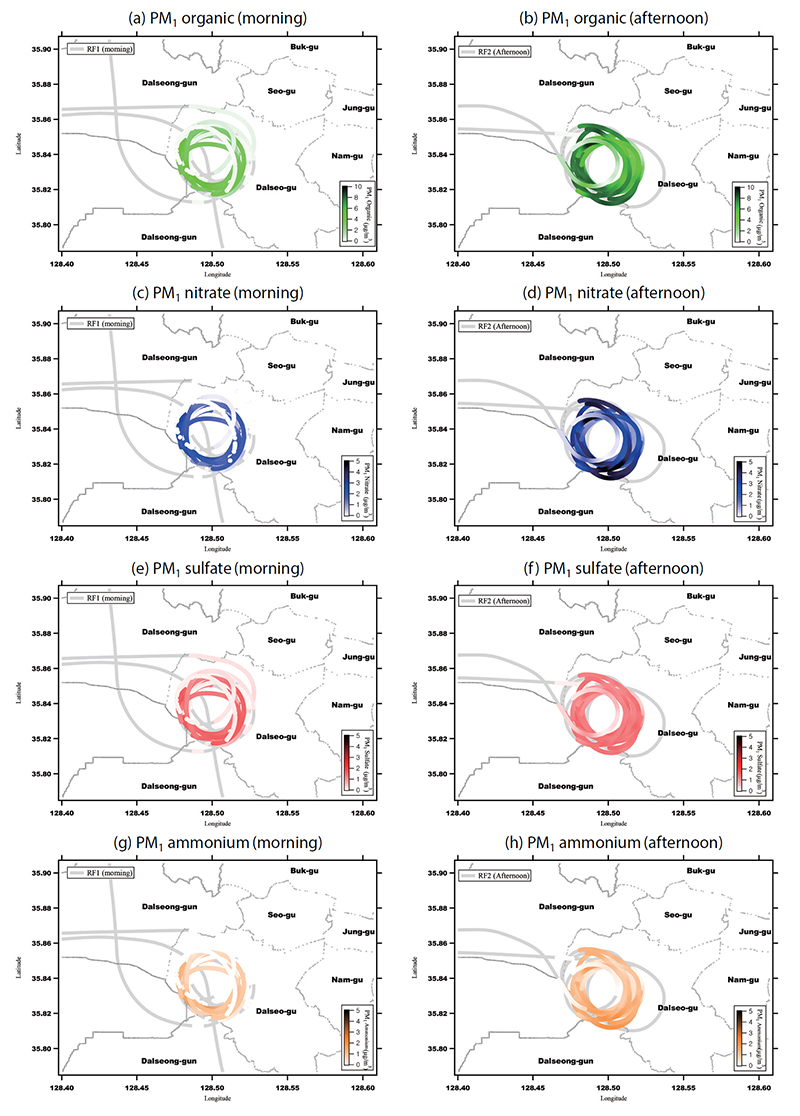
Spatial distribution of PM1 chemical components (organic, nitrate, sulfate, and ammonium) along the morning (RF1) and afternoon (RF2) flight tracks over the Seongseo Industrial Complex, Daegu.
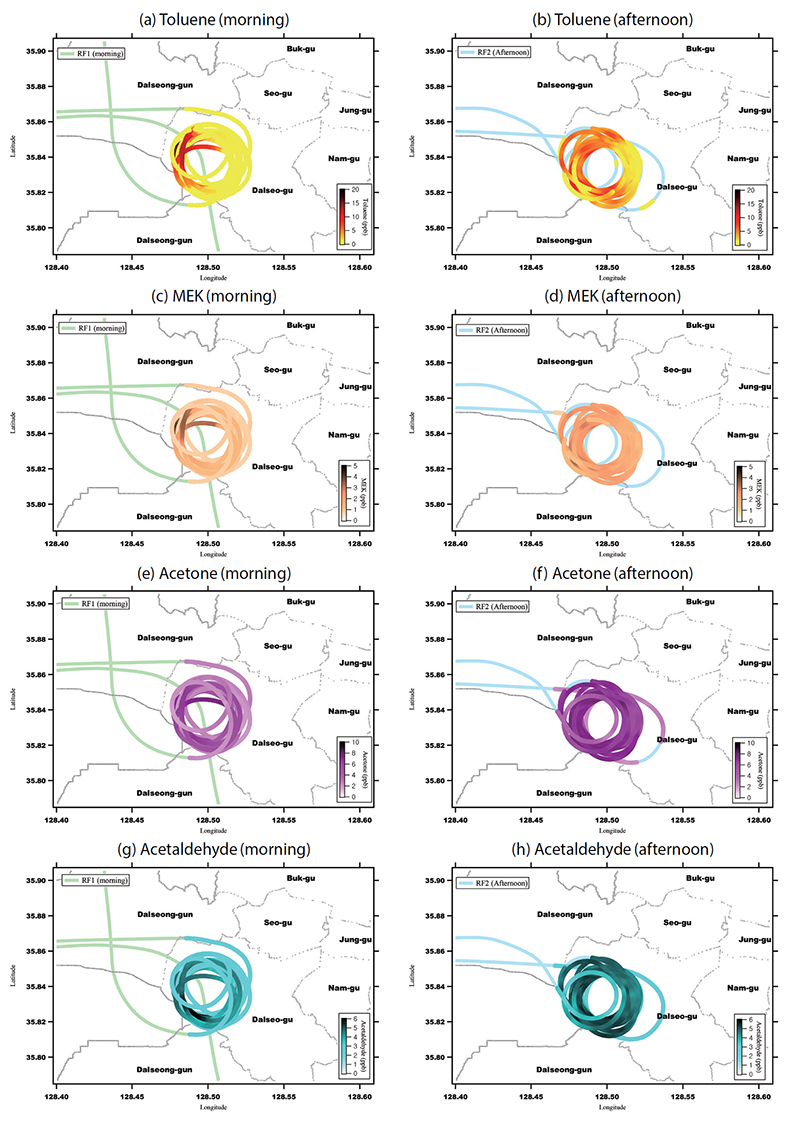
Spatial distributions of toluene, methyl ethyl ketone (MEK), acetone, and acetaldehyde along the morning (RF1) and afternoon (RF2) flight tracks over the Seongseo Industrial Complex, Daegu.
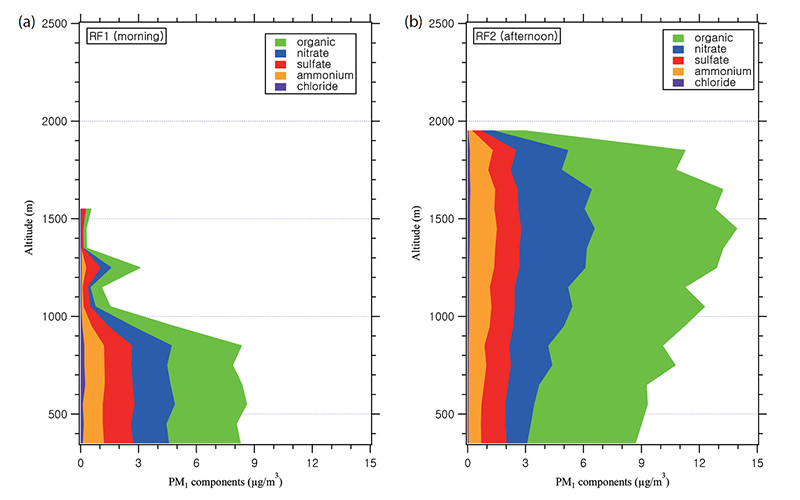
Vertical profiles of PM1 chemical components over the Seongseo Industrial Complex during the morning (RF1) and afternoon (RF2) flights.
김정호(열린공간 소장) (jeonghoflux@naver.com)
서범근(한서대학교 환경연구소 책임연구원) (beomkeun@hanmail.net)
성민영(국립환경과학원 기후대기연구부 전문연구원) (aweawe81@korea.kr)
강석원(한국외국어대학교 환경학과 박사후연구원) (kangsw0701@naver.com)
손지훈(한국외국어대학교 환경학과 박사과정) (jihoon8327@gmail.com)
최진수(국립환경과학원 기후대기연구부 연구사) (reconjs@korea.kr)
안준영(국립환경과학원 기후대기연구부 연구관) (nierair@korea.kr)
이준석(한국외국어대학교 대기환경연구센터 책임연구원) (jlee@hufs.ac.kr)
김종호(한서대학교 환경연구소 교수) (kimjh139@hanmail.net)
이태형(한국외국어대학교 환경학과 교수) (thlee@hufs.ac.kr)
박진수(국립환경과학원 기후대기연구부 연구관) (airchemi@korea.kr)