
2020년 3월 항공관측을 통한 수도권 상공 VOCs 분포 특성
 ; 최시영1) ; 성민영2) ; 김현재2) ; 최진수2) ; 안준영2) ; 박진수2), *
; 박태현3) ; 반지희3) ; 이준석4) ; 김세웅5)
; 서범근6) ; 김종호6) ; 이태형3), *
; Siyoung Choi1) ; Minyoung Sung2) ; Hyunjae Kim2) ; Jinsoo Choi2) ; Junyoung Ahn2) ; Jinsoo Park2), *
; Taehyun Park3) ; Jihee Ban3) ; Junseok Lee4) ; Saewung Kim5)
; Beomkeun Seo6) ; Jongho Kim6) ; Taehyung Lee3), *
; 최시영1) ; 성민영2) ; 김현재2) ; 최진수2) ; 안준영2) ; 박진수2), *
; 박태현3) ; 반지희3) ; 이준석4) ; 김세웅5)
; 서범근6) ; 김종호6) ; 이태형3), *
; Siyoung Choi1) ; Minyoung Sung2) ; Hyunjae Kim2) ; Jinsoo Choi2) ; Junyoung Ahn2) ; Jinsoo Park2), *
; Taehyun Park3) ; Jihee Ban3) ; Junseok Lee4) ; Saewung Kim5)
; Beomkeun Seo6) ; Jongho Kim6) ; Taehyung Lee3), *
Abstract
This study examines the distribution characteristics of volatile organic compounds (VOCs) over the Seoul metropolitan area in March 2020 based on aircraft measurements. A total of three research flights (RF1, RF2, RF3) were conducted under different meteorological conditions using a proton transfer reaction - time of flight - mass spectrometer (PTR-ToF-MS) mounted on a research aircraft. The measurements revealed that VOC concentrations were significantly elevated during stagnant atmospheric conditions (RF2), in conjunction with increased concentrations of ozone (O3), carbon monoxide (CO), and nitrogen dioxide (NO2), suggesting enhanced photochemical activity. Methanol was the most abundant VOCs across all RF, accounting for over 50% of the total VOCs. Acetaldehyde and acetone were also observed at high levels, indicating strong secondary production under photochemically favorable conditions. Anthropogenic VOCs such as toluene, benzene, and acetonitrile were notably higher in RF2, implying the influence of industrial and traffic-related emissions. Biogenic VOCs (BVOCs), including isoprene and pinene, showed increased levels in RF2, with isoprene oxidation products such as methyl vinyl ketone (MVK) providing additional evidence of active photochemistry. These findings highlight the complex interplay of anthropogenic, biogenic, and secondary sources in shaping the VOCs composition over the Seoul metropolitan region. This study demonstrates the utility of aircraft-based measurements for characterizing upper-level VOCs distributions and underscores the need for expanded airborne observations during different seasons to improve understanding of VOCs sources, transport pathways, and atmospheric transformation processes in urban environments.
Keywords:
Volatile organic compounds, Seoul metropolitan area, Aircraft measurement, PTR-ToF-MS1. 서 론
항공관측 플랫폼을 활용한 대기질 측정은 지상관측의 공간적 제약을 극복하고, 대기오염물질의 광역적 분포를 확인할 수 있는 중요한 방법이다. 이를 통해 대류권의 대기 환경 변화를 신속하게 파악할 수 있어 활용이 확대되고 있다(Park et al., 2023).
국립환경과학원은 1996년부터 항공관측을 수행해 왔다. 초기에는 5인승 소형 항공기를 사용하였으나, 2011년부터는 8인승 C90GT 항공기를 활용하였다. 하지만 기내 공간이 협소하여 측정 항목이 제한되어 입자상 물질에 대한 관측이 중심이었고(Han et al., 2006), VOCs에 대한 관측은 이루어지지 않았다.
2016년에는 한-미 협력 대기질 공동조사(Korea - United States Air Quality study, KORUS-AQ)가 수행되었다. 지상, 선박, 항공, 위성을 포함한 다양한 관측 플랫폼을 동원한 국제 대기질 관측 캠페인으로 입자상 및 가스상 물질 전반에 걸친 측정이 이루어졌다. 그 결과, 오존 및 2차 오염물질 형성의 전구물질로서 VOCs의 중요성이 부각되었으며 이에 대한 관리 정책이 제시되었다. 또한 VOCs의 배출 특성과 광화학적 반응성에 관한 기초자료가 구축되었다(Simpson et al., 2020; Nault et al., 2018).
KORUS-AQ 이후, 2017부터 2018년까지 2년에 걸쳐 21인승 B1900D 항공기를 도입하고 개조 및 승인을 거쳐 새로운 대기질 항공관측 플랫폼이 구축되었다(Park et al., 2023; Seo et al., 2019). 이 플랫폼을 이용하여 충청남도의 대형 배출원(석유화학단지 및 제철단지) 상공에서 오염물질 분포 특성을 조사한 결과, 에어로졸 및 가스상 toluene과 benzene이 풍하 방향으로 강하게 확산되는 현상이 확인되었으며, 북풍 조건에서는 내륙 지역에 광범위한 영향을 미칠 수 있음이 밝혀졌다(Kim et al., 2022a). 석유화학단지 상공에서 수행된 연구 비행에서는 반응성과 산화성이 높은 ketene의 배출 플럭스가 다수 관측되었으며, 이들이 광화학 오존 생성 기여 가능성이 높은 것으로 나타났다(Sarkar et al., 2021). 2019~2021년 충남 대규모 오염원에 대한 항공관측을 통한 배출량 산정 및 검증 방법이 제시되었으며, SO2 배출량을 산정하고 비교한 결과, 해당 기간 SO2 배출량은 35% 감소한 것으로 파악되었다(Wong et al., 2024). 2021년 6월 충남 농촌지역 상공에서 항공관측을 통해 바이오매스 연소 기원의 미세입자에 대한 화학적 특성이 파악되었다(Ban et al., 2024). 도시지역의 항공관측에서는 고농도 미세먼지 발생 기간 수도권 및 강원도 상공을 대상으로 조사가 이루어졌으며, 강한 서풍 조건에서 수도권에서 발생한 고농도 미세먼지가 풍하 방향인 강원 지역까지 영향을 미치는 것이 확인되었다(Kim et al., 2022b).
이와 같은 선행 연구들은 국내 항공관측의 활용성을 높이고, 광역 대기오염의 물리·화학적 특성을 이해하는 데 중요한 기초자료를 제공하였다. 그러나 대부분의 연구가 산업단지나 특정 배출원 중심의 국지적 분석에 한정됨에 따라, 인구가 밀집한 수도권 및 도시지역 상공에서 VOCs 연구는 제한적이었다.
그러므로 본 연구에서는 항공관측 플랫폼에 Proton Transfer Reaction - Time of Flight - Mass Spectrometer (PTR-ToF-MS)와 가스상 물질(CO, NO2, O3) 측정기를 운영하여, 수도권 상공의 VOCs와 가스상 물질의 분포를 파악하였으며, 향후 수도권 VOCs 관리 정책 수립에 기초자료로 활용하고자 한다.
2. 연구 방법
2. 1 항공관측 기간 및 기상 정보
봄철 수도권 상공 VOCs 및 가스상 물질 분포를 관측하기 위해 2020년 3월 21~22일에 3회의 RF를 수행하였다. RF1은 3월 21일 09:00~11:00, RF2는 3월 21일 14:25~16:50, RF3은 3월 22일 09:00~11:20에 실시하였다(표 1). 각각의 RF에 대한 대기 기상 조건을 파악하기 위하여, 서울대학교 GRIMs model (Lee et al., 2022)의 에어로졸광학두께(Aerosol Optical Depth, AOD), 국가환경위성센터의 AOD 위성자료를 이용하여 관측 기간 한반도 상공에서 오염물질의 이동을 파악하였다 (Kim et al., 2024). 이와 함께 미국해양대기청(National Oceanic and Atmospheric Administration, NOAA)의 Hysplit 모델(Rolph et al., 2017)을 이용하여 해당 기간 기류의 유입경로를 파악하였다.

Summary of the research flights.
2. 2 측정 및 분석 방법
VOCs 측정 분석에는 PTR-ToF-MS를 이용하였으며, 항공관측, 이동관측, 지상 고정관측 등 다양한 플랫폼에 활용되고 있다(Shin et al., 2024; Kim et al., 2021; Yuan et al., 2017; Müller et al., 2014). PTR-ToF-MS 항공관측 분석 조건을 표 2에 정리하여 제시하였다. 비행 시 외부의 시료는 그림 3의 (c) 가스 유입구를 통해 강제로 유입된다. 40°C로 유지되는 4 m 길이의 내경 1/4 inch PTFE 튜브를 통해 이송된다. PTR-ToF-MS에는 100 mL/min만 유입되고, 잔량은 기체 외부로 배출된다. 시료 중의 VOCs 반응을 위한 화학적 이온화는 H3O+ 방법을 적용하였다. 이온 이동도 관의 조건은 압력 2.2 mbar, 온도 80°C, 전장강도(E/N)는 140 Td로 일정하게 유지하였다. 분석 물질의 정성과 정량을 위한 비행시간질량분석(ToF-MS) 범위는 m/z 10~300으로 설정하였으며, 스펙트럼 획득 주기는 1 Hz로 설정하였다. 하였다. 본 연구에서 사용한 PTR-ToF-MS 운전 조건은 표 2와 같다.
Summary of PTR-ToF-MS analytical conditions for the aircraft measurement.
VOCs 물질의 정성과 정량은 표준가스를 이용한 교정곡선 및 이온의 통과 효율을 적용하는 두 가지 방법을 병행하였다. 이온의 통과 효율은 zero air와 100 ppb 표준가스(TO-14 9 mixture, RESTEK)를 측정하여 이온의 통과효율(transmission)을 산정하였다. VOCs 물질별 교정은 캐니스터에 가압된 1 ppm 표준물질(VOCs mixture, IONICON)을 이용하여 가스교정장치(GCU, IONICON)를 통해 단계적으로 희석하여 개별 물질에 대한 검량선을 작성하여 농도를 산정하였다 (Shin et al., 2024; Park et al., 2018). 표 3에 VOCs 분석 항목에 대하여, 물질별 분류(OVOC, AVOC, BVOC) 및 표준가스에 대한 이온의 감도(intensity, ncps)를 제시하였으며 물질별 교정값은 유의한 수준(R2≥0.99)으로 나타났다.
PTR-ToF-MS (8000) intensity of VOCs target compounds.
무기 가스상 물질에 대한 측정을 위하여 CO, O3, NO2 분석기를 이용하였으며, 표 4에 사양과 시간분해능을 나타냈다. CO는 Aerolaser사의 VUV-fluorimetry 분석 방법의 AL5005 (ultrafast CO-monitor)로 측정자료를 수집하였다. O3는 254 nm 파장에서 자외선흡광법을 사용하는 Teledyne API사의 T400을 사용하였고, NO2는 CAPS 측정 원리를 가진 Teledyne API사의 T500을 이용하였다. 각 장비는 항공관측 전 zero air와 span gas를 이용하여 영점 및 교정작업을 수행하였다. 항공관측은 PTR-ToF-MS와 가스상 장비 모두 1초 시간분해능으로 자료를 수집하였다.
Specification of inorganic gas measurement & analysis instruments used in this study.
항공관측 조건에서 대기 기상 및 항공기 위치 정보는 항공관측 플랫폼에 장착된 Aircraft Integrated Meteorological Measurement System-20 (AIMM-30, Aventech, Canada)를 이용하였다(그림 1의 (d)). 이 기상 측정시스템은 기상측정센서(기온, 습도, 3차원 바람, 기압 등 측정)와 관성장비가 내장되어 있어 바람 성분을 계산하여, 측정된 기상자료는 메인 메모리에 저장되고 항공관측이 완료되면 자동으로 USB flash memory에 저장된다. 이와 함께 항공기 위치는 Global Position System (GPS) 안테나로부터 신호를 받아서 위치정보와 시간정보를 동시에 수집하였다(Seo et al., 2019). 관측된 VOCs, 가스상 물질 및 기상자료는 GPS 위치 정보와 1초 간격의 표준시각 기준으로 동기화하였다.
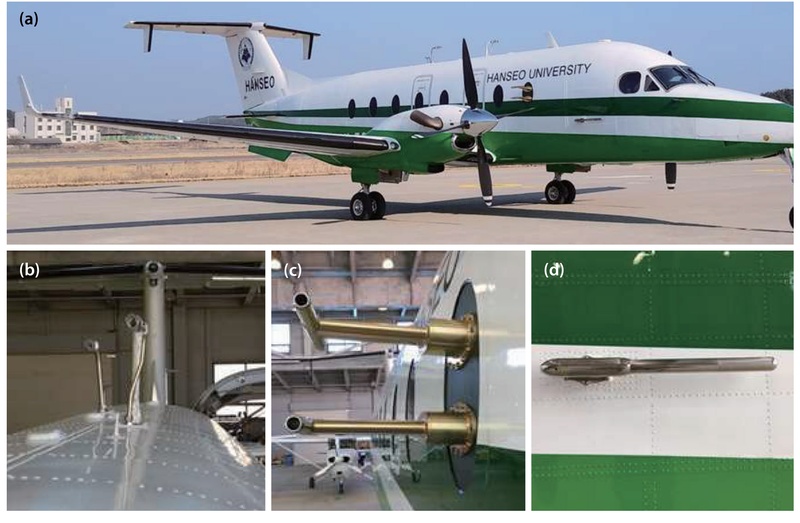
Aircraft measurement platform: (a) Beechcraft B1900D, (b) aerosol inlet, (c) trace gas inlet, (d) meteorological sensor.
2. 3 수도권 연구 비행경로
수도권 관측에 이용한 항공관측 플랫폼은 그림 1과 같이 21인승 Beechcraft B1900D 항공기(a)로 상부에 등속흡인 에어로졸 유입구(b), 측면에 미량가스 유입구(c) 및 기상 센서(d)가 장착되어 있으며, 관련된 구체적인 정보는 이전 연구에 자세히 기술되어 있다(Park et al., 2023; Seo et al., 2019).
수도권 항공관측 시 수집한 GPS 자료를 이용하여 그림 2에 RF 경로를 나타냈다. 수도권(Seoul Metropolitan Area, SMA) 비행을 자세히 기술하면, 김포공항을 시작으로 한강 상류 방향으로 올림픽대로 상공을 지나 롯데타워를 기점으로 남하하여, 서울 비행장 상공을 통과한 후에 수도권 남부를 동쪽에서 서쪽으로 가로질러 비행한 후 다시 김포공항으로 돌아오는 경로를 가진다. 이동 경로의 특성을 고찰하면, 총 4개의 구역(I, II, III, IV)으로 분류할 수 있으며, 표 5에 정리하여 나타냈다. 먼저 I 구역은 한강 상공에 해당한다. 한강을 중심으로 강변북로와 올림픽대로가 가로지르며, 강남과 강북으로 광역적인 도심 및 빌딩이 밀집되어 있으며, 위로는 북한산과 남으로는 관악산과 청계산 그리고 서쪽으로 남한산이 위치한다. 비행은 그 중심을 따라 통과하는 경로이다. I 구역에는 수도권대기환경연구소(Sudokwon atmospheric research center, SARC)가 위치한다. II 구역은 서울의 강동과 성남 상공에 해당한다. 지상에는 교통량이 많은 서울외곽순환고속도로가 있으며, 송파 IC, 성남 IC 및 판교 JC 상공을 지나게 된다. III 구역은 광교산 둘레의 수원, 안양 및 군포 상공이다. III 구역은 I 구역과 관악산, 청계산, 광교산 남쪽으로 지형적 경계가 명확히 구분된다. 마지막으로 IV 구역은 안산, 시흥, 부천, 인천 등과 같은 수도권 서부 상공이다. 이 지역에는 수도권 주요 국가산업단지(반월, 시화, 남동공단 등)가 위치하는 특징을 가진다.
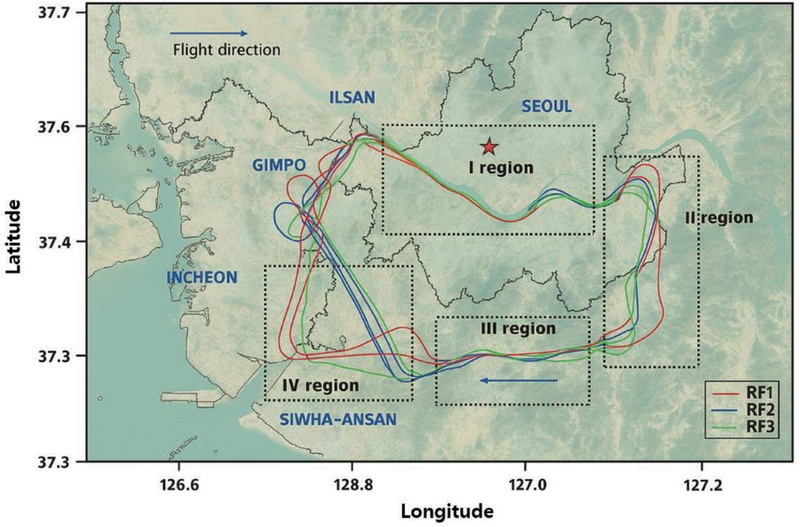
Flight tracks of the research flights (RFs): A star denotes the Sudokwon atmospheric research center (SARC) site on the map.
Description of flight regions (I~IV) and expected pollution characteristics during aircraft observations over the Seoul Metropolitan Area (SMA).
3. 결과 및 고찰
3. 1 항공관측 기간 AOD의 시·공간적 변화와 기류 특성
항공관측 기간 서울대학교 GRIMs-Chem 모델로 예측된 550 nm 파장의 AOD 분포를 통해, 2020년 3월 21일부터 23일까지 한반도 상공에서 에어로졸의 유입과 유출이 예측되었다(그림 3(a~c)). 또한 정지궤도 위성 GEO-KOMPSAT-2A(Geostationary Korea Multi-Purpose Satellite-2A)의 AOD 관측 결과(그림 3(d~f))에서도 우리나라 전역에 두꺼운 AOD 값이 나타나, 모델 예측과 일관된 경향을 보였다. 예측 및 관측된 한반도 상공의 AOD와 연구비행 시기를 분석하면, RF1은 AOD가 증가하고, RF2는 AOD가 정점을 나타내며, RF3은 AOD가 감소하는 구간으로 구분할 수 있다. AOD 증가에 대한 영향으로 자연적인황사 기원을 확인한 결과, 2020년 3월 해당 기간 우리나라 서울 지역에 황사의 영향은 없는 것으로 파악되었다. 동일한 기간 기류의 유입을 분석하였으며, NOAA Hysplit 모델을 이용한 72시간 역궤적 분석 결과(그림 3(g~i)), 3월 21~22일에는 중국 동북부 지역에서 기원한 대륙성 기류가 유입되었으며, 3월 23일에는 북서풍 기류가 유입되어 오염물질의 확산과 농도 완화에 기여한 것으로 나타났다.
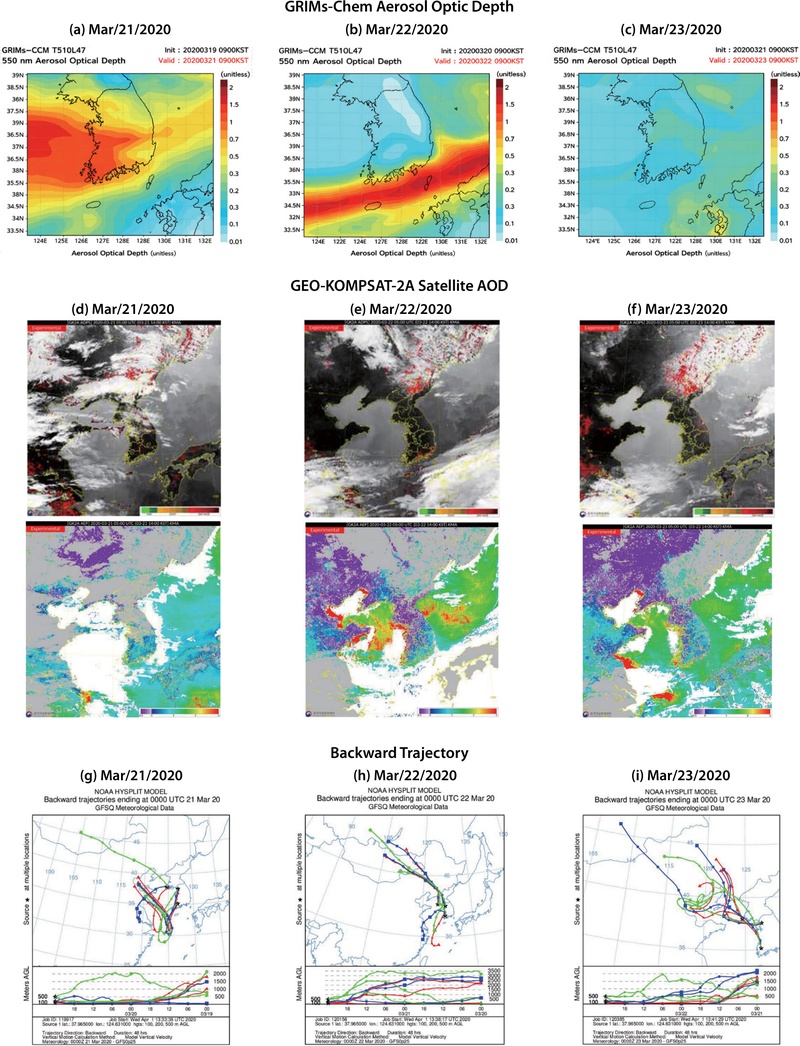
Spatiotemporal variation of aerosol optical depth (AOD) and air mass transport during the spring high PM episode (March 21~23, 2020) over the Korean Peninsula. (a~c) Forecasted AOD distribution at 550 nm from the Seoul National University GRIMs-Chem model, (d~f) GEO-KOMPSAT-2A satellite AOD imagery, and (g~i) 72-hour backward trajectory analysis from NOAA HYSPLIT model at the Seoul metropolitan area.
3. 2 RF별 항공 기상 조건
그림 4는 연구비행 RF1, RF2, RF3 수행 시 수도권 상공에서 관측된 풍향과 풍속 분포를 바람 장미로 나타낸 것이다. 세 비행 모두 남서-북서 계열의 바람이 지배적이었으나, 비행 시점의 차이에 따라 기류 특성이 뚜렷하게 구분되었다. RF1은 남동-남서 방향의 바람이 우세하였으며, 풍속은 9.8±3.6 m/s로 비교적 강한 흐름이 나타났다. RF2는 남-남서 계열 바람이 지속되었고 풍속은 9.0±3.7 m/s였다. 반면 RF3은 북서-남서 범위의 바람 중에서 북서풍의 비중이 가장 높았고, 풍속은 7.1±3.2 m/s로 다른 비행 대비 약하였다.
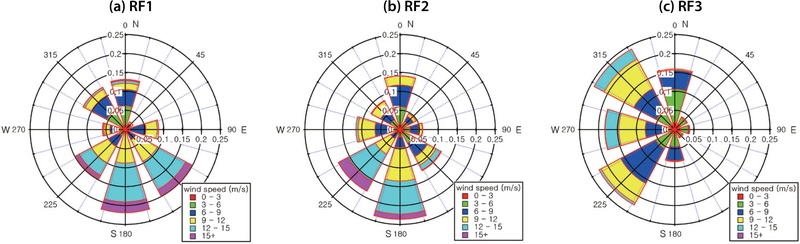
Wind roses showing the distribution of wind direction and wind speed observed during RF1, RF2, and RF3 over the Seoul airshed. Each plot indicates the frequency of wind direction (%) and the corresponding wind speed ranges(m/s) during aircraft observations. The color scale represents wind speed classes(0~3, 3~6, 6~9, 9~12, 12~15, and >15 m/s).
3. 3 수도권 상공 VOCs 분포 특징
항공관측 기간 동안 수행된 세 차례의 연구비행(RF1~RF3)에 대해, 항공기의 이륙 및 착륙 구간을 제외하고 비행 중 안정구간에서 관측된 VOCs, CO, NO2, O3, 기온, 상대습도, 비행고도 등의 평균값과 표준편차를 정리하여 표 6에 제시하였다. 물질별 농도 비교를 위해 2015년 봄철 KORUS-AQ 캠페인에서 서울 상공에서 측정된 VOCs 자료(Simpson et al., 2020)와, 2018년 여름철 SARC에서 PTR-ToF-MS로 관측된 결과(Park et al., 2018)를 함께 나타냈다. 측정된 VOCs 가운데 산화된 VOCs (methanol, acetaldehyde, acetone) 비중이 높은 특징을 보였으며, 농도 수준에는 서로 차이가 있지만 methanol이 가장 높은 농도를 나타냈다. 이러한 특징은 2015년 KORUS-AQ 및 2018년 서울에서 관측된 VOCs 분포와 유사하였다. 그러나 측정 기간에 있어서, RF1, RF2, RF3의 경우 3월에 측정되었고, KORUS-AQ는 5월, SARC는 8월 여름에 해당함으로, 계절적인 차이가 있음을 전제한다. 수도권 상공에서 관측한 VOCs 물질의 분포 특징을 OVOCs(Oxygenated VOCs-methanol, acetaldehyde, acetone, methyl vinyl ketone, methyl ethyl ketone), AVOCs (Anthropogenic VOCs-benzene, toluene), BVOCs (Biogenic VOCs-isoprene, pinene)로 분류하여 살펴보았다. 항공관측 실시간 관측자료는 보충자료(Supplementary information)로 그림 S1에 VOCs, 그림 S2에 CO, NO2, O3 분포를 나타냈다.
Summary on the research flight VOCs mixing ratio.(unit : ppb)
모든 RF에서 methanol은 가장 높은 비중을 차지하였다. RF1, RF2, RF3에서의 평균농도는 9.98 ppb, 15.15 ppb, 7.57 ppb였으며, 각각 전체 VOC의 53.3%, 53.1%, 55.8%를 차지하였다. 이 결과는 KORUS-AQ의 관측 결과와 유사하였으며, 2015년 서울 상공에서 측정된 methanol은 21.2±10.3 ppb로 전체 VOCs에서 methanol이 51%에 달하였고, 본 연구 사례보다 높은 수준이다. 2018년 8월 여름철 서울의 지상에서 측정한 결과에서도 methanol은 높은 비중을 차지하였는데, 5.38±3.14 ppb로 농도 수준은 다른 사례보다 낮은 수준이었으며, 장마 기간 이후 비교적 청정한 대기조건에 해당한다(Park et al., 2018). 도시지역에서 연구된 국외 사례를 살펴보면, 지상에서 188 m 높이의 런던 도심의 Telecom 타워에서는 19.4±13.7 ppb로 관측되었고 95 percentile 값은 46.5 ppb였다(Langford et al., 2009). 봄철 중국 광저우 도심 지상에서 PTR-ToF-MS를 이용하여 측정한 결과, methanol은 약 38 ppb 수준이었고 전체 VOCs 가운데 가장 높은 비중을 차지하였다(Han et al., 2019). Methanol은 대류권에서 가장 풍부한 비메탄계 유기 가스상 물질이며, 전 지구적인 배경농도는 약 200~400 ppt 수준이다. 이와 비교하여 다른 도시 지역에서 연구된 사례와 함께 본 연구의 관측 결과는 수도권 상공에서 methanol이 풍부한 물질임을 알 수 있다(Bates et al., 2021).
Acetaldehyde는 methanol 다음 두 번째로 높은 농도 수준을 보였으며, 2.12 ppb (RF1), 3.33 ppb (RF2), 1.49 ppb (RF3)로 나타났다. Acetaldehyde는 자동차 배출가스 및 화학 산업 공정 등에서 불완전 연소의 부산물로 직접 배출되며, 대기 중 탄화수소의 산화 반응을 통해 이차 생성되는 중요한 산화 생성물로 고려된다(Liu et al., 2022; Atkinson, 2000). RF2는 낮 시간대(14:25~16:50)에 수행되어 RF1·RF3보다 높은 기온 조건(13.0±1.0°C)이었다. 기온 상승은 광화학 반응을 활성화시켜 VOC 산화를 촉진하며, 이에 따라 2차 생성 산물인 acetaldehyde의 축적이 상대적으로 크게 나타났다. 이러한 결과는 KORUS-AQ 기간 5월 봄철 주간 항공관측을 통해 측정된 2.20±1.0 ppb와 유사한 수준이었고, 상대적으로 8월 여름철 낮은 VOCs 수준이었던 SARC의 1.23±0.97 ppb보다는 약 2~3배 높은 수준을 나타낸다. 여기서, SARC는 여름철이지만 주간과 야간 시간을 포함한 농도 수준으로 비교 결과에 차이가 있음을 밝혀둔다.
Methanol과 함께 acetone은 대기 중에서 풍부하게 존재하는 산화 생성물 중 하나로, 대기 산화 수준과 오염도를 나타내는 OVOCs 지표 물질로 알려져 있다. 본 연구에서 RF1, RF2, RF3 구간별 acetone의 평균 농도는 각각 2.12 ppb, 3.33 ppb, 1.49 ppb로 나타났으며, acetaldehyde 다음으로 높은 비중을 차지하였다. RF2 구간에서 가장 높은 농도가 관측되었으며, RF3에서는 가장 낮은 값을 보였다. Acetone은 대기 중 상대적으로 methanol보다 긴 수명을 가지며, NO2 및 OH 라디칼과 반응하여 PAN (peroxyacetyl nitrate)과 같은 오존 전구체를 생성하는 peroxyacetyl의 공급원으로 작용할 수 있으므로(Singh et al., 1994), RF2에서 관측된 acetone 농도는 해당 구간에서의 광화학 오염 가능성을 시사하는 주요 지표로 분류할 수 있다.
MVK는 isoprene의 1차 산화 반응을 통해 생성되는 대표적인 산화 생성물로, 대기 중에서 광화학적 반응의 진행 정도와 VOC 산화 수준을 평가하는 중요한 지표 물질이다(Gu et al., 2022). 본 연구에서 RF1, RF2, RF3 구간별 MVK의 평균 농도는 각각 0.13 ppb, 0.17 ppb, 0.14 ppb로 나타났으며, RF2에서 가장 높은 농도가 관측되었다. KORUS-AQ 관측 항목에는 없어서 비교가 어렵지만, SARC 지상관측에서는 0.75±0.52 ppb 수준으로 본 연구 사례보다 비교적 높은 특징이다. MVK 농도는 대기 중 isoprene의 농도 수준과 낮 시간대 강한 태양복사 조건에서의 광화학 반응의 영향을 받고, 삼림지대 또는 BVOCs 방출이 활발한 지역에서 높은 농도를 보이는 특성이 있어, SARC 측정 지점을 넓게 둘러싸고 있는 북한산 국립공원에서 배출된 isoprene의 영향이 크게 작용한 것으로 보고되었다(Park et al., 2018).
MEK는 2-butanone 또는 methyl acetone이라고도 불리며, 구조적으로 acetone과 유사한 OVOCs로 대기 중에서 다양한 인위적 및 자연적 배출원을 가진다(Yáñez-Serrano et al., 2016). 본 연구에서 RF1, RF2, RF3 구간별 MEK의 평균 농도는 각각 0.94 ppb, 1.73 ppb, 0.29 ppb로 나타났으며, KORUS-AQ 관측 결과보다 높은 수준이다. 연구 비행의 RF2에서 가장 높은 농도를 보였으며, RF3이 가장 낮았다. 이러한 분포 특징은 수도권 남서부에 밀집된 산업 배출의 영향이 직접적으로 작용한 결과로 파악된다(그림 S1).
Acetonitrile은 비교적 반응성이 낮고 대기 중 수명이 수개월에 이르는 불활성 질소계 휘발성 유기화합물로, 주로 biomass burning에서 1차 배출되며, 자연적 생성보다는 인위적 연소 기원의 특성이 강한 물질이다. 이러한 특성으로 인해 acetonitrile은 biomass burning의 지표 물질로 활용되며, 대기 중 OH 라디칼과의 반응 및 해양 흡수를 통해 서서히 제거된다(de Gouw et al., 2003). 본 연구에서 RF1, RF2, RF3 구간별 acetonitrile의 평균 농도는 각각 0.63 ppb, 0.92 ppb, 0.60 ppb로 나타났으며, SARC보다 2~3배 높은 수준이었다. RF2에서 가장 높은 농도가 관측되었으며, RF1과 RF3은 유사한 수준이었다. RF2는 전반적으로 CO, NO2 등 연소 활동과 관련된 오염물질의 농도가 가장 높게 나타난 구간으로, acetonitrile의 증가 역시 이러한 연소 또는 화학적 반응 활동이 강화된 영향으로 파악되며, 특히 주간 시간대 수도권 도심지역의 교통량은 직접적인 관련이 있을 것으로 보인다.
Benzene의 평균 농도는 각각 0.47 ppb (RF1), 0.61 ppb (RF2), 0.34 ppb (RF3)로 나타났다. RF2에서 가장 높은 농도를 보였으며, RF3은 가장 낮은 값을 기록하였다. Benzene은 단일 벤젠 고리를 가진 대표적인 방향족 탄화수소로, 세계보건기구와 국제암연구소에서 1급 발암물질로 분류되며, 교통, 연료 연소, 산업 공정 등 다양한 인위적 배출원에서 방출되는 주요 VOCs 성분이다. 반응성이 비교적 낮고 대기 중 수명이 길어 장거리 수송이 가능하며, toluene과 함께 국내 도시 및 산업 지역의 오염 특성을 평가하는 중요한 지표 물질로 활용되었다(Lee et al., 2023). KORUS-AQ 기간 측정된 benzene은 0.32±0.20 ppb로 RF3과 비슷한 수준으로 파악된다. 벤젠의 낮은 반응성과 긴 수명을 갖는 특성상, AOD가 두꺼운 구간의 RF2는 AOD가 얇은 구간인 RF3의 약 2배 높은 수준임을 고려할 때, 인위적 VOCs에 대한 영향이 강하게 작용한 것으로 볼 수 있다.
Toluene의 평균 농도는 RF1, RF2, RF3 구간별 각각 0.97 ppb, 1.52 ppb, 0.38 ppb였다. Benzene과 같이 RF2에서 가장 높은 농도를 기록하였다. Toluene은 단일 벤젠고리에 메틸기가 결합된 구조를 가진 단순 방향족 탄화수소로, benzene과 함께 도시 대기 중 대표적인 AVOCs로 고려되며, 우리나라 산업단지 인근 지역에서 높은 농도를 나타내는 물질 중의 하나로 조사되었다(Chae et al., 2024). KORUS-AQ 기간 측정된 toluene의 농도 수준은 2.28±1.83 ppb였으며, isoprene 다음으로 광화학 오존 생성의 주요 인자로 고려되었다(Simpson et al., 2020).
각각의 연구 비행에 대하여 toluene/benzene (T/B) 비율을 산정하였다. 방향족 화합물의 배출원에 대해 간접 추정 결과 RF1, RF2, RF3 각각 2.06, 3.23, 1.73이었다. KORUS-AQ 기간의 T/B는 1.96, SARC 지상관측 T/B는 2.0으로 RF1과 RF3은 비슷한 수준이나 RF2는 T/B가 3 이상으로 가장 높게 나타났다. T/B 비율은 차량 배출 영향을 강하게 받는 지역의 경우 0.9~2.2 범위에 분포하며(Deng et al., 2018; Mo et al., 2016), 용제 사용이 주요한 지역에서는 8.8 이상(Zheng et al., 2013), 산업 공정의 경우에는 1.4~5.8 범위의 값을 나타낸다(Mo et al., 2015; Shi et al., 2015). 그러므로, RF2 기간의 T/B 비율(3.23)은 산업 및 용제 사용 배출의 복합적 영향이 반영된 것으로 판단된다.
Isoprene은 대기 중에서 가장 풍부한 자연기원 탄화수소 중 하나로, 주로 활엽수 등 식물에 의해 생물학적으로 방출된다. 본 연구에서 RF1, RF2, RF3 구간별 isoprene의 평균 농도는 각각 0.26 ppb, 0.42 ppb, 0.26 ppb로 나타났다. KORUS-AQ기간 isoprene은 0.13±0.11 ppb 수준에서, O3 형성잠재력이 높은 물질로 분류되었다. 본 연구에서 RF2에서 가장 높은 농도를 기록하였으며, RF1과 RF3은 동일한 수준으로 상대적으로 낮았다. RF2는 낮 시간대(14:25~16:50)에 측정한 결과를 반영하며, isoprene은 일사량과 온도에 민감하게 반응함에 따라, RF2의 MVK와 같은 산화 생성물이 증가하였으며, 직접적인 O3 형성에 기여하는 주요 전구물질로 작용했을 것으로 추정된다(Gu et al., 2022).
Pinene은 isoprene과 함께 대표적인 생물 기원의 monoterpene류이며, isoprene과 달리 특히 소나무, 전나무 등 침엽수림에서 방출되는 자연 VOC의 주요 성분이다(Cheng et al., 2018). 본 연구에서 RF1, RF2, RF3 구간별 pinene의 평균 농도는 각각 0.18 ppb, 0.20 ppb, 0.17 ppb로 나타났다. 세 구간 모두에서 유사한 수준의 농도를 유지하고 있으며, RF2에서 소폭 증가하는 경향을 보였다. Isoprene과 비교하여 약 2배 정도 낮은 수준을 나타냈으며, pinene의 주요 방출원이 침엽수림 등 자연식생이라는 점을 고려하면, 수도권에 분포한 식생 및 산림 조성과 밀접한 관련이 있을 것으로 생각된다. 특히 isoprene은 O3 생성에 관여하며(Atkinson and Arey, 2003; Atkinson, 2000), pinene은 2차 유기 에어로졸을 형성하는 전구물질로 기능함에 따라 항공관측뿐만 아니라, 지상관측을 통해 이와 같은 BVOCs에 대한 자연적인 배출 영향을 파악하는 연구를 수행할 필요가 있다.
RF1, RF2, RF3에서 가스상 물질의 분포는 VOCs 분포와 유의한 특징을 나타냈다. RF2 구간 CO, NO2, O3 성분의 농도도 가장 높았으며, 주간 시간에 오염물질이 대기 중에 축적되는 것으로 나타났다. 불완전 연소 과정에서 배출되는 CO는 RF1 259 ppb, RF2 346 ppb, RF3 266 ppb로, RF1의 오전에서 RF2 오후로 진행하며 CO가 대기 중에 축적되는 것을 일차적으로 확인할 수 있었다. 이와 함께 교통 및 연소 기원의 NO2 물질도 RF2에서 13 ppb (∆3 ppb)로 증가하였으며, O3는 RF2에서 62 ppb (∆19 ppb)로 모두 증가하였다. 이는 광화학 반응에 대한 영향이 상대적으로 높았음을 보여주며, 기온 또한 RF2가 13.0°C로 가장 높아 광화학 반응에 유리한 환경을 조성했을 것이다. 반면에 상대습도는 RF1에서 76.3%로 가장 높았으며, RF2는 64.7%였고, RF3는 가장 낮은 57.6%를 기록하여 상대적으로 건조한 조건이었음을 보여준다. 해당 기간 기류 유입의 변화가 있었으며, RF1과 RF2는 남풍이 주풍이었고, RF3은 북서풍 조건이었다. 즉, 국지적으로 정체된 조건에서 증가한 VOCs와 가스상 오염물질은 기류의 변화와 함께, 차고 건조한 북서풍의 유입을 통해 확산 및 감소한 것으로 파악된다.
4. 결 론
본 연구는 2020년 3월 봄철 수행한 항공관측자료를 바탕으로, 수도권 상공의 VOCs의 분포 특성을 분석하였다. 총 세 차례의 연구비행에 대한 결론을 정리하면 다음과 같다.
1) 수도권 상공 VOCs는 OVOCs가 지배적이며, methanol은 전체 VOCs의 50% 이상을 차지하였다. 이러한 OVOCs 우세 현상은 KORUS-AQ 및 SARC 관측 결과와 일관되며, 수도권 상공에서 산화된 VOCs의 비중이 높다는 특징을 다시 확인하였다.
2) RF2에서 산업·용제 기원의 MEK와 toluene이 증가하였다. 특히 항공 경로 중 서남부 산업단지(시화-안산)의 영향이 명확하게 나타났으며, T/B 비율 상승(3.23)은 산업·용제 사용 배출 특성이 상공까지 확장되어 영향을 미쳤음을 시사한다. 이는 남서 기류 유입 시 산업지역 배출이 수도권 상공으로 직접 전달될 수 있음을 보여주는 근거가 된다.
3) RF2는 주간 기온 상승과 함께 isoprene 및 그 산화 생성물(MVK)을 확인하였다. 이는 상공에서도 식생 기원의 BVOCs 신호가 존재함을 나타내며, 수도권 인근 산림지역에서 배출된 BVOCs가 대기 상층의 광화학 반응에 기여할 가능성을 보여준다.
도시·산업·산림이 혼재한 수도권 상공에서 서로 다른 기원의 VOCs가 기류 조건에 따라 동시에 관측될 수 있음을 항공관측을 통해 확인하였다. 이는 상공 대기의 VOC 조성이 다양한 배출원과 대기 이동 과정의 상호작용에 의해 결정된다는 점을 보여준다. 향후에는 고농도 오존 발생기(5~7월)를 포함한 집중 관측, 도시·산업·산림 지역에 대한 비교 비행을 통해 수도권 상공 VOCs의 기원, 이동 특성, 그리고 광화학적 역할을 정밀하게 규명할 필요가 있다.
Acknowledgments
본 연구는 환경부의 재원으로 국립환경과학원의 지원을 받아 수행된 과제의 일부 결과이며, 이에 감사드립니다(입체관측사업: NIER-2022-01-01-100).
References
-
Atkinson, R. (2000) Atmospheric chemistry of VOCs and NOx, Atmospheric Environment, 34, 2063-2101.
[https://doi.org/10.1016/S1352-2310(99)00460-4]

-
Atkinson, R., Arey, J. (2003) Gas-phase tropospheric chemistry of biogenic volatile organic compounds: A review, Atmospheric Environment, 37, 197-219.
[https://doi.org/10.1016/S1352-2310(03)00391-1]
-
Ban, J., Park, T., Kang, S., Choi, S., Wong, G., Choi, J., Seo, B.-K., Kim, S., Ahn, J., Lim, Y., Sung, M., Jung, S., Jung, J., Kim, H., Park, S.-M., Lee, J., Kim, J., Kim, J., Park, S.B. Park, J., Lee, T. (2024) Impact of biomass burning on air quality: A case study of the agricultural region in South Korea, Atmospheric Environment, 339, 120864.
[https://doi.org/10.1016/j.atmosenv.2024.120864]
-
Bates, K.H., Jacob, D.J., Wang, S., Hornbrook, R.S., Apel, E.C., Kim, M.J., Millet, D.B., Wells, K.C., Chen, X., Brewer, J.F., Ray, E.A., Commane, R., Diskin, G.S., Wofsy, S.C. (2021) The global budget of atmospheric methanol: New constraints on secondary, oceanic, and terrestrial sources, Journal of Geophysical Research: Atmospheres, 2021, 126(4), e2020JD033439.
[https://doi.org/10.1029/2020JD033439]
-
Chae, J.-S., Chae, J.-S., Jeon, J.-M., Kang, B.-W., Kim, J.-H., Moon, K.-J., Park, G.-T., Kang, D.-I. (2024) The Study on Emission Characteristics of Gas-phase Hazardous Air Pollutants Generated at the Large-scale Industrial Complexes, Journal of Korean Society for Atmospheric Environment, 40(1), 27-47, (in Korean with English abstract).
[https://doi.org/10.5572/KOSAE.2024.40.1.27]
-
Cheng, X., Li, H., Zhang, Y., Li, Y., Zhang, W., Wang, X., Bi, F., Zhang, H., Gao, J., Chai, F., Lun, X., Chen, Y., Gao, J, Lv, J. (2018) Atmospheric isoprene and monoterpenes in a typical urban area of Beijing: Pollution characterization, chemical reactivity and source identification, Journal of Environmental Sciences, 71, 150-167.
[https://doi.org/10.1016/j.jes.2017.12.017]
-
de Gouw, J.A., Warneke, C., Parrish, D.D., Holloway, J.S., Trainer, M., Fehsenfeld, F.C. (2003) Emission sources and ocean uptake of acetonitrile (CH2CN) in the atmosphere, Journal of Geophysical Research: Atmospheres, 108(D11), 4329.
[https://doi.org/10.1029/2002JD002897]
-
Deng, C.X., Jin, Y.J., Zhang, M., Liu, X.W., Yu, Z.M. (2018) Emission Characteristics of VOCs from On-Road Vehicles in an Urban Tunnel in Eastern China and Predictions for 2017-2026, Aerosol and Air Quality Research, 18, 3025-3034.
[https://doi.org/10.4209/aaqr.2018.07.0248]
-
Gu, C., Wang, S., Zhu, J., Wu, S., Duan, Y., Gao, S., Xhou, B. (2022) Investigation on the urban ambient isoprene and its oxidation processes, Atmospheric Environment, 270, 118870.
[https://doi.org/10.1016/j.atmosenv.2021.118870]
-
Han, C., Liu, R., Luo, H., Li, G., Ma, S., Chen, J., An, T. (2019) Pollution profiles of volatile organic compounds from different urban functional areas in Guangzhou China based on GC/MS and PTR-TOF-MS: Atmospheric environmental implications, Atmospheric Environment, 214, 116843.
[https://doi.org/10.1016/j.atmosenv.2019.116843]
- Han, J.S., Kim, Y.M., Ahn, J.Y., Kong, B.J., Choi, J.S., Lee, S.U., Lee, S.J. (2006) Spatial Distribution and Variation of Long-range Transboundary Air Pollutants Flux during 1997-2004, Journal of Korean Society for Atmospheric Environment, 22, 99-106, (in Korean with English abstract).
-
Kim, C.H, Kim, J., Noh, S., Lee, S., Yoon, S.H., Lee, S.S., Park, J.-S., Kim, J.B. (2021) A Study on Temporal-Spatial Characteristics of Volatile Organic Compounds Distributed near Petrochemical Industrial Complex using PTR-ToF-MS, Journal of Korean Society for Atmospheric Environment, 37(5), 812-828, (in Korean with English abstract).
[https://doi.org/10.5572/KOSAE.2021.37.5.812]
-
Kim, H., Choi, J., Ahn, J., Kim, J., Lee, T., Cho, S., Park, J. (2022b) A Study on the Characteristics of Aerosol Chemical Components Over the Seoul Air-Shed (I) - Chemical Evolution of PM-1.0, Journal of the Korean Society of Urban Environment, 22(2), 91-99, (in Korean with English abstract).
[https://doi.org/10.33768/ksue.2022.22.2.91]
-
Kim, H., Park, J., Choi, J., CHoi, S., Ahn, J., Kim, J., Cho, S. (2022a) A Study on the Characteristics of Aerosol Chemical Components Over the Large Emission Sources in Chungcheongnam-do, Journal of the Korean Society of Urban Environment, 22(3), 119-128, (in Korean with English abstract).
[https://doi.org/10.33768/ksue.2022.22.3.119]
-
Kim, M., Kim, J., Lim, H., Lee, S., Cho, Y., Lee, Y.-C., Go, G., Lee, K. (2024) Aerosol optical depth data fusion with Geostationary Korea Multi-Purpose Satellite (GEO-KOMPSAT-2) instruments GEMS, AMI, and GOCI-II: statistical and deep neural network methods, Atmospheric Measurement Techniques, 17(14), 4317-4335.
[https://doi.org/10.5194/amt-17-4317-2024]
-
Langford, B., Nemitz, E., House, E., Phillips, G.J., Famulari, D., Davison, B., Hopkins, J.R., Lewis, A.B., Hewitt, C.N. (2009) Fluxes and concentrations of volatile organic compounds above central London, UK, Atmospheric Chemistry and Physics, 10(2), 627-645.
[https://doi.org/10.5194/acp-10-627-2010]
-
Lee, B.K., Choi, S.D., Shin, B., Kim, S.J., Lee, S.J., Kim, D.G., Lee, G., Kang, H.J., Kim, H.S., Park, D.Y. (2023) Sensitivity analysis of volatile organic compounds to PM2.5 concentrations in a representative industrial city of Korea, Asian Journal of Atmospheric Environment, 17(1): 3.
[https://doi.org/10.1007/s44273-023-00003-y]
-
Lee, S., Park, R.J., Hong, S.-Y., Koo, M.-S., Jeong, J.I., Yeh, S.-W., Son, S.-W. (2022) A New Chemistry-Climate Model GRIMs-CCM: Model Evaluation of Interactive Chemistry-Meteorology Simulations, Asia-Pacific Journal of Atmospheric Sciences, 58, 647-666.
[https://doi.org/10.1007/s13143-022-00281-6]
-
Liu, Q., Gao, Y., Huang, W., Ling, Z., Wang, Z., Wang, X. (2022) Carbonyl compounds in the atmosphere: A review of abundance, source and their contributions to O3 and SOA formation, Atmospheric Research, 274(15), 106184.
[https://doi.org/10.1016/j.atmosres.2022.106184]
-
Mo, Z., Shao, M., Lu, S. (2016) Compilation of a source profile database for hydrocarbon and OVOC emissions in China, Atmospheric Environment, 143, 209-217
[https://doi.org/10.1016/j.atmosenv.2016.08.025]
-
Mo, Z., Shao, M., Lu, S., Qu, H., Zhou, M., Sun, J., Gou, B. (2015) Process-specific emission characteristics of volatile organic compounds (VOCs) from petrochemical facilities in the Yangtze River Delta, China, Science of The Total Environment, 533, 422-431.
[https://doi.org/10.1016/j.scitotenv.2015.06.089]
-
Müller, M., Mikoviny, T., Feil, S., Haidacher, S., Hanel, G., Hartungen, E., Jordan, A., Märk, L., Mutschlechner, P., Schottkowsky, R., Sulzer, P., Crawford, J.H., Wisthaler, A. (2014) A compact PTR-ToF-MS instrument for airborne measurements of volatile organic compounds at high spatiotemporal resolution, Atmospheric Measurement Techniques, 7, 3763-3772.
[https://doi.org/10.5194/amt-7-3763-2014]
-
Nault, B.A., Campuzano-Jost, P., Day, D.A., Schroder, J.C., Anderson, B., Beyersdorf, A.J., Blake, D.R., Brune, W.H., Choi, Y., Corr, C.A., de Gouw, J.A., Dibb, J., DiGangi, J.P., Diskin, G.S., Fried, A., Huey, L.G., Kim, M.J., Knote, C.J., Lamb, K.D., Lee, T., Park, T., Pusede, S.E., Scheuer, E., Thornhill, K.L., Woo, J.H., Jimenez, J.L. (2018) Secondary organic aerosol production from local emissions dominates the organic aerosol budget over Seoul, South Korea, during KORUS-AQ, Atmospheric Chemistry and Physics, 18, 17769-17800.
[https://doi.org/10.5194/acp-18-17769-2018]
- Park, J.-S., Song, I.-H., Kim, H.-W., Lim, H.-B., Park, S.-M., Shin, S.-N., Shin, H.-J., Lee, S.-B., Kim, J.-S., Kim, J.-H. (2018) Characteristics of Diurnal Variation of Volatile Organic Compounds in Seoul, Korea during the Summer Season, Journal of the Korean Society for Environmental Analysis, 21(4), 264-280, (in Korean with English abstract).
-
Park, T., Ban, J., Ahn, J.Y., Lee, T., Park, J. (2023) Review and Recommendations of Domestic and International Research on Aircraft-based Measurements for Air Pollutants, Journal of Korean Society for Atmospheric Environment, 39(5), 723-750, (in Korean with English abstract).
[https://doi.org/10.5572/KOSAE.2023.39.5.723]
-
Rolph, G., Stein, A., Stunder, B. (2017) Real-time Environmental Applications and Display sYstem: READY, Environmental Modelling & Software, 95, 210-228.
[https://doi.org/10.1016/j.envsoft.2017.06.025]
-
Sarkar, C., Wong, G., Mielnik, A., Nagalingam, S., Gross, N.J., Guenther, A.B., Lee, T., Park, T., Ban, J., Kang, S., Park, J.-S., Ahn, J., Kim, D., Kim, H., Choi, J., Seo, B.-K., Kim, J.-H., Kim, J.-H., Park, S.B., Kim, S. (2021) Unexplored volatile organic compound emitted from petrochemical facilities: Implications for ozone production and atmospheric chemistry, Atmospheric Chemistry and Physics, 21, 11505-11518.
[https://doi.org/10.5194/acp-21-11505-2021]
-
Seo, B.-K., Park, S.b., Lee, D., Yu, M., Yu, J., Bae, K.-N., Ahn, J., Park, J., Kim, S., Lee, T., Kim, J. (2019) Airborne Inlets and Instrumentation on Aircraft Platform for Air Quality Observation, Journal of Korean Society for Atmospheric Environment, 35, 815-830, (in Korean with English abstract).
[https://doi.org/10.5572/KOSAE.2019.35.6.815]
-
Shi, J., Deng, H., Bai, Z., Kong, S., Wang, X., Hao, J., Han, X., Ning, P. (2015) Emission and profile characteristic of volatile organic compounds emitted from coke production, iron smelt, heating station and power plant in Liaoning Province, China, Science of The Total Environment, 515, 101-108
[https://doi.org/10.1016/j.scitotenv.2015.02.034]
-
Shin, S.-H., Park, J.-S., Kim, J.B., Kim, P., Kim, C.H., Hwang, K., Park, S.-M., Lee, J., Park, J.-M., Kim, J. (2024) Characteristics of Volatile Organic Compounds Distribution in Downtown Ansan Near Industrial Complexes, Journal of the Korean Society for Environmental Analysis, 27(1), 14-28, (in Korean with English abstract).
[https://doi.org/10.36278/jeaht.27.1.14]
-
Simpson, I.J. Blake, D.R., Blake, N.J., Meinardi, S., Barletta, B., Hughes, S.C., Fleming, L.T., Crawford, J.H., Diskin, G.S., Emmons, L.K., Fried, A., Guo, H., Peterson, D.A., Wisthaler, A., Woo, J.-H., Barre, B., Gaubert, B., Kim, J., Kim, M.J., Kim, Y., Knote, C., Mikoviny, T., Pusede, S.E., Schroeder, J.R., Wang, Y., Wennberg, P.O., Zeng, L. (2020) Characterization, sources and reactivity of volatile organic compounds(VOCs) in Seoul and surrounding regions during KORUS-AQ, ELEMENTA: Science of the Anthropocene, 8, 37.
[https://doi.org/10.1525/elementa.434]
-
Singh, H.B., O’Hara, D., Herlth, D., Sachse, W., Blake, D.R., Bradshaw, J.D., Kanakidou, M., Crutzen, P.J. (1994) Acetone in the atmosphere: Distribution, sources, and sinks, Journal of Geophysical Research, 99(D1), 1805-1819.
[https://doi.org/10.1029/93JD00764]
-
Wong, G., Park, M., Park, J., Ahn, J-Y., Sung M., Choi, J., Park, T., Ban, J., Kang, S., Lee, T., Kim, J., Seo, B.-K., Yu, J.-H., Kim, J., Woo, J.-H., Kim, S. (2024) Investigating the impact of control strategies on the sulfur dioxide emissions of South Korean industrial facilities using an aircraft mass balance approach, Atmospheric Environment, 328, 120496.
[https://doi.org/10.1016/j.atmosenv.2024.120496]
-
Yáñez-Serrano, A.M., Nölscher, A.C., Bourtsoukidis, E., Derstroff, B., Zannoni, N., Gros, V., Lanza, M., Brito, J., Noe, S.M., House, E., Hewitt, C.N., Langford, B., Nemitz, E., Behrendt, T., Williams, J., Artaxo, P., Andreae, M.O., Kesselmeier, J. (2016) Atmospheric mixing ratios of methyl ethyl ketone (2-butanone) in tropical, boreal, temperate and marine environments, Atmospheric Chemistry and Physics, 16, 10965-10984.
[https://doi.org/10.5194/acp-16-10965-2016]
-
Yuan, B., Koss, A.R., Warneke, C., Coggon, M., Sekimoto, K., de Gouw, J.A. (2017) Proton-Transfer-Reaction Mass Spectrometry: Applications in Atmospheric Sciences, Chemical Reviews, 117(21), 13187-13229.
[https://doi.org/10.1021/acs.chemrev.7b00325]
-
Zheng, J., Yu, Y., Mo, Z., Zhang, Z., Wang, X., Yin, S., Peng, K., Yang, Y., Feng, X., Cai, H. (2013) Industrial sector-based volatile organic compound (VOC) source profiles measured in manufacturing facilities in the Pearl River Delta, China, Science of The Total Environment, 456, 127-136.
[https://doi.org/10.1016/j.scitotenv.2013.03.055]
Appendix
Supplementary Materials
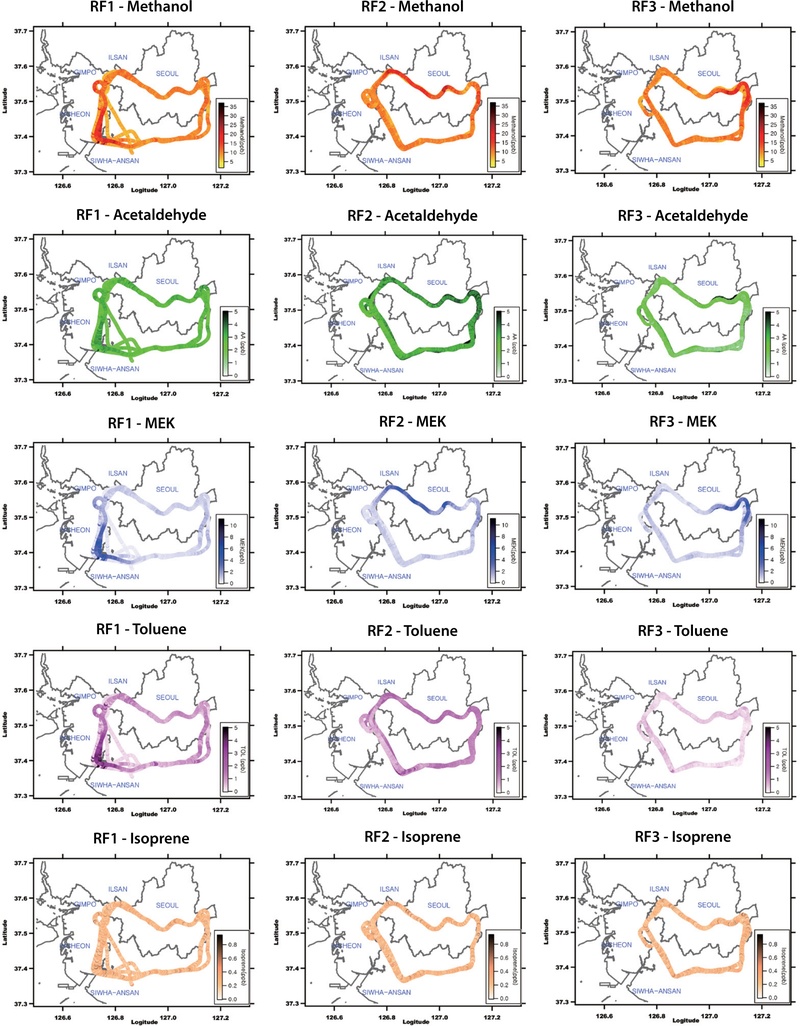
Spatial Distributions of Selected VOCs During RF1~RF3 Flight Tracks over the Seoul Metropolitan Area. Flight path concentrations of five volatile organic compounds (VOCs) - methanol, acetaldehyde, MEK, toluene, and isoprene - measured during three research flights (RF1 to RF3) using PTR-ToF-MS.
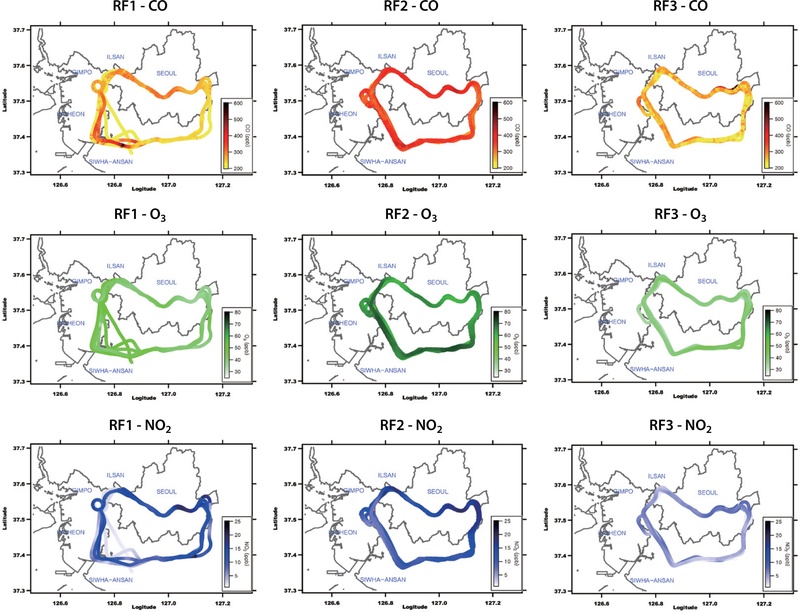
Spatial distribution of trace gas concentrations (CO, O3, and NO2) over the Seoul metropolitan area during aircraft-based measurements on March 21~22, 2020. Each panel shows the flight tracks and observed concentrations during RF1 (left), RF2 (center), and RF3 (right) for CO (top row), O3 (middle row), and NO2 (bottom row). Higher concentrations of CO and NO2 were observed in RF2 under stagnant meteorological conditions, indicating enhanced emissions and accumulation. O3 levels also increased in RF2, suggesting intensified photochemical activity during the daytime.
김정호 (열린공간 소장) (jeonghoflux@naver.com)
최시영 (충남대학교 환경공학과 박사과정) (swing0128@naver.com)
성민영 (국립환경과학원 기후대기연구부 연구원) (aweawe81@korea.kr)
김현재 (국립환경과학원 기후대기연구부 환경연구사) (nownow@korea.kr)
최진수 (국립환경과학원 기후대기연구부 환경연구사) (recongs@korea.kr)
안준영 (국립환경과학원 기후대기연구부 환경연구관) (nierair@korea.kr)
박진수 (국립환경과학원 기후대기연구부 환경연구관) (airchemi@korea.kr)
박태현 (한국외국어대학교 환경공학과 박사연구원) (taehyun_park@naver.com)
반지희 (한국외국어대학교 환경공학과 박사연구원) (cbjh0822@naver.com)
이준석 (한국외국어대학교 대기환경연구센터 책임연구원) (jlee@hufs.ac.kr)
김세웅 (UC Irvine, Department of Earth System, Professor) (saewungk@uci.edu)
서범근 (한서대학교 환경연구소 연구교수) (beomkeun@hanmail.net)
김종호 (한서대학교 환경연구소 교수) (kimjh139@hanmail.net)
이태형 (한국외국어대학교 환경공학과 교수) (thlee@hufs.ac.kr)